Kennedy Half Dollar Value Chart
1964–Present • By Year • By Mint Mark • Silver Content • Current Prices
Kennedy Half Dollar Value Chart by Year
Kennedy half dollar value depends first on composition: 1964 halves are 90% silver, 1965–1970 halves are 40% silver, and anything from 1971 on is copper-nickel clad. As a result, most circulated halves from 1971 onward are worth only face value, while the silver years, key dates like the 1970-D, proofs, and high-grade mint-state coins carry real premiums. The chart below breaks every issue down by decade, with circulated, MS-63, and MS-65 values for each date and mint mark.
For other series, see our full coin price guides. If you're not sure what you have, our What's My Coin Worth guide walks you through identifying and valuing any coin.
1960s Kennedy Half Dollars (1964–1969)
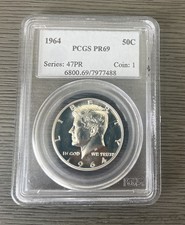
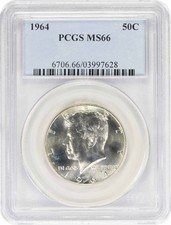
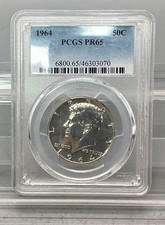
The series opened in 1964, just months after President Kennedy's assassination, and that first year is the only one struck in 90% silver. Because the public saved the new coin as a keepsake, the Mint produced more than 400 million 1964 halves, so common examples trade close to melt value. From 1965 through 1969, the composition dropped to 40% silver clad. Coins dated 1965–1967 carry no mint mark at all; mint marks returned in 1968, moved to the obverse, alongside new San Francisco proofs. For collectors, the scarcer 1964 Accented Hair variety is the decade's standout.
| Year & Mint | Composition | Circ. | MS-63 | MS-65 | Notes | Shop |
|---|
1970s Kennedy Half Dollars (1970–1979)
The 1970s hold the series' biggest business-strike key date: the 1970-D, the last 40% silver business strike, which was sold only in mint sets and never released into circulation. In 1971 the Mint switched to copper-nickel clad, so most later dates from this decade are worth face value in circulated grades. Even so, the 1974-D Doubled Die Obverse is well worth checking for. The dual-dated 1776–1976 Bicentennial halves, with Independence Hall on the reverse, were struck in both 1975 and 1976, which is why no 1975-dated half exists.
| Year & Mint | Composition | Circ. | MS-63 | MS-65 | Notes | Shop |
|---|




1980s Kennedy Half Dollars (1980–1989)
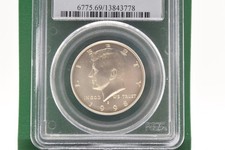
Starting in 1980, Philadelphia halves carry a P mint mark for the first time. Mintages fell through the decade as the half dollar faded from everyday use, and as a result 1982, 1983 and 1986 are tougher to find in high mint-state grades. The real standout is 1987: no Kennedy halves were struck for circulation that year, so the 1987-P and 1987-D came only from mint sets. In particular, gem examples of these lower-mintage dates draw strong interest from registry set collectors.
| Year & Mint | Composition | Circ. | MS-63 | MS-65 | Notes | Shop |
|---|
1990s to Present Kennedy Half Dollars (1990–Today)
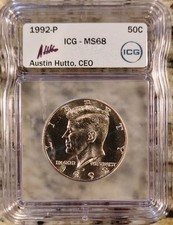
Collector interest picks up again in the 1990s. In 1992 the Mint brought back 90% silver for Kennedy proofs in its Silver Proof Sets, and the 1998-S Matte Finish silver half, issued only in a special Robert F. Kennedy collector set, became one of the modern series' scarcer issues. From 2002 onward, the Mint stopped releasing halves into circulation; instead, it sold them in rolls, bags and sets for collectors. For the series' 50th anniversary in 2014, the Mint also issued a .9999 fine gold Kennedy half and a silver set in several finishes.
| Year & Mint | Composition | Circ. | MS-63 | MS-65 | Notes | Shop |
|---|
Buy Kennedy Half Dollars From Trusted Bullion Dealers
JM Bullion, APMEX, and Money Metals Exchange are among the best-known precious metals dealers in the country, and all three also sell Kennedy half dollars alongside their gold and silver bars, rounds, and coins. Because they price silver halves against the live spot price, they're a practical place to buy 1964 90% silver and 1965–1970 40% silver Kennedys by the coin or the roll. Inventory changes often, so it pays to compare prices across all three before you buy, especially for key dates like the 1970-D or certified high-grade coins.



Proof Kennedy Half Dollars
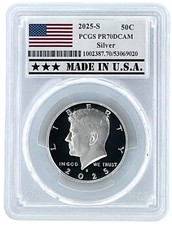
The U.S. Mint has produced proof Kennedy half dollars every year since 1964. Proof coins are struck on specially prepared planchets with polished dies, resulting in mirror-like fields and frosted devices. From 1992 onward, the Mint began issuing silver proof Kennedy halves (90% silver) as part of the Silver Proof Set, commanding premiums over standard clad proofs.
Key proof issues include the 1964 Accented Hair variety (an early reverse die showing more detail — worth $40–$150 in PR-65), the 1970-S proof (the only 1970 Kennedy half available to the public, as the 1970-D business strike was mint-set only), and any Deep Cameo (DCAM) designation, which adds significant value to any year.
Junk Silver & the 1964 Kennedy Half
The 1964 Kennedy half dollar is the single most common 90% silver coin found in junk silver bags and rolls. Each coin contains .3617 troy ounces of pure silver, making the melt value calculation straightforward: multiply the current silver spot price by .3617. At $67/oz silver, a 1964 Kennedy half has approximately $24.23 in silver melt value.
A full roll of 20 Kennedy half dollars (1964 only) contains 7.234 troy ounces of silver — a popular accumulation unit among silver stackers. Mixed rolls of 1965–1970 clad silver halves contain less silver per coin (.1479 oz each) but are also widely traded. Both are excellent entry points for beginning precious metals investors. For a full silver content reference, see the Silver Coin Melt Calculator.
Shop Kennedy Half Dollars on eBay
Browse 1964 silver halves, 40% silver clad rolls, key dates, and proof sets from trusted sellers.
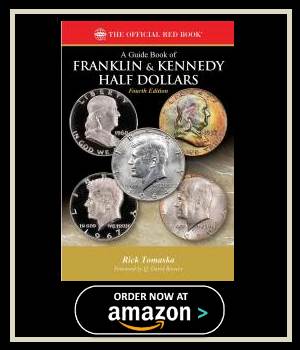
Kennedy Half Dollar Books on Amazon
Frequently Asked Questions
How do I know if my Kennedy half dollar is silver?
What is the most valuable Kennedy half dollar?
Are Kennedy half dollars worth collecting?
How much silver is in a Kennedy half dollar?
Where can I sell Kennedy half dollars?
Why don't Kennedy half dollars circulate anymore?
As the first year of the Kennedy design and the only year the coin was struck with 90 percent silver, it continues to attract collectors, silver stackers, and everyday people
 '
'