United States Coins
Half Cents to Gold Eagles • 230+ Years of American Coinage
Cents — America's Everyday Coin
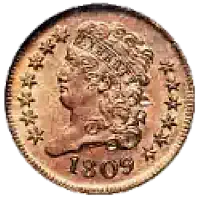
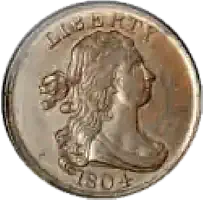
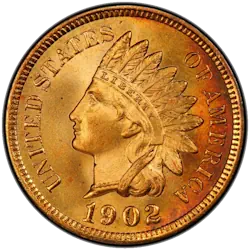
The cent is the longest-running U.S. denomination, struck from 1793 until the Mint produced its last circulating pennies in November 2025, and it came in three formats. Half cents (1793–1857) were the smallest denomination the country ever issued, led by the 1796 No Pole at $891,250. Large cents (1793–1857) were roughly the size of a modern quarter; in particular, the 1793 Chain Cent set the series record when its finest example sold for $2.35 million in 2015. Small cents then took over in 1856 with the Flying Eagle, followed by the Indian Head (1859–1909) and the Lincoln cent from 1909 on, which is still where most collectors start.
Half Cents
Large Cents
Small Cents
Five Cent & Odd Denominations
This group covers the coins between the cent and the dime. The two cent piece (1864–1873) was the first U.S. coin to carry "In God We Trust," while the silver trime (1851–1873) and the nickel three cent piece (1865–1889) filled the three-cent role. The silver half dime ran from 1792 to 1873, and its unique 1870-S sold for $3.12 million in 2023. After that, the nickel five-cent piece took over, moving through the Shield, Liberty Head, Buffalo, and Jefferson designs since 1866; its 1913 Liberty Head, known in just five examples, brought $4.56 million in 2018.
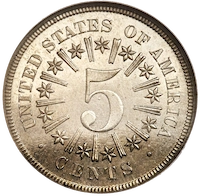
Nickels (5¢)

Two Cent Pieces
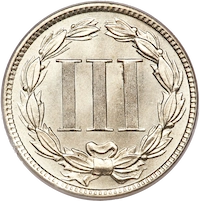
Three Cent Coins
Half Dimes
Dimes, Quarters & the Twenty Cent Experiment
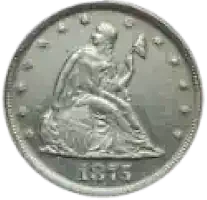
The dime and quarter both date to 1796 and shared the Draped Bust, Capped Bust, Seated Liberty, and Barber designs before going separate ways in 1916. Dimes then moved to the Mercury dime (1916–1945) and the Roosevelt dime (1946–present), with the unique 1873-CC No Arrows at the top of the series at $3.6 million. Quarters, meanwhile, switched to the Standing Liberty (1916–1930) and Washington (1932–present) designs, and the single known Proof 1823/2 overdate sold for $396,563. The short-lived twenty cent piece (1875–1878) rounds out the group, and its 1876-CC holds the record at $870,000.

Dimes
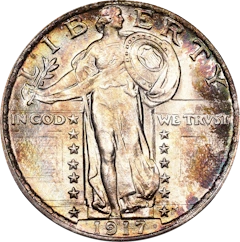
Quarters
Twenty Cent Piece
Half Dollars & Dollars
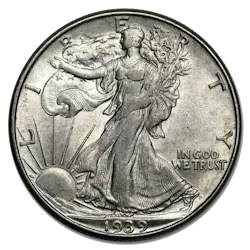
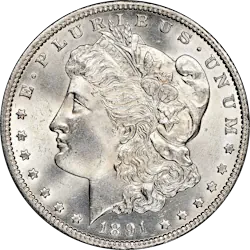
Half dollars and dollars both began in 1794 and moved from the Flowing Hair and Draped Bust designs through Seated Liberty to the 20th-century classics. Half dollars include the Barber, Walking Liberty (1916–1947), Franklin (1948–1963), and Kennedy (1964–present), and the finest known 1797 sold for $1.68 million in 2021. Dollars, on the other hand, are anchored by the Morgan (1878–1904 and 1921) and Peace (1921–1935) silver dollars, while the 1804 dollar sits at the top of all American silver at $7.68 million.
Half Dollars
Dollars
Silver Melt Calculator
Gold Coins
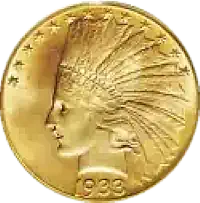
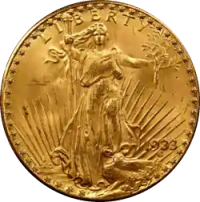
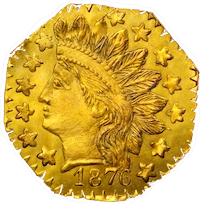
U.S. gold coins were struck from 1795 to 1933 in denominations from $1 to $20: the gold dollar (1849–1889), quarter eagle (1796–1929), $3 piece (1854–1889), half eagle (1795–1929), eagle (1795–1933), and double eagle (1849–1933). The series also holds the most valuable coin ever sold at public auction, the 1933 Saint-Gaudens double eagle at $18.9 million in 2021, as well as the finest 1822 half eagle at $8.4 million. California fractional gold pieces from the Gold Rush era round out the group.
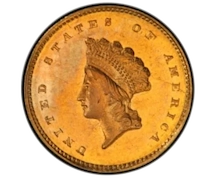
Gold Dollar ($1)
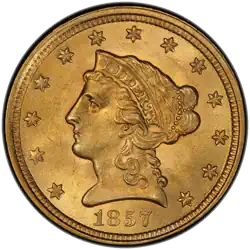
Gold Quarter Eagle ($2.50)
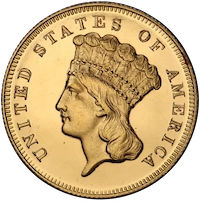
Gold $3 Coins
Gold Half Eagle ($5)
Gold Eagle ($10)
Gold Double Eagle ($20)
Gold Fractional Coins
US Gold Coins Overview


![[Lot of 25] Mercury Dimes 90% Silver 1916-1945 US Silver Coin Lot](https://i.ebayimg.com/images/g/VZUAAeSwSg9qqv54/s-l225.jpg)


Denomination Overview
Every U.S. coin denomination at a glance, with its years of issue and the record-setting rarity at the top of each series. Record figures are public auction results including buyer's premium; each dedicated guide has complete date-by-date values by grade.
| Denomination | Years | Notable Rarity | Guide | Shop |
|---|---|---|---|---|
| Half Cent | 1793–1857 | 1796 No Pole — $891,250 | View Guide → | Shop → |
| Large Cent | 1793–1857 | 1793 Chain Cent — $2.35M | View Guide → | Shop → |
| Small Cent | 1856–2025 | 1909-S VDB — $800–$3,000+ (circulated) | View Guide → | Shop → |
| Two Cent Piece | 1864–1873 | 1864 Small Motto — $4,100+ | View Guide → | Shop → |
| Three Cent (Silver & Nickel) | 1851–1889 | 1851-O Trime — $2,000+ | View Guide → | Shop → |
| Nickel (5¢) | 1866–present | 1913 Liberty Head — $4.56M | View Guide → | Shop → |
| Half Dime | 1792–1873 | 1870-S — $3.12M (unique) | View Guide → | Shop → |
| Dime | 1796–present | 1873-CC No Arrows — $3.6M (unique) | View Guide → | Shop → |
| Twenty Cent Piece | 1875–1878 | 1876-CC — $870,000 | View Guide → | Shop → |
| Quarter | 1796–present | 1823/2 Overdate — $396,563 (Proof) | View Guide → | Shop → |
| Half Dollar | 1794–present | 1797 — $1.68M | View Guide → | Shop → |
| Dollar | 1794–present | 1804 Dollar — $7.68M | View Guide → | Shop → |
| Gold Coins ($1–$20) | 1795–1933 | 1933 Double Eagle — $18.9M | View Guide → | Shop → |
Collecting United States Coins: History, Rarity & Value
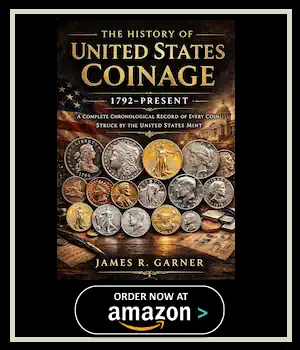
The United States Mint has struck more than a dozen coin denominations since 1792, from the copper half cent up to the $20 gold double eagle. Some, like the dime and quarter, have stayed in production for more than two centuries. Others lasted only a few years before Congress dropped them. Because of that long and uneven history, United States coins reward collectors who know the stories behind the dates, since those stories usually explain why a particular coin is rare.
Why Some Denominations Came and Went
Several of the odd denominations exist because of the Civil War. During the war, hoarding pulled silver and gold out of circulation, so the government needed small change made from cheaper metals. The bronze two cent piece arrived in 1864, and the copper-nickel three cent piece followed in 1865. Earlier, the tiny silver trime had been created in 1851 so people could buy three-cent postage stamps without handling bulky large cents; it remains the lightest coin the Mint has ever issued.
The half dime has the deepest roots of all. It traces back to the 1792 half disme, among the first coins struck under the Mint Act, and it ran until the nickel replaced it for good in 1873. The twenty cent piece, by contrast, failed almost immediately. It was so close in size and design to the quarter that the public kept confusing the two, and after 1876 it was struck only as Proofs for collectors.
What Makes a U.S. Coin Rare
Melting is the most common reason a date becomes scarce. For example, the 1873-CC No Arrows dime survives as a single coin because the rest of its Carson City run was ordered melted, and nearly all 10,000 of the 1876-CC twenty cent pieces met the same fate. Likewise, the 1933 gold recall required most gold coins to be turned in and destroyed, which is why only one 1933 double eagle is legal to own privately.
Short runs and design changes create rarities too. The 1793 Chain Cent drew public criticism because a chain seemed a poor symbol for a free nation, so it was replaced within weeks. Similarly, the 1796 No Pole half cent was struck before its die broke and was replaced. The 1804 dollar, meanwhile, was actually struck decades after its date for diplomatic presentation sets. Fifteen were known for more than a century until a sixteenth surfaced in 2025, and that example sold for $6 million at Stack's Bowers in December 2025.
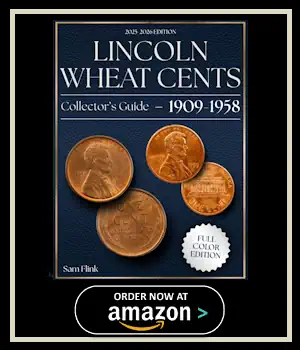
Still, many key dates remain within reach of ordinary collectors. In the Lincoln cent series, for instance, the 1909-S VDB, 1914-D, 1922 No D, 1955 Doubled Die Obverse, and the off-metal 1943 copper and 1944 steel errors can all turn up in old collections. Among early quarters, the 1823/2 overdate is known in roughly 30 business strikes.
Silver, Gold & Melt Value
Metal content sets a floor under the value of many older coins. Dimes, quarters, and half dollars dated 1964 or earlier are 90% silver, and Kennedy halves from 1965–1970 are 40% silver. Morgan and Peace dollars are also 90% silver, so the Silver Melt Calculator gives a quick baseline for any of them. Gold works the same way: common-date Liberty Head and Saint-Gaudens gold usually trades at a modest premium over its gold content. However, scarce dates, high grades, and Carson City or Southern branch-mint issues (Charlotte, Dahlonega, and New Orleans) carry numismatic premiums well above melt.
How to Check What Your Coin Is Worth
Most coins from pocket change, inherited jars, or old albums are worth face value or a small premium, but every denomination has a short list of key dates worth hundreds or thousands of dollars. The quickest way to check a specific coin is the FRC Coin Price Guide, which lists values by date and grade. If you aren't sure yet what you're holding, start with the What's My Coin Worth walkthrough.
Condition moves value as much as the date does. In fact, the same coin can sell for a few dollars worn smooth and for thousands in Mint State, so pair any price lookup with an honest grade estimate. The Coin Grading Guide explains the 70-point Sheldon scale that dealers and grading services use. For any coin claimed to be a key date, PCGS or NGC certification is worth the cost, because those are the coins counterfeiters target most.

Frequently Asked Questions
What is the most valuable U.S. coin ever sold?
What is the oldest U.S. coin denomination?
How can I tell if my old coin is silver?
Which U.S. coins are known in only one or a handful of examples?
What is a good starting point for collecting U.S. coins?
Should I get my coins professionally graded?
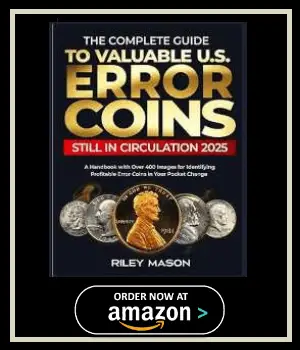
With over 400 high-resolution images and detailed explanations, you'll learn to spot rare and valuable coins still found in U.S. circulation today.
 '
'