Australia & Oceania Coins — Perth Mint, Pacific Islands & Collector Guide
Perth Mint • Royal Australian Mint • New Zealand • Pacific Island Commemoratives
Regional Numismatic Appeal
The coins of Australia and Oceania represent one of the most dynamic and creatively ambitious regions in world numismatics. This part of the globe is home to the Perth Mint — one of the world's most celebrated bullion and commemorative minting operations — alongside the Royal Australian Mint in Canberra, the New Zealand Mint in Auckland, and a constellation of smaller Pacific island nations whose minting partnerships produce some of the hobby's most innovative and visually striking pieces.
What makes Oceania's coinage particularly compelling for collectors is the range it covers. At one end, you have straightforward bullion — the Australian Gold and Silver Kangaroo series, the Silver Kookaburra, the Platinum Koala — that attract investors worldwide for their .9999 purity and Perth Mint quality guarantees. At the other end, the commemorative programs of Niue, the Cook Islands, and Fiji push the technical limits of what's possible on a coin: colorization, antique finishes, embedded crystals, and shapes that depart entirely from the round format. The region rewards collectors of every persuasion.
The Perth Mint — Australia's Bullion Powerhouse
The Perth Mint occupies a unique position in the global precious metals market. Originally established in 1899 as a branch of the British Royal Mint to process gold from the Western Australian goldfields, it became an Australian government entity in 1970 and has since grown into one of the world's largest and most respected precious metals operations. Unlike most national mints, the Perth Mint does not restrict itself to circulating coinage — its focus is squarely on bullion and collector coins, which it produces to extraordinary standards.
The Australian Gold Kangaroo (originally the Gold Nugget, launched 1986) was one of the world's earliest modern gold bullion coins, launched the same year as the American Gold Eagle. Struck in .9999 fine gold with annual design changes, it competes directly with the American Eagle, Canadian Maple Leaf, and South African Krugerrand for the attention of gold investors globally. The Australian Silver Kookaburra (first issued 1990) and the Silver Koala (from 2007) round out the Perth Mint's bullion portfolio, while the Silver Kangaroo provides a lower-premium alternative for silver stackers. All are produced at .9999 fineness and backed by the Perth Mint's government guarantee.
The Royal Australian Mint and Circulating Coinage
Australia's circulating coins are produced by the Royal Australian Mint in Canberra, which opened in 1965 and struck Australia's first decimal coinage when the country converted from pounds and shillings to dollars and cents. The circulating series features a range of native wildlife on its reverses: the echidna (5 cents), platypus (20 cents), lyrebird (10 cents), and kangaroo (1 dollar) are the most familiar. The Queen's portrait appeared on the obverse through the Elizabeth II era, with Charles III now taking her place on new issues.
Pre-decimal Australian coins — pennies, threepences, sixpences, shillings, florins, and crowns struck under the Sydney, Melbourne, and Perth Mint facilities from the 1850s through 1964 — are an active collecting field with significant key dates. The 1930 penny is Australia's most famous numismatic rarity. The depression-era government did not order circulation pennies struck that year, but an estimated 3,000 were minted anyway, with roughly 1,500 believed to survive today; top-graded circulation examples have sold for as much as $60,000 at auction. A separate handful of true Proof-quality 1930 pennies — only six were ever struck — are a different tier of rarity entirely: one sold privately for over $1.15 million in 2019, making it the single most valuable Australian coin ever sold.
New Zealand and Pacific Island Coinage
New Zealand's circulating coinage features iconic national imagery: the kiwi bird, the Māori hei-tiki, the kotuku (white heron), and the yellow-eyed penguin. The New Zealand Mint in Auckland has built a strong reputation for its commemorative silver programs, including its annual Niue coin partnerships and its own Kiwi bullion series. The 1 oz Silver Kiwi, struck in .999 fine silver with an antique finish, is among the most distinctive wildlife bullion coins from the Pacific region.
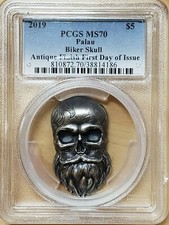
Smaller Pacific nations have emerged as significant players in the world commemorative coin market through minting partnerships. Niue has gained worldwide attention through collaborations with international mints producing themed coins — everything from Disney characters to Star Wars, DC Comics, and historical subjects — many struck by the acclaimed Mint of Poland. The Cook Islands have embraced similar partnerships, commissioning striking designs often produced by technologically advanced European mints. Fiji, Palau, Tuvalu, and Solomon Islands each add their own distinctive pieces to what has become one of the hobby's most eclectic collecting areas. For related content, see our Perth Mint guide and the FRC Coin Price Guide.
Australia & Oceania Coin Explorer
Browse Australian bullion, circulating and pre-decimal key dates, New Zealand issues, and Pacific island commemoratives. Select a category and click any coin for details and current listings.
Perth Mint, Royal Australian Mint & Pacific Island Issues
Minting Excellence and Pacific Innovation
The Perth Mint's approach to commemorative coinage has been widely imitated but rarely equaled. Its high-relief proof coins, colored enamel inserts, and shaped coins have set technical benchmarks that other mints actively study. The annual Lunar Series — now in its third generation — is perhaps the most successful ongoing commemorative program in world numismatics, with each year's animal design minted in gold, silver, and platinum at multiple sizes, creating a matrix of collectibles that attracts investors and collectors simultaneously.
The Royal Australian Mint in Canberra focuses more on circulating and numismatic issues tied to Australian national life — annual proof sets, commemorative dollars, and themed programs covering Australian history, flora, fauna, and famous Australians. Its ANDA (Australian Numismatic Dealers Association) exclusive releases and AlBr (aluminum bronze) dollar commemoratives are popular with domestic collectors. Together, the two Australian mints and their Pacific island partners have made Oceania one of the most productive and creative coin-producing regions in the world.


Where to Find Australia & Oceania Coins
JM Bullion
Kitco
Money Metals Exchange
SD Bullion
Silver Gold Bull
eBay
 Find Australia & Oceania Coins on eBayMoney Back Guarantee
FindRareCoins.com participates in the eBay Partner Network, Amazon Associates, and AWIN affiliate programs. Purchases made through links on this page may earn us a commission at no additional cost to you.
Frequently Asked Questions
What is the Perth Mint and how is it different from the Royal Australian Mint?
The Perth Mint and the Royal Australian Mint are two separate government-owned minting operations. The Perth Mint, located in Western Australia, was established in 1899 and is now owned by the Western Australian state government. It focuses primarily on precious metals bullion and commemorative coins sold globally, and operates one of the world's largest gold and silver coin programs. The Royal Australian Mint in Canberra is owned by the federal Australian government and is responsible for producing Australia's circulating coinage as well as numismatic issues for domestic collectors. Both are respected internationally but serve different primary markets.
What is the most valuable Australian coin?
The 1930 penny is Australia's most famous rarity, and in its true Proof form is also its most valuable coin outright. Only six Proof-quality 1930 pennies were struck at the Melbourne Mint, and one sold privately for over $1.15 million in 2019 — the highest price ever paid for an Australian coin. The far more available circulation-strike version of the 1930 penny — roughly 1,500 known survivors from an unauthorized depression-era minting — is a different tier of rarity, though still valuable in its own right, with top-graded examples reaching $60,000 at auction. The 1852 Adelaide Pound — Australia's first gold coin, struck privately during the gold rush — is a strong rival at the top end, with exceptional examples reaching six figures at major auctions.
Are Australian Silver Kookaburras a good investment?
The Silver Kookaburra has been one of the stronger performers among annual silver bullion programs over the long term. Because designs change annually and mintages are controlled, older years — particularly issues from the 1990s — regularly trade at meaningful premiums above spot silver value. The 1 oz .9999 purity, Perth Mint quality guarantee, and strong global collector base give it advantages over many generic silver rounds. That said, like all precious metals, price appreciation is not guaranteed, and premiums above spot can shrink during periods of high silver prices. Most buyers treat them as a combination of silver investment and numismatic collectible rather than pure investment.
Why do small Pacific island nations like Niue issue coins?
Small Pacific island nations issue coins as a revenue-generating activity through licensing and minting partnerships. By granting the right to use their currency authority (their legal tender status) to international minting operations, nations like Niue, Cook Islands, and Tuvalu earn royalties on coins they couldn't produce themselves. The coins are legal tender in the issuing country but are designed and intended for the collector market, not circulation. This arrangement has proven lucrative for all parties: the island nations earn income, the minting partners gain access to legal tender status, and collectors get innovative numismatic products. It is a well-established and entirely legitimate area of modern numismatics.
What is the Australian Gold Lunar Series?
The Australian Gold Lunar Series is an ongoing annual program from the Perth Mint that features a different animal from the Chinese zodiac each year — the Year of the Rat, Ox, Tiger, Rabbit, and so on through a 12-year cycle. Each year's design is struck in gold (and silver) at multiple sizes: 1/20 oz, 1/10 oz, 1/4 oz, 1/2 oz, 1 oz, 2 oz, 10 oz, and 1 kilo. The program has run through three complete 12-year cycles (Series I from 1996, Series II from 2008, Series III from 2020), making early Series I coins from the 1990s the most collected and valuable. Complete year sets and size sets within a single year are popular collecting goals.
How do I tell if an Australian coin is silver?
Pre-decimal Australian coins (struck before 1966) contained silver in several denominations: the threepence, sixpence, shilling, florin, and crown were all 92.5% silver up to 1945, then 50% silver from 1946 to 1963. The 1966 round 50-cent piece was 80% silver. Decimal issues after 1966 are generally not silver unless they are specifically marked as silver (collector or bullion issues). For modern bullion coins from the Perth Mint, silver content and purity (.999 or .9999) is marked directly on the coin. For pre-decimal coins, checking the date and denomination against a reference guide or the Charlton catalogue of Australian coins will confirm the silver content of any specific issue.
What does "IRA eligible" mean for Perth Mint coins?
IRA eligible means the coin meets the IRS requirements for inclusion in a self-directed precious metals Individual Retirement Account (IRA) in the United States. For gold coins, IRS rules require a minimum purity of .995 fine; for silver, .999 fine. The Australian Gold Kangaroo (.9999 fine), Australian Silver Kangaroo (.9999 fine), and Australian Silver Kookaburra (.9999 fine) all meet these standards. To hold physical coins in an IRA, they must be stored at an approved IRS depository — not at home — through a self-directed IRA custodian. Many precious metals dealers offer IRA rollover services specifically for Perth Mint bullion products.
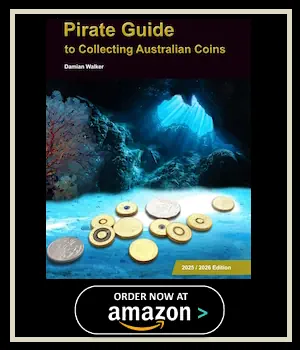
The Pirate Guide will take you through all coins released into circulation in Australia with high quality photos, along with valuable errors and varieties to look for. Mintage (rarity) for each coin.
 '
'