1933 Double Eagle Value —
The $18.9 Million Gold Coin & Its Legal History
1933 Double Eagle Value at a Glance
| Sale / Benchmark | Date | Venue | Price | Shop |
|---|---|---|---|---|
| Farouk specimen (world record) | June 8, 2021 | Sotheby's, New York — consigned by Stuart Weitzman | $18,872,250 | eBay → |
| Farouk specimen (first legal sale) | July 30, 2002 | Sotheby's / Stack's, New York | $7,590,020 | eBay → |
| Any other genuine 1933 double eagle | — | U.S. government property | Not legally saleable | eBay → |
| Common-date Saint-Gaudens $20 (legal alternative) | October 2026 | Dealer market | ~$4,200–$4,700 circulated (melt ≈ $4,020) | eBay → |
The 1933 double eagle value comes down to one number: the $18,872,250 that a single coin brought at Sotheby's in June 2021, the highest price ever paid for a coin at auction. Every other 1933 gold double eagle has no market value at all, because the U.S. government considers each one stolen property. In other words, that legal situation, and not simple scarcity, is what makes this the most valuable coin in the world.
This guide covers why the coin was never released, where each of the 14 known survivors is today, and how the one legal specimen reached private hands. If you're looking at a Saint-Gaudens double eagle of your own, our What's My Coin Worth tool and the FRC coin price guide cover the dates you can actually buy and sell. For the full $20 gold series, see our Gold Double Eagle guide.
Key Facts
- Mintage: 445,500 struck at Philadelphia in 1933. However, the Mint never officially released any of them.
- Known survivors: 14 — one in private hands, two at the Smithsonian, eleven held by the U.S. Mint
- Legal to own: Exactly one, the Farouk specimen, monetized under a 2001 settlement
- Auction record: $18,872,250 at Sotheby's on June 8, 2021
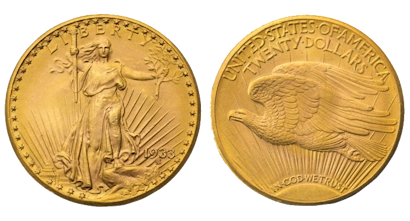
- Composition: 90% gold, 10% copper, 33.436 g, 34 mm, 0.9675 troy oz of pure gold
- Designer: Augustus Saint-Gaudens (obverse and reverse)
Why the 1933 Double Eagle Was Never Released
The story starts with a design many collectors call the most beautiful U.S. coin ever made. In 1905, President Theodore Roosevelt asked sculptor Augustus Saint-Gaudens to give American coinage the artistry of ancient Greek coins. As a result, the design shows Liberty striding forward with a torch and olive branch, with an eagle in flight against a rising sun on the reverse. Saint-Gaudens died in August 1907, however, before regular production of his $20 piece began. The Mint then struck the design every year from 1907 through 1933.
Even so, the 1933 issue never reached circulation. On April 5, 1933, President Franklin D. Roosevelt signed Executive Order 6102, which required Americans to turn in most gold coin and bullion as the country moved off the gold standard during the Great Depression. The Philadelphia Mint had struck 445,500 double eagles dated 1933 that spring, but it paid none of them out before the order took effect.
Instead, the Treasury ordered the Mint to melt the entire 1933 mintage into gold bars. Before the melt, two coins went to the Smithsonian's National Numismatic Collection for safekeeping. A small number also slipped out of the Mint. Investigators later traced them to Mint cashier George McCann and Philadelphia jeweler Israel Switt, who sold them to collectors and dealers.
Because the coins were never issued, the government treats every 1933 double eagle outside its own collections as stolen federal property. As a result, the Secret Service tracked down several coins in the 1940s and 1950s, and the Mint destroyed most of them. Only one privately held coin ever escaped that fate, through a paperwork accident covered below.
The 14 Known 1933 Double Eagles
The 1933 double eagle isn't rare because few were made. In fact, a mintage of 445,500 was normal for the series. Instead, it's rare because almost none were allowed to survive. Tracing each known coin is the clearest way to understand 1933 double eagle value.
In August 2026, the U.S. Mint put all eleven of its 1933 double eagles on public display together for the first time, at the American Numismatic Association's World's Fair of Money in Pittsburgh. That group is the ten Langbord coins plus an eleventh that a private citizen voluntarily surrendered.
| Specimen / Location | Count | Legal Status | Notes | Shop |
|---|---|---|---|---|
| Farouk specimen | 1 | Legal to own — the only exception | Exported to Egypt in 1944 under a license issued in error; monetized in 2001; sold for $18.87 million in 2021 to an undisclosed buyer | eBay → |
| Smithsonian National Numismatic Collection | 2 | Museum property | Legally transferred by the Mint in 1934 before the melt | eBay → |
| Langbord family coins (U.S. Mint) | 10 | U.S. government property | Found in a family safe deposit box and submitted to the Mint in 2004; forfeiture upheld in 2016, Supreme Court declined review in 2017 | eBay → |
| Surrendered coin (U.S. Mint) | 1 | U.S. government property | Voluntarily handed over by a private citizen who had first bought it on the open market | eBay → |
Legal Status & the Farouk Specimen's Path to Auction
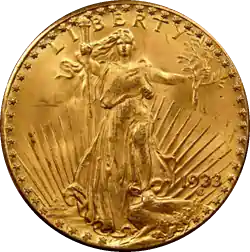
In 1944, before anyone realized the coins had left the Mint illegally, the Treasury Department issued an export license that let one 1933 double eagle leave the country for the collection of King Farouk of Egypt. Once the theft came to light, Treasury tried to get the coin back. However, Egypt never returned it. After Farouk lost his throne in 1952, his collection went to auction and the double eagle disappeared from view.
It finally resurfaced in 1996, when British dealer Stephen Fenton tried to sell it to undercover Secret Service agents at New York's Waldorf-Astoria hotel. After that, years of litigation followed. Finally, in 2001, the two sides settled: the government agreed to formally monetize this one coin, making it legal tender, and to sell it at auction with the proceeds split between Fenton and the Treasury. Shoe designer Stuart Weitzman then bought it at Sotheby's and Stack's in July 2002 for $7,590,020.
The Record Sale & the Langbord Ruling
Weitzman consigned it back to Sotheby's in June 2021, where it sold for $18,872,250 to an undisclosed buyer. Even five years later, that price defines 1933 double eagle value and remains the highest ever paid for a single coin at auction. The Langbord family, meanwhile, lost its fight over ten more coins. The full Third Circuit ruled for the government in 2016, and the Supreme Court declined to hear the case in 2017. Those rulings confirmed that every 1933 double eagle other than the Farouk coin belongs to the United States.
Counterfeit & Replica Warning
The 1927-D Comparison
Collect the Series Instead
1933 Double Eagle Timeline
The coin's story stretches across more than a century, from a presidential art project to a federal courtroom. In particular, the legal fight over the Langbord coins took thirteen years to resolve. Each of these moments shaped today's 1933 double eagle value.
1905–1934: Design, Recall & Melt
1944–1996: Theft, Farouk & the Sting
2001–2026: Courts & the Record Sale
Collectible Saint-Gaudens Double Eagle Values (1907–1932)
For most collectors, 1933 double eagle value is purely academic. However, you can own every other date in the series, and several of them are true rarities. Common dates trade only slightly above their gold value. Key dates, on the other hand, carry large collector premiums because most of their mintages went into the melting pot in the 1930s.
For reference, the ranges below run from circulated grades to choice mint state and are approximate. Always check current auction records at PCGS CoinFacts before a major purchase, and buy key dates only in PCGS or NGC holders.
| Date | Notes | Approx. Value Range | Shop |
|---|---|---|---|
| 1907 High Relief | Saint-Gaudens' original design; wire and flat rim varieties | $12,000 – $150,000+ | eBay → |
| 1907 Arabic Numerals | First low-relief production version, no motto | $4,300 – $10,000+ | eBay → |
| 1908 No Motto | Last year without IN GOD WE TRUST | $4,200 – $8,000+ | eBay → |
| 1909/8 Overdate | An 8 is visible beneath the 9 | $4,500 – $20,000+ | eBay → |
| Common dates (1910–1928, Philadelphia) | Most affordable way into the series | $4,200 – $4,700 circulated | eBay → |
| 1920-S | Major rarity; most of the mintage was melted | $20,000 – $400,000+ | eBay → |
| 1921 | 528,500 struck, very few survive | $50,000 – $500,000+ | eBay → |
| 1927-D | Fewer than 15 known; the series' top legal rarity | $1,000,000+ | eBay → |
| 1932 | Last date legally released; most were melted | $10,000 – $50,000+ | eBay → |
Learn the Series Before You Buy
Saint-Gaudens double eagles are among the most counterfeited U.S. gold coins. For that reason, a good reference book is the cheapest protection you can buy before spending thousands on a key date.
Saint-Gaudens References on AmazonWhere to Buy Saint-Gaudens Double Eagles
No dealer sells a genuine 1933. Still, the dealers below carry common-date Saint-Gaudens double eagles and other one-ounce gold coins, usually at a modest premium over melt. For certified key dates, eBay's graded listings and the major auction houses offer the widest selection.





 '
'