Counterfeit Coin Detection Guide
Authentication Tests & Red Flags for Every Collector
Counterfeit coins are a real and growing problem for collectors at every level. Modern fakes — many imported from overseas — have become increasingly difficult to detect with the naked eye. A convincing replica of an 1893-S Morgan dollar or a 1916-D Mercury dime can easily fool a beginner, and some fakes have even slipped past experienced dealers. The best defense is knowledge: knowing what genuine coins look and feel like, and knowing which counterfeiting methods to look for.
This guide covers the most commonly faked U.S. coins, what authentic examples look like, how to spot the most common counterfeit tells, and the physical tests every collector should know. When in doubt, always seek professional authentication from PCGS or NGC before purchasing or selling any coin worth over $100.
Important: The presence of a counterfeit does not mean a seller is intentionally dishonest — many fakes change hands unknowingly. Always buy key-date coins from reputable dealers and request proof of authenticity for any coin worth $200 or more. PCGS and NGC-certified coins in original holders are the safest purchases.
Essential Authentication Tests
Before examining individual coins, every collector should master these fundamental tests. They can be performed at home with minimal equipment and will catch a large percentage of common fakes.
Quick Reference: Published Coin Weights
- Morgan Silver Dollar (1878–1921): 26.73g | 38.1mm diameter | 90% silver
- Peace Dollar (1921–1935): 26.73g | 38.1mm diameter | 90% silver
- Walking Liberty Half Dollar (1916–1947): 12.50g | 30.6mm | 90% silver
- Franklin Half Dollar (1948–1963): 12.50g | 30.6mm | 90% silver
- Kennedy Half Dollar 1964: 12.50g | 30.6mm | 90% silver
- Mercury / Roosevelt Dime (pre-1965): 2.50g | 17.9mm | 90% silver
- Washington Quarter (pre-1965): 6.25g | 24.3mm | 90% silver
- Lincoln Cent (copper, pre-1983): 3.11g | 19.05mm
- Lincoln Cent (zinc, 1983+): 2.50g | 19.05mm
The Most Commonly Counterfeited U.S. Coins
The following coins are the most frequently counterfeited in the collector market. Each entry includes what genuine examples look like, how fakes are typically made, and specific red flags to check.
Morgan dollars are the most commonly counterfeited U.S. coin series, both due to their silver content and the enormous premium commanded by key dates. Two categories of fakes dominate: cast replicas (easy to detect) and genuine common-date Morgans with altered dates or mintmarks (harder to detect).
- Weight: 26.73g ±0.1g on a precision scale
- Reeding: 189 reeds on the edge, uniformly spaced
- Sharp hair detail on Liberty's ear and cotton blossoms
- Eagle's breast feathers are crisp and individually defined
- Mintmark is part of the die — same depth as surrounding field
- High-pitched silver ring when tapped on fingertip
- VAM variety attribution available for known die pairs
- Grainy, porous surface visible under magnification (cast fake)
- Seam line visible along the edge (cast fake, two-piece mold)
- Mintmark slightly raised above field, poorly defined, or off-position
- Flatness or mushiness in fine detail areas (hair curl, feathers)
- Weight under 26.5g or over 27.0g — suspect immediately
- Dull thud instead of silver ring when tapped
- Date digits look slightly different spacing from known genuine coins
Special warning: The 1893-S is a genuine condition rarity, not an absolute one — it's the lowest-mintage Morgan at just 100,000 struck, and PCGS estimates only around 123 survivors in any Mint State grade, with true Gem MS65-or-better population likely just 6 to 8 coins despite higher published grading-service tallies. However, thousands of well-worn circulated examples exist (PCGS alone shows nearly 4,000 graded VF-15 to Poor-01), so the coin is genuinely common in low grades and genuinely rare only in higher, problem-free condition. Given the extreme premium for Mint State and AU examples, counterfeiting is rampant at every tier — assume any offered 1893-S is fake until professionally authenticated by PCGS or NGC.
The genuine 1916-D mintmark is small and positioned to the left of the fasces (the bundle of rods) on the reverse. Because it was struck in the first year of the design at relatively low mintage, nearly every "1916-D" encountered outside of certified holders is a fake.
- Weight: 2.50g ±0.05g
- Mintmark: small, slightly oval "D" left of fasces on reverse, part of original die
- 1916 date digits have distinctive spacing unique to that year's obverse die
- Reverse has sharper, more defined fasces than later years
- Mintmark position is consistent — any deviation is suspect
- Mintmark appears added — raised above field, scratched surround, tooling marks
- Mintmark position doesn't match reference photos (PCGS CoinFacts)
- Date altered from 1941-D — look for tooling, unnatural digit shape, color change
- Mintmark appears a different color or reflectivity than surrounding metal
- Weight off by more than 0.1g — immediate red flag
Best test: Compare the mintmark under 10× magnification against PCGS CoinFacts reference images. Genuine mintmarks show die flow lines; added mintmarks show tool marks, solder, or a different surface texture.
The 1909-S VDB is one of the most famous U.S. coins, making it a perennial target for forgers. The two most common techniques are adding an "S" mintmark to a 1909 Philadelphia VDB cent, or adding "V.D.B." to a genuine 1909-S cent. Both alterations can be difficult to detect without magnification.
- Weight: 3.11g (copper) ±0.05g
- "S" mintmark below date is part of the original die — same depth as "1909"
- "V.D.B." on reverse at 6 o'clock — letters are crisp, same metal color
- Die flow lines (parallel striations) under magnification on both "S" and surrounding field
- Specific die characteristics catalogued — consult PCGS CoinFacts for reference photos
- Mintmark appears soldered, scratched in, or raised differently than surrounding surface
- Mintmark area shows disturbed metal, tool marks, or color inconsistency
- "V.D.B." letters appear added — slight relief difference, color change, scratchy appearance
- Mintmark under magnification shows no die flow lines — was applied separately
- Date or lettering style inconsistent with genuine 1909-S die characteristics
The genuine 1955 Doubled Die Obverse is one of the most dramatic and recognizable error coins in American numismatics — the doubling is so bold it's visible to the naked eye. However, many sellers misrepresent machine-doubled coins (common, no value) or altered coins as genuine DDOs.
- Massive, clear doubling on date — both date images are fully formed and separated
- Doubling on ALL obverse lettering: "LIBERTY," "IN GOD WE TRUST," date
- Both images are equally sharp — this is hub doubling, not mechanical doubling
- No mintmark (Philadelphia) on a genuine 1955 DDO
- Doubling is rotated slightly counterclockwise from original design
- One image is sharp, one is flat and shelf-like — this is machine doubling, not DDO
- Doubling appears only on date or only on some letters — not genuine hub doubling
- Letters look smeared rather than doubled — die deterioration, not DDO
- Artificially deepened letters via etching — unnatural relief, scratchy under magnification
- Any mintmark present — genuine 1955 DDO has no "D" or "S"
Only a small handful of genuine 1943 copper cents are known. The overwhelming majority of "1943 copper cents" offered for sale are plated steel cents or date alterations. Two simple tests catch most fakes immediately.
- Magnet test: genuine copper does NOT stick. Plated steel cents DO stick.
- Weight: genuine copper = 3.11g. Plated steel = 2.70g (lighter).
- Date characteristics: compare "3" shape against known genuine examples
- Genuine examples show no signs of alteration under strong magnification
- ALL genuine specimens have been submitted to PCGS or NGC — get it certified
- Sticks to magnet = copper-plated steel. Not genuine. Full stop.
- Weighs ~2.70g = steel core under copper plating. Not genuine.
- Altered 1948: look for "3" that looks like a modified "8" — uneven curves, filled loop
- Altered 1953: "3" formed from a modified "5" — look for remnants of the top loop
- Copper color appears applied, not natural — color inconsistency around date
Rule of thumb: If a magnet doesn't stick to it AND it weighs 3.11g, you have something worth professionally authenticating. Do NOT sell, spend, or assume without PCGS or NGC certification first.
The 1932-D (436,800 mintage) and 1932-S (408,000 mintage) are the key dates of the Washington quarter series. Most fakes are genuine 1932 Philadelphia quarters with mintmarks added — a relatively unsophisticated technique that's easy to detect with magnification.
- Weight: 6.25g ±0.1g | Diameter: 24.3mm
- Mintmark is below the eagle on the reverse — part of the original die
- Die flow lines visible under magnification on mintmark and surrounding field
- Mintmark size, font, and position documented in reference materials
- Same metal color and reflectivity as surrounding reverse field
- Mintmark appears raised, soldered, or has a different luster than surrounding metal
- Metal disturbance (tool marks, scratches) around mintmark area
- Mintmark color differs from coin surface — looks newer or applied
- Scratches or filing marks visible where mintmark meets field
- Under magnification: no die flow lines connecting mintmark to field
Walking Liberty half dollars (1916–1947) are 90% silver and widely collected. Key dates command strong premiums — making them targets for both cast counterfeits and alteration. The 1921 issues are particularly vulnerable to date and mintmark manipulation.
- Weight: 12.50g ±0.1g | Diameter: 30.6mm
- Walking Liberty's gown has fine fold detail — smoothed or mushy on cast fakes
- Mintmark is on obverse below "IN GOD WE TRUST" (1916–1917) or reverse (1917+)
- Reeding: 150 reeds, uniform spacing on genuine struck coins
- Edge has no seam line — single-piece struck coin
- Grainy, porous surfaces under loupe — characteristic of cast fakes
- Seam line along the edge — indicates two-piece cast fake
- Fine gown detail is flat or missing — design not fully realized
- Mintmark position inconsistent with reference — may be added
- Weight more than 0.2g off from 12.50g target
Buy With Confidence — Shop Certified Coins
PCGS and NGC-certified coins eliminate authentication risk entirely. Browse authentication tools on Amazon to build your own detection kit.
Authentication Tools on Amazon →Affiliate links — we may earn a commission at no extra cost to you.
Where to Buy Certified Coins & Get Authentication
The safest purchases are always coins already certified by a major grading service. These dealers offer PCGS and NGC-certified inventory or direct grading submission services.






Counterfeiting Risk Quick Reference
Use this table as a fast-reference guide when examining any potentially valuable coin purchase.
| Coin | Primary Fake Method | Best Quick Test | Risk Level |
|---|---|---|---|
| Morgan Dollar key dates | Cast replicas; altered mintmarks on common dates | Weight (26.73g), edge seam, mintmark depth | Very High |
| 1916-D Mercury Dime | Mintmark added to 1916-P; date altered from 1941-D | Mintmark depth comparison; weight 2.50g | Very High |
| 1909-S VDB Lincoln Cent | Mintmark added; "VDB" added to 1909-S | Mintmark die flow lines under magnification | Very High |
| 1943 Copper Cent | Copper-plated steel cent; altered 1948 date | Magnet test + weight (3.11g vs 2.70g) | Extreme |
| 1955 Doubled Die Cent | Machine-doubled coins misrepresented as DDO | Both images equally sharp (hub doubling) | Medium |
| 1932-D/S Washington Quarter | Mintmark added to 1932-P (no mintmark) | Mintmark depth; weight 6.25g; die flow lines | Medium |
| Walking Liberty Half key dates | Cast fakes; altered dates; added mintmarks | Weight 12.50g; edge seam; surface texture | Medium |
| Peace Dollar key dates | Cast replicas; date alterations (1921) | Weight 26.73g; surface texture under loupe | Medium |
| Silver Dollar common dates | Tungsten-core fake Morgans and Peace dollars | Ring test + precise weight + caliper diameter | Lower |
 Find Certified Coins on eBay
Money Back Guarantee
Find Certified Coins on eBay
Money Back Guarantee
FindRareCoins.com participates in the eBay Partner Network, Amazon Associates, and AWIN affiliate programs. Purchases made through links on this page may earn us a commission at no additional cost to you.
Frequently Asked Questions
How can I tell if a Morgan dollar is fake?
Start with a digital scale — a genuine Morgan weighs 26.73g. Then check the edge for a seam (cast fakes are made in two halves). Under a loupe, cast fakes show a grainy, porous surface on the fields. Tap it on your fingertip — silver rings clearly, while base-metal fakes produce a dull thud. For key-date Morgans (1893-S, 1889-CC, 1895), professional PCGS or NGC certification is the only reliable authentication.
What tools do I need to detect counterfeit coins?
The essential kit is a 0.01g precision digital scale ($10–$20), a digital caliper ($10–$20), a 10× loupe ($15–$30), and a neodymium rare-earth magnet ($5). Total investment is around $50–$80 and will catch the vast majority of common fakes. For serious collectors buying high-value coins, there are also more advanced tools: sigma metalytics analyzers, XRF analyzers, and ultrasonic thickness gauges can detect sophisticated fakes including tungsten-core coins.
Is it illegal to own or sell counterfeit coins?
In the United States, it is a federal crime to knowingly pass counterfeit coins as genuine with intent to defraud (18 U.S.C. § 485–491). Owning a counterfeit for personal reference or awareness is generally not illegal, but selling one while representing it as genuine is a serious federal offense. If you discover you've unknowingly purchased a counterfeit, do not attempt to resell it as genuine — mark it and keep it as a reference, or turn it over to authorities.
Are Chinese-made replica coins dangerous to the market?
Yes — a significant volume of Chinese-manufactured coin replicas enter the collector market annually, ranging from obvious tourist fakes to high-quality deceptions intended to deceive. Under U.S. law, replicas must be marked "COPY" if they imitate genuine U.S. coins. Many imported fakes do not carry this marking, making them illegal to sell in the United States. Quality has improved substantially over the past decade, making professional authentication more important than ever for high-value purchases.
Should I buy only PCGS or NGC certified coins?
For any coin worth more than $200–$300, buying only PCGS or NGC certified examples is the strongest protection against counterfeits. The certification holders are tamper-evident, and PCGS and NGC both guarantee the authenticity of everything they certify. The premium you pay for certified coins over raw coins is the cost of certainty — and for key dates worth thousands, that certainty is well worth the cost. Raw coins can still be fine purchases from trusted dealers for lower-value items, but always apply the authentication tests covered in this guide.
What should I do if I think I bought a fake coin?
First, do not attempt to resell it as genuine. Document the purchase with receipts and photos. Submit the coin to PCGS or NGC for authentication — their professional opinion is legally defensible. If confirmed fake, contact the seller for a refund; reputable dealers will refund authenticated counterfeits. For purchases made through eBay, the Money Back Guarantee covers items not as described — a counterfeit sold as genuine qualifies. For high-value fraud situations, the Secret Service investigates counterfeit currency and coin cases.
Is a coin rare in Mint State also rare in every other grade?
Not necessarily — this is a common misconception. Some coins, like the 1893-S Morgan Dollar, are genuine "condition rarities": extremely scarce in high, problem-free grades, but with thousands of well-worn circulated examples still in existence. Others are "absolute rarities," genuinely scarce in every grade with no meaningful population at any level. Before assuming a low population figure applies to the whole date, check whether the source is describing Mint State survivors specifically or the coin's total surviving population across all grades — the two numbers can differ by orders of magnitude.
Counterfeits are an unavoidable part of the numismatic landscape, but they don't have to be a threat to your collection. The physical tests covered here — weight, ring, edge, and magnification — will catch the vast majority of fakes. For anything worth significant money, professional authentication is always worth the modest cost. Buy smart, authenticate first, and stick to certified examples for key dates.
For more on buying and valuing specific coins, visit our Coin Price Guide, our Morgan Dollar Research Guide, and our Error Coins Value Guide for detailed information on the most collected and most valuable U.S. coins.
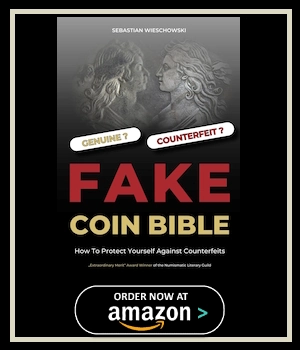
The "Fake Coin Bible" is your weapon against daily fraud! This book shows you, through 111 detailed examples, how to recognize counterfeits at a glance and protect yourself from fraud.
 '
'