1794 Flowing Hair Dollar ValueAmerica's First Silver Dollar: Prices by Grade, a $10 Million Record & Common Copies
The Mint delivered just 1,758 of them in October 1794, and only about 130 to 150 survive. Here is what each grade is worth, and how to tell a real one from the many copies.
1794 Flowing Hair Dollar Value by Grade
A genuine 1794 Flowing Hair dollar is worth about $50,000 even in About Good, more than $200,000 in Very Fine, and $1 million or more in Mint State. The finest known coin sold for $10,016,875 at auction in 2013 and later changed hands privately for a reported $12 million.
| Grade | What It Looks Like | Typical Value |
|---|---|---|
| AG-3 | Heavy wear, date and lettering partly worn into the rims | $50,000 – $75,000 |
| G-4 to VG-10 | Full outline of Liberty, little hair detail | $90,000 – $150,000 |
| F-12 to F-15 | Some hair strands and eagle feathers visible | $150,000 – $200,000 |
| VF-20 to VF-35 | Clear hair detail, wear on the high points | $215,000 – $320,000 |
| EF-40 to EF-45 | Light wear, sharp details | $335,000 – $1,000,000 |
| AU-50 to AU-58 | Trace wear, some original luster | $780,000 – $900,000 |
| MS-60 to MS-62 | Uncirculated, with marks | $500,000 – $1,100,000 |
| MS-63 to MS-66+ | Choice to gem, only a handful known | $2,800,000 – $6,600,000 |
| SP-66 (unique specimen) | The silver-plug coin, finest known | $10,016,875 – $12,000,000 |
Values are for PCGS- or NGC-certified coins, based on auction results through 2026. Only a few 1794 dollars sell each year, so one sale can move a grade's price. Repaired, holed or cleaned coins sell for far less; one tooled Very Fine brought $64,625 in 2015.
The 1794 Flowing Hair dollar was the first silver dollar the United States ever made. It carries Robert Scot's portrait of Liberty with loose, flowing hair on the front and a small eagle inside a wreath on the back. For the dollars that followed, see our early American silver dollars guide.
Because only 1,758 were delivered, and most of those wore down in circulation, a 1794 dollar in any grade is a major rarity. Genuine coins sell through major auction houses rather than everyday marketplaces. For values on other coins, check the coin prices guide, or try What's My Coin Worth if you aren't sure what you have.
- Delivered: 1,758 on October 15, 1794
- Survivors: roughly 130 to 150 in all grades
- Designer: Robert Scot
- Composition: 89.24% silver, about 27 grams
- Edge: lettered HUNDRED CENTS ONE DOLLAR OR UNIT
- Record: $10,016,875 (Stack's Bowers, January 2013)
1794 Flowing Hair Dollar Auction Records
The auction record for a 1794 Flowing Hair dollar is $10,016,875, paid at Stack's Bowers in January 2013 for the finest known coin, graded PCGS SP-66. At the time, it was the highest price ever paid for any coin. Later, it sold privately to GreatCollections for a reported $12 million.
Business-strike coins have set records of their own. In particular, the finest regular strike, graded PCGS MS-66+, brought $4,993,750 in 2015 and $6,600,000 at Heritage in 2021. More recently, an MS-63+ example sold for $4.5 million in November 2025, a record for a coin below gem grade.
| Grade | Price | Sale |
|---|---|---|
| PCGS SP-66 | $10,016,875 | Stack's Bowers, January 2013 (auction record) |
| PCGS MS-66+ CAC | $6,600,000 | Heritage, August 2021 |
| PCGS MS-66+ | $4,993,750 | Sotheby's / Stack's Bowers, September 2015 |
| PCGS MS-63+ CAC | $4,500,000 | Stack's Bowers, November 2025 |
| PCGS MS-64 CAC | $2,820,000 | Stack's Bowers, August 2017 |
| NGC MS-62 | $1,050,000 | Stack's Bowers, December 2020 |
| PCGS EF-45 CAC | $1,020,000 | Stack's Bowers, December 2025 |
| NGC AU-55 CAC | $840,000 | Stack's Bowers, August 2021 |
| PCGS VF-35 | $312,000 | Stack's Bowers, February 2026 |
| PCGS VF-20 | $216,000 | Stack's Bowers, November 2025 (record for the grade) |
America's First Silver Dollar
The Coinage Act of 1792 created the dollar as the nation's basic unit of money, but the new Mint needed two years to strike one. On October 15, 1794, it delivered its first batch of 1,758 silver dollars. However, the Mint's press was really built for smaller coins, so it couldn't strike a dollar-sized coin with full pressure.
As a result, most 1794 dollars show weak detail on the lower left of the front, where the first stars and the 17 of the date often look flat. Because the coins didn't meet the Mint's standards, it held off on striking more dollars until it got a larger press in 1795. Every 1794 dollar comes from a single pair of dies, which collectors call BB-1 or B-1.
The Silver Plug Specimen
The finest known 1794 dollar is unlike any other. Before striking, the Mint added a small silver plug to the center of the blank to bring it up to the correct weight. It was also struck with extra care, so PCGS grades it as a specimen, SP-66. Many experts believe it may be the very first silver dollar the Mint made.
The coin has passed through several famous collections. For example, the Cardinal Collection bought it for a reported $7.85 million in 2010, then sold it for $10,016,875 at auction in 2013. Bruce Morelan, the buyer, later sold it to GreatCollections for a reported $12 million.
1795 Flowing Hair Dollar: The One Collectors Can Find
If you want a Flowing Hair dollar for your collection, the 1795 is the realistic choice. With its new, larger press, the Mint struck about 160,000 dollars that year, so far more survive. Even so, a 1795 still costs several thousand dollars in low grades.
There are two main types, named for the number of leaves under each of the eagle's wings: Two Leaves and Three Leaves. Values are similar for both, although rarer die varieties bring premiums. Some 1795 dollars also have a silver plug like the famous 1794, and these sell for more.
| 1795 Grade | Typical Value | Shop |
|---|---|---|
| Good (G-4 to G-6) | $4,000 – $4,500 | eBay → |
| Very Good (VG-8 to VG-10) | $4,500 – $6,600 | eBay → |
| Fine (F-12 to F-15) | $5,300 – $8,000 | eBay → |
| Very Fine (VF-20 to VF-35) | $9,000 – $16,000 | eBay → |
| Extremely Fine (EF-40 to EF-45) | $15,000 – $18,000 | eBay → |
| About Uncirculated (AU-50 to AU-58) | $25,000 – $40,000 | eBay → |
| Mint State (MS-60 to MS-64) | $58,000 – $600,000 | eBay → |
Values are for certified 1795 Two Leaves and Three Leaves dollars, based on 2025–2026 auction results. A PCGS MS-64 CAC Three Leaves sold for $600,000 in December 2025.
The current eBay listings below show certified 1795 Flowing Hair dollars along with the Draped Bust dollars that replaced them. Any listing that claims to be a 1794 is left out, since nearly all of those are copies.




How to Spot a Fake 1794 Flowing Hair Dollar
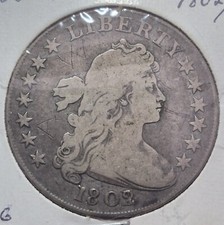
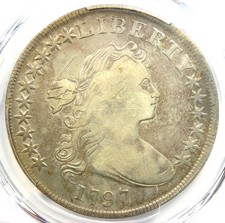
The 1794 dollar is one of the most copied coins in American history. Museum gift shops, souvenir makers and overseas counterfeiters have turned out countless replicas. If a 1794 dollar turned up in a drawer, an estate box or a flea market, it is almost certainly one of these copies.
Start with the basics. A genuine coin weighs about 27 grams, has lettered edge text reading HUNDRED CENTS ONE DOLLAR OR UNIT, and shows the weak lower-left stars and date described above. In contrast, many copies are too light, have a plain or reeded edge, or show every star sharply. Some are even marked COPY in small letters.
What to Do If You Have a 1794 Dollar
Weigh it on a gram scale and check the edge first. If it weighs about 27 grams, has the lettered edge, and shows the weak left side of the strike, send clear photos to PCGS or NGC or visit a major dealer for an opinion. A light coin, a plain edge, or the word COPY settles it right away, and in that case it isn't worth a grading fee.

 '