Advertising Disclosure: This page contains affiliate links. As an eBay Partner Network affiliate, FindRareCoins.com earns from qualifying purchases. As an Amazon Associate, we earn from qualifying purchases. We may also earn commissions from other dealers linked on this site, at no extra cost to you. Full disclosure
Silver Dollar Value ChartMorgan, Peace, Ike & SBA
Morgan • Peace • Eisenhower • SBA • Sacagawea • Current Prices
How Much Is a Silver Dollar Worth?
A Morgan or Peace silver dollar (1878–1935) is worth at least its silver melt value, about $43 with silver near $56 an ounce, and most common dates sell for about $45 to $65 in circulated condition. However, key dates such as the 1893-S Morgan and 1928 Peace are worth hundreds to thousands of dollars. Meanwhile, Eisenhower (1971–1978) and Susan B. Anthony (1979–1981 and 1999) dollars were made for circulation without silver and are usually worth $1, except the 40% silver S-mint Ikes and a few scarce varieties.
Silver Dollar Value Charts by Series
Morgan Dollar Value Chart
Morgan dollars were designed by George T. Morgan and struck from 1878 to 1904, then again in 1921. Today they are also the most widely collected U.S. silver coins. Common dates in circulated condition trade close to silver melt value, while key dates like the 1893-S and the proof-only 1895 are among the most valuable coins in American numismatics. Full Morgan Dollar guide →
Year & Mint
G–VG
F–VF
MS-60
MS-63
Notes
Shop
Peace Dollar Value Chart
Peace dollars were struck from 1921 to 1928, then again in 1934–1935, to commemorate the end of World War I. Designed by Anthony de Francisci, they feature a radiant Liberty obverse and perched eagle reverse. Similarly, common Peace dollars in circulated condition trade close to silver melt value. Full Peace Dollar guide →
Year & Mint
G–VG
F–VF
MS-60
MS-63
Notes
Shop
Eisenhower Dollar Values (1971–1978)
Eisenhower dollars were struck from 1971 to 1978 as large circulation dollars honoring President Dwight D. Eisenhower. Standard circulation strikes, however, are copper-nickel clad with no silver content and are worth face value in circulated grades. The Mint also struck 40% silver collector versions — these contain .3161 oz of pure silver and trade above melt. Full Eisenhower Dollar value chart →
Year & Mint
Composition
Circ.
MS-63
MS-65
Notes
Shop
Susan B. Anthony & Sacagawea Dollar Values
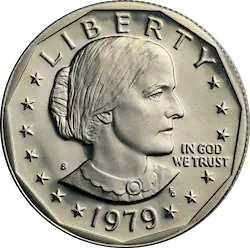
Susan B. Anthony dollars (1979–1981, 1999) and Sacagawea/Presidential dollars (2000–present) are copper-nickel clad with no precious metal content. As a result, most circulated examples are worth face value — $1. Still, exceptions include the 1979-S Type 2 and 1981-S Type 2 proofs, plus the 1979-P Wide Rim variety. Full Susan B. Anthony dollar value guide →
Date / Type
Circ.
MS-63
Proof
Notes
Shop
GSA Morgan Dollars: In the 1970s, the U.S. General Services Administration sold hundreds of thousands of uncirculated Morgan dollars from Treasury vaults — primarily Carson City (CC) mint issues — in special government packaging. These GSA hoard dollars command significant premiums, especially in original hard plastic holders with original envelopes. So never remove a CC Morgan from its GSA holder without checking current demand first.
Related Value Charts
Kennedy Half Dollars
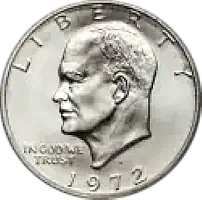
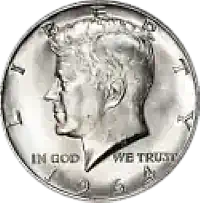
Every date from 1964 to today, including 90% and 40% silver years.
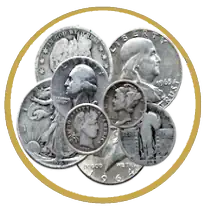
Works with every common U.S. silver coin — dollars, half dollars, quarters, dimes, and war nickels. Enter today's spot price once, then get instant melt values across the board, whether you're pricing a single coin, a full roll, or an inherited collection.
Where to Buy Silver Dollars
One of the largest online bullion and coin dealers, with a wide selection of certified Morgan and Peace silver dollars across every grade tier.
A 1921 silver dollar can be a Morgan or a Peace dollar. The 1921 Morgan, struck at Philadelphia, Denver and San Francisco, is common: $44 to $52 circulated and $100 to $175 in MS-63. The 1921 Peace dollar, however, is a one-year high-relief design worth $90 to $130 even in Good and $900 to $1,500 in MS-63. When in doubt, check the reverse: an eagle with a wreath is a Morgan, an eagle perched on a rock is a Peace dollar.
1922 Silver Dollar Value
The 1922 Peace dollar is the most common Peace dollar ever made, so a circulated example is worth about $44 to $52, close to melt value. In Mint State, however, coins bring $95 to $150 in MS-63, depending on mint mark.
1971 and 1972 Silver Dollar Value
Dollars dated 1971 and 1972 are Eisenhower dollars. The Philadelphia and Denver coins contain no silver and are worth $1 circulated, while the S-mint collector coins in blue or brown government packaging are 40% silver and worth $21 to $26. In particular, the 1972 Type 2 reverse is the variety to look for, at $10 to $20 in MS-63 and $40 to $75 in MS-65.
1979 Susan B. Anthony Dollar Value
A circulated 1979 Susan B. Anthony dollar is worth face value. Even so, two exceptions are worth checking: the 1979-P Wide Rim (Near Date) brings $5 to $10 uncirculated, and the 1979-S Type 2 proof, with a clear S mint mark, sells for $60 to $90. See the Susan B. Anthony dollar value guide for every variety.
Most Valuable Silver Dollars
How to Read This Silver Dollar Value Chart
Every price in these tables is a typical retail range for a problem-free coin, broken out by grade. G–VG covers well-worn coins where the design is outlined but most fine detail is gone. F–VF covers moderately worn coins that still show most of the major design elements. MS-60 and MS-63, on the other hand, are uncirculated coins with no wear at all, separated by how many bag marks and luster breaks they carry. For other denominations, our coin price guides cover everything from cents through gold.
For common dates, however, the biggest single factor is silver. Morgan and Peace dollars each hold .7734 oz of pure silver, so melt value sets a hard floor under the price of any circulated example. With silver around $56 an ounce today, that floor sits near $43 per coin. Silver moves daily, so run the numbers in our silver coin melt calculator before you buy or sell.
Key dates, though, follow different rules. An 1893-S, 1889-CC, or 1928 Peace dollar is priced on scarcity rather than metal content, and the jump between grades can run into thousands of dollars. If you have a coin and aren't sure where it falls, our What's My Coin Worth guide walks through identifying the date, mint mark, and grade step by step.
Grading Silver Dollars: What the Grades Mean
Grading a silver dollar starts with the high points of the design, since those wear first. For example, on a Morgan, look at the hair above Liberty's ear and the eagle's breast feathers. Similarly, on a Peace dollar, check the hair strands over Liberty's temple and the feathers on the eagle's leg. Flat, smooth high points mean a circulated coin; the more detail that's missing, the lower the grade.
Uncirculated coins are separated by surface quality rather than wear. Silver dollars were bagged and shipped a thousand at a time, so nearly every Mint State example carries contact marks from other coins. An MS-60 may show heavy marks and muted luster, an MS-63 has fewer and smaller marks with better eye appeal, and MS-65 or higher coins look close to pristine. As a result, on many dates an MS-65 is worth several times the MS-63 price.
Finally, cleaning is the most common value killer. A cleaned coin shows fine parallel hairlines and an unnatural, overly bright shine, and PCGS and NGC will label it "Details" instead of assigning a straight grade. Never polish or dip a silver dollar before it's been evaluated. For key dates, and for anything that looks uncirculated, third-party grading is usually worth the fee before you sell.
Most common-date Morgan dollars in circulated condition sell for roughly $45–$65, because their .7734 oz of silver alone is worth about $43 at today's spot price. Uncirculated common dates, meanwhile, run about $70–$175 in MS-60 to MS-63. Key dates are a separate market: the 1893-S brings $4,000 or more even in Good, and the 1895 — struck only as 880 proofs — sells for $38,000+ even when worn. The series auction record belongs to an 1893-S graded MS-67, which sold for $2,086,875 at GreatCollections in 2021. For deeper coverage see our Morgan Silver Dollars guide.
What is the difference between a Morgan and a Peace dollar?
Both are 90% silver dollar coins containing .7734 oz of pure silver, but they differ in design, era, and collector profile. Morgan dollars (1878–1921) feature a classic eagle and Liberty head design by George T. Morgan — bold, detailed, and widely considered among the most beautiful U.S. coin designs. Peace dollars (1921–1935), however, feature a more modern, art-deco Liberty design by Anthony de Francisci. Morgan dollars have more key dates and much higher price ceilings; Peace dollars are easier to complete as a full date set. See our Peace Silver Dollars guide for the full series breakdown.
Are Eisenhower dollars worth anything?
Standard copper-nickel Eisenhower dollars (1971–1978) in circulated condition are worth face value — $1. The 40% silver collector versions (sold in blue and brown government packaging) contain .3161 oz of silver, about $18 in melt at today's spot price, and typically sell for $21–$35. High-grade uncirculated examples (MS-65+) of any Ike dollar can bring $30–$150+ because problem-free specimens are hard to find. Among circulation strikes, the 1972 Type 2 reverse is especially sought after. Our Eisenhower Dollar value chart covers every date and variety.
Is a 1971 silver dollar made of silver?
Only some. Circulation 1971 Eisenhower dollars from Philadelphia and Denver are copper-nickel clad and worth $1 in circulated condition. The 1971-S collector version, sold in a blue government envelope or brown box, is 40% silver with .3161 oz of pure silver and sells for about $21 to $26. So if your 1971 dollar has no mint mark or a D, it contains no silver.
What is the melt value of a silver dollar?
Morgan and Peace dollars each contain .7734 oz of pure silver, so melt value equals the silver spot price times .7734 — about $43 with silver at $56 an ounce. Our silver coin melt calculator lets you plug in today's spot price. Melt value is the floor for common circulated dates, while key dates and uncirculated coins sell for well above it.
How do I know if my silver dollar is real?
Genuine Morgan and Peace dollars weigh 26.73 grams — a digital scale is your first tool. The coin should produce a clear, ringing tone when tapped. Counterfeit coins, however, often weigh less or have a dull thud. Also check for sharp details, correct edge reeding, and proper diameter (38.1mm). For high-value key dates, professional authentication by PCGS or NGC is essential — never buy an uncertified key-date Morgan dollar at significant cost.
Where is the best place to sell silver dollars?
For common-date circulated Morgans and Peace dollars, precious metals dealers typically pay 90–100% of silver melt value. eBay often returns slightly above melt when sold to collectors. For key dates, certified examples consistently bring the strongest prices at major auction houses like Heritage Auctions and Stack's Bowers, or through eBay with PCGS/NGC attribution. Generally, avoid pawn shops, which rarely pay numismatic value. Get multiple offers before selling any significant coin.
What does the GSA hoard mean for a Carson City Morgan dollar's value?
GSA (General Services Administration) hoard coins are Carson City Morgan dollars sold directly by the U.S. government during the 1970s in special hard plastic holders with a black-and-white insert card. A CC Morgan still sealed in its original GSA holder typically commands a premium over the same coin graded raw, because the holder verifies an unbroken chain of custody back to the Treasury vaults. Breaking a coin out of its GSA holder to send it for third-party grading can reduce collector interest for some dates — check current market demand before removing one.
From the commonly collected Morgan dollar and the ultra rare early dollar of 1794 to the Sacagawea 'golden' dollars, this book covers it all, with over 200 full size color images
Covering the first decade of American silver dollars, this book reveals the fascinating story of how a fledgling nation developed its currency and established its first mint. 200 photos.
We use cookies for the purposes of statistical analysis, improving the friendliness and usability of our website, tailoring content to your interests and engaging with social media. By visiting and using our website, you consent to our use of cookies as described in our cookie policy.
This website uses cookies to improve your experience while you navigate through the website. Out of these cookies, the cookies that are categorized as necessary are stored on your browser as they are essential for the working of basic functionalities of the website. We also use third-party cookies that help us analyze and understand how you use this website. These cookies will be stored in your browser only with your consent. You also have the option to opt-out of these cookies. But opting out of some of these cookies may have an effect on your browsing experience.
Necessary cookies are absolutely essential for the website to function properly. This category only includes cookies that ensures basic functionalities and security features of the website. These cookies do not store any personal information.
Any cookies that may not be particularly necessary for the website to function and is used specifically to collect user personal data via analytics, ads, other embedded contents are termed as non-necessary cookies. It is mandatory to procure user consent prior to running these cookies on your website.