1975 No S Dime ValueTwo Known Proofs, a $506,250 Record & Why Most 1975 Dimes Are Worth 10¢
The Mint sold 2.8 million proof sets in 1975, and only two held a dime without its S. Here is what those two are worth, and why the 1975 dime in your change almost certainly isn't one.
1975 No S Dime Value: The Two Known Coins
A genuine 1975 No S dime is worth around $500,000. Only two are known, and both are proof coins that came out of 1975 proof sets. The Ohio family's coin set the public auction record of $506,250 at GreatCollections in October 2024, while the finer coin sold privately for $516,000 in 2019.
| Coin | Grade | Last Price | Last Sale |
|---|---|---|---|
| Ohio family coin | PCGS PR-67, CAC | $506,250 | GreatCollections, October 2024 (auction record) |
| Finest known | PCGS PR-68 | $516,000 | Private sale, September 2019, days after a $456,000 Heritage auction |
Both coins are in private collections. Neither one is for sale, and no one has ever confirmed a third example.
The 1975 No S dime is one of the rarest and most valuable modern U.S. coins. Every proof dime struck that year was supposed to carry an S mint mark for San Francisco. However, a California collector found two without it in the five proof sets she ordered from the Mint. For the rest of the series, see our Roosevelt dimes guide.
Even so, almost every 1975 dime without a mint mark is an ordinary coin from Philadelphia, worth ten cents. The next section explains the difference. For other coins, check the coin prices guide, or try What's My Coin Worth if you aren't sure what you have.
- Known: 2, both proofs, both graded by PCGS
- Struck at: San Francisco, for 1975 proof sets
- Proof sets made: about 2.85 million
- Composition: copper-nickel clad, 2.27 grams
- Mint mark location: obverse, just above the date
- Record: $506,250 (GreatCollections, October 2024)
What Your 1975 Dime Is Probably Worth
If you found a 1975 dime with no mint mark in your change, it is almost certainly a regular Philadelphia coin. Philadelphia never used a P on dimes in 1975, so all 585 million of its dimes have a blank space above the date. As a result, a circulated one is worth face value, and an uncirculated one brings only a dollar or two.
A real No S dime has a proof finish, with mirror-like fields and frosty or brilliant devices, and it came from a sealed proof set. Because no genuine example has ever turned up in circulation, a worn or dull 1975 dime cannot be one.
| Coin | Mintage | Typical Value | Shop |
|---|---|---|---|
| 1975 dime, no mint mark (Philadelphia) | 585,673,900 | 10¢ circulated; $1 – $5 uncirculated | eBay → |
| 1975-D dime (Denver) | 313,705,300 | 10¢ circulated; $1 – $5 uncirculated | eBay → |
| 1975-S proof dime (with S) | 2,845,450 | $2 – $5; $15 – $30 in PR-69 Deep Cameo | eBay → |
| 1975 proof set (6 coins) | 2,845,450 | $5 – $12 | eBay → |
Values are typical retail prices through 2026. Only top-grade coins, certified by PCGS or NGC, bring more than a few dollars.
Other No-S Proof Dimes Worth Checking
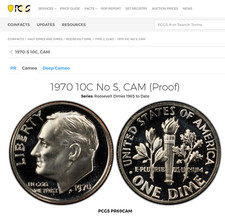
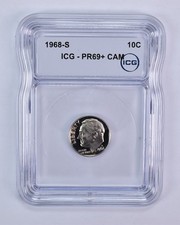
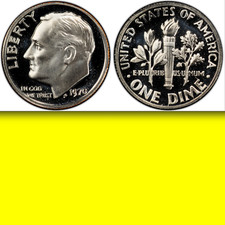
The 1975 is not the only proof dime that left San Francisco without its S. The Mint made the same mistake in 1968, 1970 and 1983, and those coins are far easier to find. If you have proof sets from any of those years, check the dime in each one, because a No-S example is worth hundreds or even thousands of dollars.
| Coin | Known | Typical Value | Shop |
|---|---|---|---|
| 1968 No S proof dime | About a dozen | $12,500 – $35,000 | eBay → |
| 1970 No S proof dime | Several hundred | $750 – $3,600 | eBay → |
| 1983 No S proof dime | Several hundred | $750 – $6,000 | eBay → |
| 1982 No P dime (circulation) | Thousands | $50 worn – $400 in MS-65 | eBay → |
Proof values per PCGS price data and recent auction results. The 1982 No P is a circulation coin, not a proof; see our 1982 no mint mark dime guide.
Since you can't buy a 1975 No S dime, the listings below show the closest coins collectors can actually own: the 1968, 1970 and 1983 No-S proofs, the 1982 No P dime, and original 1975 proof sets.




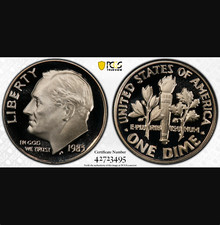


1975 No S Dime Sale History
The two coins have changed hands only a handful of times since the 1970s, and each sale has set a new benchmark for modern coins. In 1978, dealer Fred Vollmer sold one to an Ohio farm family for $18,200. Two years later, he sold the other to a collector for $38,550.
The finer coin first appeared at auction in 2011, when it brought $349,600 at Stack's Bowers. Then, in 2019, it sold for $456,000 at Heritage and changed hands again within a week for $516,000. Meanwhile, the Ohio coin stayed in a bank vault for more than 40 years until the family sold it in 2024.
| Date | Coin | Price | Sale |
|---|---|---|---|
| October 2024 | Ohio coin, PR-67 | $506,250 | GreatCollections (auction record) |
| September 2019 | Finest known, PR-68 | $516,000 | Private sale to a Roosevelt dime collector |
| September 2019 | Finest known, PR-68 | $456,000 | Heritage, Long Beach |
| August 2011 | Finest known, PR-68 | $349,600 | Stack's Bowers, ANA Rarities Night |
| 1980 | Finest known | $38,550 | Private sale by Fred Vollmer |
| 1978 | Ohio coin | $18,200 | Private sale by Fred Vollmer |
How the 1975 No S Dime Happened
In 1975, the Mint still added the S to each proof die by hand before sending the dies to San Francisco. At least one dime die left without it. Nobody noticed, and the coins it struck went into proof sets with the other five coins, which all had their S.
The first coin surfaced in July 1977, when a California collector sent it to Coin World. At first, the staff couldn't confirm it was a true proof strike. Still, ANACS authenticated it in January 1978, and the same collector soon revealed a second one. She had ordered five proof sets from the Mint, and two of them held No S dimes.
Why Only Two Have Turned Up
Most 1975 proof sets went straight into drawers and safe deposit boxes, and many still sit there today. In theory, more No S dimes could be hiding in unopened sets. Even so, collectors have searched for almost 50 years without finding a third, which suggests the die struck very few coins before the mistake was caught.
How to Spot a Fake 1975 No S Dime
Most fake 1975 No S dimes are genuine 1975-S proof dimes with the S removed. A careful forger can grind or polish the mint mark away, but doing so damages the mirror surface above the date. On a genuine coin, that area is just as smooth and reflective as the rest of the field.
Under magnification, look for a dull patch, fine scratches, or a shallow dip where the S should be. In addition, check the rest of the coin, because tool marks or uneven shine almost always mean someone altered it. Both genuine coins are fully brilliant proofs without frosted cameo contrast, according to PCGS.
What to Do If You Have 1975 Proof Sets
Check the dime in each 1975 proof set under a magnifier, looking just above the date for the S. If a proof dime clearly shows no S and no sign of removal, leave it sealed in its original holder and contact PCGS or NGC about authentication. The holder and any purchase records help prove where the coin came from. A plain circulation dime without a mint mark, on the other hand, isn't worth a grading fee.

 '