
U.S. Dime Error Coins
The 1982 no mint mark Roosevelt, missing clad layers, Mercury dime doubled dies, and the full spectrum of valuable misprinted dimes — values, identification, and where to find them.
Collector's Value GuideMisprinted dimes — coins produced with manufacturing errors at the U.S. Mint — are among the most accessible and rewarding targets in American coin collecting. From the famous 1982 no mint mark Roosevelt to missing clad layers that expose the copper core, misprinted dimes offer collectors real upside at every budget level.
What Are Misprinted Dimes?
The term "misprinted dimes" refers to Roosevelt and Mercury dimes that left the U.S. Mint with manufacturing defects — errors in the die, the planchet, or the striking process that produced coins visibly different from the intended design. Unlike damaged coins (which lose value), genuine misprinted dimes are errors that occurred during production and are actively sought by collectors.
Misprinted dimes fall into three broad categories. Die errors — like doubled dies and overdates — originate in the die preparation process. Planchet errors — like missing clad layers and wrong planchets — originate in the blank preparation process. Striking errors — like off-center strikes, double strikes, and die caps — occur during coin production itself.
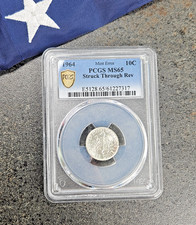


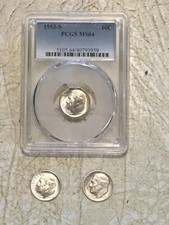

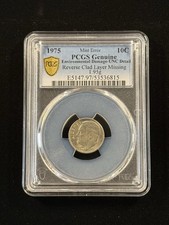


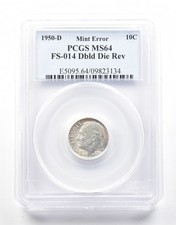
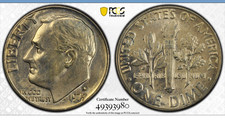
Misprinted Dimes — Complete Error List & Values
Every major dime error type with current value ranges and direct eBay search links. Values are for certified PCGS/NGC examples where noted; raw circulated examples typically bring 40–60% less.
| Error / Variety | Value Range | Shop |
|---|---|---|
| 1982 No Mint Mark Roosevelt Dime | $75 – $300+ | eBay → |
| Missing Clad Layer Dime (full obverse) | $150 – $400+ | eBay → |
| Missing Clad Layer Dime (full reverse) | $100 – $350+ | eBay → |
| Dime Struck on Cent Planchet | $200 – $2,000+ | eBay → |
| 1942/41-P Mercury Dime Overdate | $500 – $5,000+ | eBay → |
| 1942/41-D Mercury Dime Overdate | $800 – $8,000+ | eBay → |
| Mercury Dime Doubled Die Obverse | $100 – $3,000+ | eBay → |
| Roosevelt Dime Doubled Die Obverse | $25 – $500+ | eBay → |
| Off-Center Strike 40–60% (date visible) | $30 – $300+ | eBay → |
| Broadstrike Dime (no collar) | $20 – $150+ | eBay → |
| Die Cap Dime | $300 – $1,500+ | eBay → |
| Double Strike Dime (rotated) | $75 – $500+ | eBay → |
| Clipped Planchet Dime (curved 25%+) | $20 – $100+ | eBay → |
| Indent Error Dime | $30 – $200+ | eBay → |
| Partial Collar Strike Dime | $25 – $150+ | eBay → |
| Repunched Mint Mark Dime | $15 – $200+ | eBay → |
| Lamination Error Dime | $15 – $100+ | eBay → |
| Struck Through Grease Dime | $15 – $75+ | eBay → |
| 1975 No-S Proof Roosevelt Dime | $350,000 – $500,000+ | eBay → |
| 1968 No-S Proof Roosevelt Dime | $10,000 – $50,000+ | eBay → |
| 1970 No-S Proof Roosevelt Dime | $500 – $2,000+ | eBay → |
Misprinted Dime Explorer
Browse misprinted dimes and errors by series — click any card for full details and current eBay listings.
The 1982 No Mint Mark Roosevelt Dime
How to Identify It and What It's Worth
The 1982 no mint mark Roosevelt dime is the most famous modern misprinted dime. In 1982, the Philadelphia Mint accidentally shipped dies without the required P mint mark — the only time this happened after P marks became standard in 1980. Hundreds of thousands entered circulation before the error was caught. In circulated condition these trade for $75–$100; choice uncirculated (MS-65+) examples bring $200–$300.
How to Find Misprinted Dimes in Circulation
Roll Searching, What to Look For, and Damage vs. Error
Request 1982 dime rolls from your bank and check the area above Roosevelt's shoulder under a 5x loupe for the missing P. For missing clad layer dimes, look for coins with an obviously copper or bi-colored appearance. For doubled dies, focus on the date and LIBERTY lettering — even minor doubling can add significant value on key dates.
Post-mint damage — scratches, gouges, and coins altered by machine — has no collector value. Genuine errors occur during minting and show clean, unstruck fields around the anomaly. A coin that looks bent or gouged after leaving the Mint is damage, not an error.
Related Error Coin Guides

Frequently Asked Questions
What are misprinted dimes worth?
Values vary widely by error type. The 1982 no mint mark Roosevelt dime is worth $75–$300+ depending on condition. Missing clad layer dimes bring $100–$400. Wrong planchet errors range from $200 to $2,000+. Mercury dime doubled dies like the 1942/41 overdate can reach $500–$8,000+. The 1968 No-S Proof is a major modern rarity at $10,000–$50,000+. At the very top of the series sits the 1975 No-S Proof — only two are known to exist, and the finer example sold for a record $506,250 in 2024, making it the single most valuable modern U.S. coin error. Condition and severity of the error are the two biggest value drivers.
How do I find the 1982 no mint mark dime?
Check the obverse above Roosevelt's shoulder near the rim. All Philadelphia dimes from 1980 onward should have a P mint mark there. If the space is blank on a 1982 dime, you have the error. Worn examples can lose fine detail — submit questionable pieces to PCGS or NGC if the area is worn smooth. Roll searching 1982 dimes remains a practical hunting strategy.
What is a missing clad layer dime worth?
Values depend on which layer is missing and how much is absent. A full single missing clad layer (one face entirely copper-toned) is worth $100–$400 depending on grade and which side is affected. Partial missing clad layer examples are less valuable — typically $20–$75. Coins with both clad layers missing are rare and worth substantially more when genuine.
Is the 1942/41 Mercury Dime overdate a misprinted dime?
Technically it's a variety — a hub dating error where the wrong year hub was used to impress a working die. The 1942/41-P is a $500–$5,000 coin in most grades; the scarcer Denver version (1942/41-D) commands $800–$8,000+. Authentication by PCGS or NGC is essential for both.
Can I still find misprinted dimes in circulation?
Yes — the 1982 no-P dime occasionally appears in roll searches. Hundreds of thousands were produced and many circulated for years. The odds in any given roll are low, but dedicated roll searchers occasionally still find examples. Missing clad layer dimes also surface in circulation from time to time.
What's the difference between a doubled die and machine doubling?
A genuine doubled die shows distinctly separated, shelf-like doubling with full detail on both images — created when a hub impresses a die twice at slightly different positions. Machine doubling produces a flat, smeared secondary image with no depth. Machine doubling has no collector premium; genuine doubled dies can add hundreds or thousands to a dime's value.
What reference books cover misprinted dimes?
The Cherrypicker's Guide to Rare Die Varieties covers Roosevelt and Mercury dimes in depth. For Mercury Dimes, the Tomaska reference is the specialist standard. For general error coins, Alan Herbert's The Official Price Guide to Mint Errors is an excellent starting reference for identifying and valuing misprinted dimes of all types.
The Ultimate U.S. Error Coin Guide 2027 is a practical and easy-to-use reference designed to help you confidently identify, evaluate, and collect U.S. error coins.

 '
'