How to Grade Coins — A Beginner's Guide to the Sheldon Scale
Grading Terms • The 1-70 Scale • Key Wear Points by Series
Why Coin Grading Matters
Coin grading is the process of evaluating a coin's physical condition and assigning it a standardized rating — and it is, alongside rarity, the single biggest factor separating a coin worth face value from one worth thousands. Two coins of the exact same date and mint mark can differ in value by 10x, 100x, or more depending on grade alone. A worn 1921 Morgan dollar might bring $30; a pristine uncirculated example of the same date can sell for $150 or more, and a true gem can climb into the thousands.
Before 1978, there was no single agreed-upon system — dealers graded largely by instinct and reputation. That year, the American Numismatic Association published the Official ANA Grading Standards, and third-party certification services like PCGS and NGC later built on that foundation to create the standardized 1-to-70 numerical scale used across the hobby today. Understanding this scale is the first real skill every collector develops, and it's the foundation beneath every value chart on this site — from our Wheat Penny Value Chart to the full Coin Price Guide.
You don't need professional training to grade usefully. With practice, good lighting, and an understanding of where wear appears first on each design, most collectors can estimate a coin's grade closely enough to know roughly what it's worth — and to recognize when a coin is valuable enough to justify professional certification.
Key Facts
- Scale: The Sheldon Scale runs from 1 (barely identifiable) to 70 (theoretically perfect)
- Origin: Created by Dr. William Sheldon in 1949, formally adopted by the ANA in 1978
- Major grading services: PCGS and NGC are the two dominant third-party certifiers; ANACS and ICG are also widely recognized
- Grade prefixes: MS (Mint State), AU (About Uncirculated), PR/PF (Proof) modify the numerical grade
- Tools needed: A 5x–10x loupe or magnifying glass and a strong, direct light source
The Sheldon Grading Scale
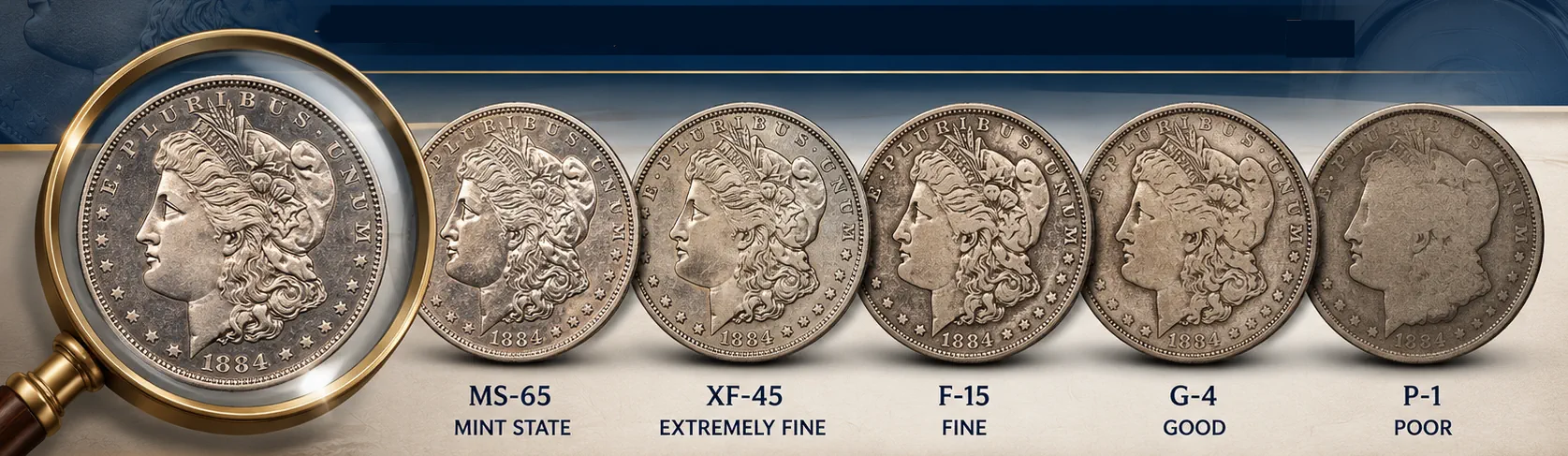
Every U.S. coin grade maps to a number between 1 and 70. Circulated grades occupy the lower end of the scale and describe progressively less wear; Mint State grades (60–70) describe coins that never entered circulation at all, differentiated instead by strike quality, luster, and the number and severity of contact marks.
| Grade | Term | Description |
|---|---|---|
| PO-1 / FR-2 | Poor / Fair | Barely identifiable as to type; date and major devices mostly worn away |
| AG-3 | About Good | Heavily worn; major features visible only in outline |
| G-4 to G-6 | Good | Design fully visible but flat; rim may be worn into the lettering |
| VG-8 to VG-10 | Very Good | Moderate wear; some details in high points beginning to show |
| F-12 to F-15 | Fine | Moderate to heavy wear, but all major design elements clear |
| VF-20 to VF-35 | Very Fine | Light to moderate wear on high points only; strong overall detail |
| EF-40 / XF-45 | Extremely Fine | Light wear confined to the very highest points; luster may remain in protected areas |
| AU-50 to AU-58 | About Uncirculated | Trace wear only; most to nearly all original mint luster present |
| MS-60 to MS-62 | Mint State (Basal) | No wear, but numerous or heavy contact marks and/or weak luster |
| MS-63 to MS-64 | Choice Uncirculated | No wear; moderate, well-scattered marks; pleasing overall eye appeal |
| MS-65 to MS-66 | Gem Uncirculated | Minimal marks visible to the naked eye; strong luster and strike |
| MS-67 to MS-70 | Superb Gem / Perfect | Virtually to literally flawless under magnification; extremely rare for most series |
How to Grade a Coin: 5 Steps
Set Up Your Lighting
Use a single, strong, direct light source — an incandescent or halogen bulb works better than diffuse overhead lighting. Hold the coin at an angle and slowly rotate it; wear and luster both reveal themselves differently depending on how light rakes across the surface.
Check the High Points First
Every design has specific points that receive the most friction from handling and are the first to show wear — Liberty's cheek, an eagle's breast feathers, the tops of letters. These "high points" are the single most important thing to examine, and where to look differs by series (see below).
Evaluate Luster and Strike
Original mint luster has a distinctive rolling, cartwheel-like shine as the coin is tilted. Cleaned or heavily circulated coins lose this. Separately, assess strike quality — a weakly struck coin can look worn even with no actual wear, so don't confuse the two.
Look for Contact Marks
For coins with little to no wear, grading becomes about counting and weighing contact marks — nicks and scuffs picked up from contact with other coins in mint bags. Fewer, smaller, and less-visible marks push a coin toward higher Mint State grades.
Compare Against References
Compare your coin side-by-side with PCGS Photograde or NGC's online grading guides, which show reference photos at every grade. Our own Coin Grading Simulator walks through the same wear, luster, strike, and eye-appeal factors interactively.
Key Wear Points by Series
Wear appears first on a design's highest-relief details, and those details are different for every series. Knowing exactly where to look — rather than judging a coin's condition at a glance — is what separates a reliable self-grade from a guess.
Morgan Dollar
Check the hair above Liberty's ear and the eagle's breast feathers. Full, sharp feather detail signals a higher grade; flattened feathers indicate circulation wear even if the rest of the coin looks strong.
Mercury Dime
The horizontal bands on the reverse fasces are the key detail. "Full Bands" (FB) — fully separated, unworn bands — command a significant premium over examples where the bands show any wear or die weakness.
Standing Liberty Quarter
Liberty's shield and the date are both struck in relatively low relief and wear quickly — many circulated examples have partially or fully worn dates, which significantly affects value versus a coin with a clear, legible date.
Franklin Half Dollar
The Liberty Bell's lower bell lines are the diagnostic detail. "Full Bell Lines" (FBL) examples, where all the horizontal lines at the bell's base are unbroken, carry a real premium over otherwise identical coins.
Walking Liberty Half Dollar
Check Liberty's head, left hand, and the leg closest to the viewer on the obverse, and the eagle's breast on the reverse — these raised, exposed areas show friction well before the rest of the design.
Buffalo Nickel
The date and the horn on the buffalo's head wear away first and fastest — many circulated Buffalo nickels have a partially or completely worn date, which caps their grade regardless of the rest of the coin's condition.
Self-Grading vs. Professional Certification
Learning to grade your own coins is valuable for quick assessments, sorting a large collection, and knowing roughly what you have before deciding what's worth pursuing further. But self-grading has real limits, and knowing when to submit a coin to PCGS or NGC instead is its own important skill.
As a general rule, any coin you believe could be worth more than $100–150 — and certainly any key date or coin in apparent Mint State condition — is worth having professionally graded. Third-party certification does three things a home grade can't: it provides an unbiased, market-recognized grade; it authenticates the coin as genuine, protecting against counterfeits and altered coins; and it encapsulates the coin in a tamper-evident holder that preserves both the grade and the coin's condition, making it far easier to sell with confidence later. The grade difference between adjacent Mint State levels — MS-63 to MS-65, for instance — can multiply a coin's value several times over, which is exactly the kind of distinction professional grading exists to settle.
Ready to Check What Your Coins Are Worth?
Once you've estimated a grade, use our free tools to translate that grade into an actual dollar value, or shop certified examples to see how condition affects price firsthand.

Affiliate links — FindRareCoins.com may earn a commission at no additional cost to you.
Grading & Authentication Resources
PCGS
The most widely recognized third-party grading service, with population reports, CoinFacts research, and a free online Photograde reference.
View PCGS Photograde →NGC
PCGS's leading competitor, offering comparable certification, an online grading guide, and a large price and population database.
Visit NGC →ANACS & ICG
Smaller but well-established certification services, often used for lower-value coins where PCGS/NGC fees aren't cost-effective.
Visit ANACS → | Visit ICG →FRC Coin Grading Simulator
Our free interactive tool walks through wear, luster, strike, and eye appeal to estimate a grade band before you decide whether to submit a coin.
Try the Simulator →eBay Certified Coins
Browse thousands of PCGS- and NGC-certified coins to see firsthand how grade differences translate into price.
Browse Certified Coins →FRC Coin Price Guide
Once you know a coin's grade, look up its current market value across every U.S. denomination.
View Price Guide →Related Guides
🎓 Coin Value Checker
Look up specific date-and-mintmark values once you've settled on a grade.
Check Values →Frequently Asked Questions
What is the Sheldon Scale?
The Sheldon Scale is the 1-to-70 numerical grading system used for U.S. coins, created by Dr. William Sheldon in 1949 and formally adopted as the American Numismatic Association's official grading standard in 1978. Every recognized coin grade, from Poor (PO-1) to Perfect Mint State (MS-70), maps to a specific number on this scale, giving collectors and dealers a common language for describing condition.
What tools do I need to grade a coin at home?
A 5x to 10x magnifying loupe and a strong, direct light source are the two essentials. A halogen or incandescent bulb works better than fluorescent or diffuse lighting, since raking light at an angle reveals wear and luster far more clearly than flat overhead light. Beyond that, reference photos — from PCGS Photograde, NGC's grading guide, or our own Coin Grading Simulator — help calibrate your eye against known examples.
What's the difference between circulated and Mint State grades?
Circulated grades (Poor through About Uncirculated, roughly 1–58) describe coins that show actual wear from handling and use. Mint State grades (60–70) describe coins with no wear at all — differentiated instead by the number and severity of contact marks, strike quality, and luster. A coin either has wear or it doesn't; that single distinction is the biggest fork in the entire grading scale.
Should I clean my coins before grading or selling them?
No — never clean a coin you intend to grade, sell, or collect seriously. Cleaning removes the coin's original surface and leaves hairline scratches visible under magnification, which professional graders penalize heavily. A cleaned coin that would otherwise grade MS-63 can be "body-bagged" (returned ungraded) by PCGS or NGC, dramatically reducing its value. Sell and submit coins exactly as you find them.
When is it worth paying to have a coin professionally graded?
As a general guideline, any coin you believe is worth more than $100–150, any key date, and any coin that appears to be in Mint State condition are all strong candidates for professional certification. Grading fees typically range from $20–$50+ per coin depending on value and turnaround time, so it usually only makes sense once a coin's potential value clearly exceeds that cost.
Why do PCGS and NGC sometimes grade the same coin differently?
Grading involves genuine human judgment, and even experienced graders can disagree by a point or two on borderline coins — this is normal and expected rather than a sign either service is wrong. For this reason, serious collectors sometimes "crossover" or resubmit a coin to see if it grades differently, particularly when a coin seems to sit right at the edge between two grade levels.
 '
'