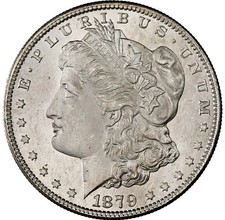
Morgan dollar value starts with silver. Each coin holds 0.77344 troy ounces of pure silver, so even the most worn common date carries a melt floor of about $45 at mid-October 2026 prices. From there, date, mint mark, and grade decide everything. A common 1921 in circulated condition trades just above melt, while a Carson City key date or the legendary 1893-S can run from four figures to well into six.
Our Morgan dollar calculator above gives a quick estimate by date, mint, and grade, using the live silver price as its base. After that, read on for the Carson City issues, key dates, mint marks, and grading standards that drive the market. For a full date-by-date value table, see our Morgan Silver Dollars guide. You can also check a coin in hand with What's My Coin Worth, or compare other series in the full Coin Price Guide.
Carson City Morgan Dollars
The CC mint mark is the most coveted in the Morgan Dollar series. Operating from 1870 to 1893, the Carson City Mint produced coins with Wild Western heritage and notoriously low mintages — making every CC Morgan a collector's prize.
Why CC Morgans Command Premium Prices
- Low mintages — many years saw under 2 million coins struck
- Heavy circulation in the Old West mining economy
- Romantic historical association with Nevada silver rushes
- Mint closed in 1893 — no CC coins after that year
- Survivors in Mint State condition are exceptionally scarce
1879-CC
Carson City
Mintage: 756,000. Scarce in every grade, including the popular "Capped Die" CC-over-CC variety.
G-4: ~$435 · MS-63: ~$7,500
Rare
1889-CC
Carson City
Mintage: 350,000. The rarest and most valuable Carson City Morgan, and a key date for the whole series.
G-4: ~$1,100 · MS-63: ~$34,600
Key Date
1893-CC
Carson City
Final year of CC production. Mintage: 677,000. Last chance for CC collectors.
G-4: ~$680 · MS-63: ~$6,500
Key Date
1885-CC
Carson City
Mintage: 228,000, the lowest of any CC Morgan. Many went to Treasury vaults, so Mint State examples survive in higher numbers.
G-4: ~$520 · MS-63: ~$1,600
Scarce
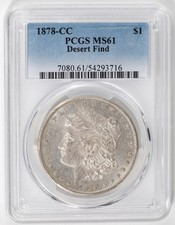
1878-CC
Carson City
First year of issue. Mintage: 2,212,000. Most accessible CC Morgan for new collectors.
G-4: ~$210 · MS-63: ~$2,100
Scarce
1880-CC
Carson City
Mintage: 495,000. Multiple reverse varieties. Popular with variety collectors.
G-4: ~$190 · MS-63: ~$1,900
Scarce
Key Dates & Rare Varieties
These are the Morgan dollar dates every serious collector tracks. The 1893-S Morgan Dollar leads the pack as the rarest business-strike date in the series, with just 100,000 struck.
Most key dates fall into one of three groups. Some are simply low-mintage coins, such as the 1893-S and the 1894 from Philadelphia. Others are Carson City issues, led by the 1889-CC and 1893-CC. A third group is common in worn grades but rare in Mint State, because most survivors circulated heavily; the 1893-O, 1895-O, and 1901 all belong here.
Varieties add another layer. For example, the 1878 tail-feather types, the 1879-CC "Capped Die," and the 1888-O "Hot Lips" doubled die all carry premiums over the regular coin. In addition, the proof-only 1895, often called the "King of Morgans," is the one date no business-strike set can include.
Morgan Dollar Key Dates at a Glance
- 1893-S — lowest business-strike mintage (100,000); the series' top rarity
- 1895 — proof only, 880 struck; no business strikes known
- 1889-CC — rarest Carson City Morgan in every grade
- 1893-CC — final Carson City year, scarce in Mint State
- 1893-O and 1895-O — New Orleans dates that are very rare uncirculated
- 1894 — just 110,972 struck at Philadelphia
- 1901 — common worn, but a major rarity in gem condition
For current prices on every date and mint mark, from Good-4 to MS-65, see the full value chart in our Morgan Silver Dollars guide.
Understanding Mint Marks
Morgan Dollars were struck at five mints between 1878 and 1921. The mint mark is found on the reverse (eagle side) just above the DO in DOLLAR.
P
Philadelphia
1878–1904, 1921
No mint mark on coin. Highest overall mintages.
CC
Carson City
1878–1893
Most coveted mint mark. Closed after 1893.
O
New Orleans
1879–1904
Southern mint. Closed 1909. Some key dates.
S
San Francisco
1878–1904, 1921
High quality strikes. Home of the 1893-S key date.
D
Denver
1921 only
Only struck Morgans in the 1921 revival year.
Certified Coin Grading Reference
PCGS and NGC use a 70-point Sheldon scale. For Morgan Dollars, these are the grades that matter most to collectors and investors. MS-63 is the most popular investment grade — enough quality to be attractive without the steep premium of MS-65.
Good
G-4 / G-6
Heavy wear. Design outline visible but major details flat. Most common circulated grade for key dates.
Very Fine
VF-20 / VF-30
Moderate wear. Hair above ear worn but visible. Eagle breast feathers show. Popular collector grade.
Extremely Fine
EF-40 / EF-45
Light wear on high points. Hair well defined. Attractive problem-free coins. Good value range.
About Uncirculated
AU-50 / AU-58
Slight wear on highest points only. Most luster present. AU-58 often mistaken for MS.
Mint State
MS-60 / MS-62
No wear but may have heavy bag marks or poor luster. Uncirculated but not premium quality.
Choice BU
MS-63
Above average strike, luster, and surface quality. The most popular investment grade Morgan.
Gem BU
MS-65
Strong luster, sharp strike, minimal marks. Dramatic price jumps over MS-63. Worth seeking in common dates.
Superb Gem
MS-67+
Exceptional quality. Population reports often show just a handful known. Record auction prices.
New to grading, or want a deeper walkthrough of wear, luster, strike, and eye appeal? See our full Coin Grading Guide.
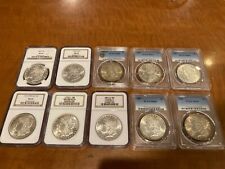
Morgan Dollars on eBay
Live eBay listings for Morgan dollars appear below. Before you buy, compare dealers, premiums, and buying tips in our Where to Buy Morgan Dollars guide.
Frequently Asked Questions
What is the minimum value of a Morgan Dollar?
Every Morgan Dollar contains 0.77344 troy ounces of pure silver, so its minimum value is always the silver melt value — about $45 with silver near $58 per ounce in mid-October 2026. Even common-date circulated Morgans are worth at least this amount, and most sell for a small premium above melt.
How do I tell if my Morgan Dollar is worth getting certified?
Generally, professional grading by PCGS or NGC is worth the cost (typically $30–$75 per coin) if: the coin appears to grade MS-63 or higher, it's a key date or semi-key date, or it appears to be an EF-45 or better example of a Carson City issue. For common-date circulated coins, the certification cost often exceeds the value gained.
What makes a Carson City Morgan more valuable?
Carson City Morgans command premiums due to their low mintages (often under 1 million), romantic historical appeal from the Nevada silver rush era, and the fact that the mint closed in 1893 — limiting the total number of CC coins ever produced. In Mint State grades,
CC Morgans are dramatically scarcer than their Philadelphia counterparts, leading to substantial price premiums.
Is the 1921 Morgan Dollar worth collecting?
The 1921 Morgan is the most common date in the series with over 86 million combined across three mints. In circulated grades it trades near melt value. However, the 1921-D and 1921-S are slightly scarcer, and high-grade MS-65+ examples of all three mints can be worthwhile. It makes an excellent starter coin for new Morgan collectors.
What are the most important varieties to know about?
Key varieties include the 1878 8 Tailfeathers vs. 7 Tailfeathers reverse, the 1878 7/8 TF overdate, the 1880 CC Reverse of 1878 variety, and various GSA holder coins from Treasury bag releases in the 1970s. The VAM (Van Allen-Mallis) reference catalogues over 1,000 Morgan Dollar varieties — many command significant premiums among specialist collectors.
Where is the best place to buy certified Morgan Dollars?
Reputable sources include PCGS and NGC authorized dealers, major auction houses (Heritage, Stack's Bowers), and
eBay from verified power sellers with strong feedback. For bullion-grade Morgans, dealers like JM Bullion offer competitive pricing. Always verify certification numbers on the PCGS or NGC population registry before purchasing high-value coins.








 '