1931-S Wheat Penny ValuePrices by Grade, Rarity & How to Spot a Fake
1931-S Wheat Penny Value by Grade
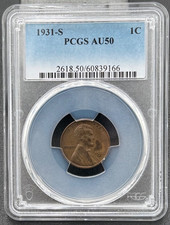
A 1931-S wheat penny is worth about $60 to $70 even when heavily worn, and roughly $600 in Gem MS-65 Red. San Francisco struck only 866,000 of them, the lowest mintage of any Lincoln cent from the Great Depression. That small mintage makes the 1931-S one of the four major key dates in the series.
Find your coin's grade below. Circulated coins are graded Brown (BN), so the Red-Brown (RB) and Red (RD) columns apply only to Mint State coins. For every other date, see the wheat penny value chart. You can also browse our coin price guides or start with What's My Coin Worth?
| 1931-S Grade | Brown (BN) | Red-Brown (RB) | Red (RD) | Shop |
|---|---|---|---|---|
| G-4 (Good) | $60–$70 | — | — | Shop → |
| F-12 (Fine) | $80–$90 | — | — | Shop → |
| VF-20 (Very Fine) | $85–$100 | — | — | Shop → |
| XF-40 (Extremely Fine) | $100–$125 | — | — | Shop → |
| AU-55 (About Uncirculated) | $130–$150 | — | — | Shop → |
| MS-60 | $150–$175 | — | — | Shop → |
| MS-63 | $190–$210 | $220–$250 | $245–$275 | Shop → |
| MS-65 | About $450 | $450–$500 | $575–$650 | Shop → |
| MS-66 | $1,000–$1,100 | $1,100–$1,250 | $2,500–$4,150 | Shop → |
| MS-67 | — | — | $38,000–$43,200 | Shop → |





Why Red Coins Bring So Much More
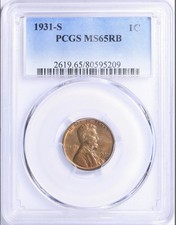
Color is the biggest price driver in Mint State. A 1931-S in MS-65 Red sells for about $600, while the same grade in Brown sells for about $450. At MS-66, the gap grows wider still, because original red color survives on only a small share of coins.
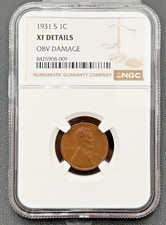
Many uncirculated 1931-S cents were cleaned over the years to make them look red again. Graders catch this, and a cleaned coin gets a "Details" label instead of a numeric grade. For that reason, a natural Red-Brown coin is often a better buy than a suspiciously bright Red one without a holder.
1931-S Penny Auction Records
The highest price we've found for a 1931-S penny is $43,200, for a PCGS MS67 Red at Heritage in August 2025. Very few coins have reached that grade at PCGS. Below it, MS66+ Red examples have sold between about $7,800 and $18,600.
| Grade | Price | Venue & Date | Shop |
|---|---|---|---|
| PCGS MS67 RD | $43,200 | Heritage, Aug. 2025 | Shop → |
| PCGS MS67 RD | $38,400 | Heritage, Jan. 2025 | Shop → |
| PCGS MS66+ RD | $18,600 | Heritage, June 2021 | Shop → |
| MS66+ RD | $9,600 | Stack's Bowers, Summer 2025 | Shop → |
| PCGS MS66+ RD | $7,800 | Stack's Bowers, Aug. 2024 | Shop → |
These top results are for coins most collectors will never see. In everyday trading, the 1931-S changes hands most often in Extremely Fine to MS-63, where prices sit between about $100 and $275. Those grades are also where recent sold listings give you the clearest picture of the market.
Why the 1931-S Penny Is Scarce
The 1931-S is scarce because San Francisco struck only 866,000 cents that year, as demand for new coins collapsed during the Great Depression. It was the mint's last cent until 1935, because San Francisco struck no cents at all from 1932 through 1934. For comparison, Denver made 4,480,000 cents in 1931, and Philadelphia made more than 19 million.
Interestingly, the 1931-S is easier to find in high grade than its mintage suggests. Much of the issue sat in government storage until it was released in quantity in 1934. By then collectors knew the mintage was low, so many coins were set aside before they ever circulated. CoinWeek reports that about half a million were shipped to the Federal Reserve Bank in Salt Lake City.
A Popular Hoard Story Lacks Evidence
You may read that a dealer named Maurice Scharlack hoarded 200,000 pieces. CoinWeek calls that claim doubtful, because no evidence of the hoard has turned up. Still, the coin was clearly saved in quantity: in 1935, dealer R.A. Webb was already advertising "strictly uncirculated" examples at 35 cents each.
That early saving is why Mint State coins are available today. Even so, original red coins remain hard to find, and true Gem examples command a strong premium over circulated ones.
How to Identify a 1931-S Penny
A 1931-S penny shows a small S directly below the date on the front. If there's nothing below the date, the coin is a common 1931 from Philadelphia, and a D means Denver. Use a 5x to 10x loupe to check the mint mark, because it's small and often worn.
On a genuine coin, the S has the same color, wear and texture as the date beside it. The 3 in 1931 also has a shape that differs from the 3 on other 1930s cents, according to CoinWeek. As a result, a careful look at the date helps rule out altered coins from other years.
Check the Grade and Color
Most surviving 1931-S cents grade Extremely Fine or better, so a heavily worn example is actually less common than a nice one. Still, strike quality varies, and few coins are fully struck. Look for even wear, natural toning and no signs of cleaning, such as hairline scratches or a bright, pinkish color.
If your coin looks Mint State, compare it with certified photos before guessing at the grade. A one-point difference in grade, or a change from Red-Brown to Red, can double the value. Our coin grading guide explains how the scale works.
How to Spot a Fake 1931-S Penny
The most common fake 1931-S is a genuine 1931 Philadelphia cent with an S added below the date. Because the base coin is real, the date and design look right. Under magnification, though, an added S usually shows a seam, glue residue, or a color that doesn't quite match.
- Added S: attached to a common 1931 cent. Check the base of the S for a line or gap.
- Altered date: another S-mint cent with the last digit reworked into a 1. Compare the 3 and the final 1 with a genuine coin.
- Cast copies: grainy or porous surfaces, with soft, weak lettering.
For any 1931-S worth more than $100, buy in a PCGS or NGC holder, or have your own coin certified before selling it. Certification costs less than the price gap between a real coin and a fake.
The 1931-S and Other Key Date Wheat Pennies
The 1931-S is the most affordable of the four major wheat penny key dates. The others are the 1909-S VDB, the 1914-D and the 1922 No D. In other words, it's often the first key date a collector buys, and it's a good place to start a set.
| Key Date | Mintage | Typical Value, Well Worn | Full Guide | Shop |
|---|---|---|---|---|
| 1909-S VDB | 484,000 | About $800–$900 | 1909-S VDB guide | Shop → |
| 1914-D | 1,193,000 | About $150–$200 | 1914-D guide | Shop → |
| 1922 No D | Part of 1922-D | About $500–$700 | 1922 No D guide | Shop → |
| 1931-S | 866,000 | About $60–$70 | You're here | Shop → |

 '