1922 No D Penny Value
Die Pairs, Strong Reverse Diagnostics & How to Spot Fakes
The only "Philadelphia-looking" cent of 1922 was actually struck in Denver, and that's exactly what makes it a key date.
1922 No D Values & Related Guides
1922 No D Penny Value by Grade
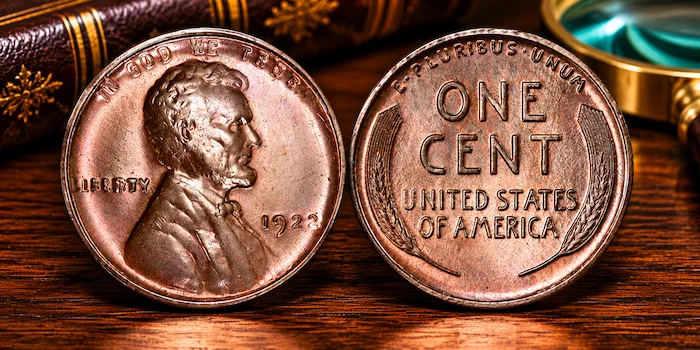
The values below are approximate retail figures for the Strong Reverse (Die Pair 2) in brown (BN) color, based on published price guide data. Weak reverse and Weak D coins sell for considerably less, and certified coins with original surfaces and good eye appeal can bring more than the figures shown. Red-brown (RB) and especially full Red (RD) examples are a different market altogether.
| Variety / Grade | What to Expect | Approx. Value | Shop |
|---|---|---|---|
| Strong Reverse, G-4 | Heavy wear, full rims, date clear | ~$550 | eBay → |
| Strong Reverse, VG-8 | Some LIBERTY and wheat detail | ~$650 | eBay → |
| Strong Reverse, F-12 | Wheat lines partly visible | ~$700 | eBay → |
| Strong Reverse, VF-20 | Most wheat lines clear | ~$900+ | eBay → |
| Strong Reverse, EF-40 | Light wear on cheek and jaw | ~$1,800+ | eBay → |
| Strong Reverse, AU-50 | Trace wear on high points | ~$4,000+ | eBay → |
| Strong Reverse, MS-60 | No wear, often dull or spotted | ~$10,000+ | eBay → |
| Strong Reverse, MS-63 | Attractive, few marks | ~$19,000+ | eBay → |
| No D Weak Reverse (Die Pairs 1, 3, 4) | No visible D, mushy reverse | Well below Strong Reverse | eBay → |
| 1922 Weak D | Partial D visible | Modest premium | eBay → |
| Regular 1922-D | Full, clear D mint mark | Tens of dollars circulated | eBay → |
Why Red examples are in a class of their own
Most surviving 1922 No D cents are brown and circulated. Uncirculated pieces are scarce, and coins that keep their original red mint color are true condition rarities. When Heritage offered a PCGS MS-63 Red Strong Reverse example in 2018, CoinWeek reported that it was believed to be only the second-finest Red Strong Reverse known, with PCGS recording a single MS-64 Red as the finest. Coins at that level trade at major auctions, not in coin shop cases.
Grading a 1922 No D
Grading this coin takes some care, because the Denver dies were worn to begin with. Even a lightly circulated Strong Reverse may look softer on the obverse than you'd expect from its grade. Focus on wear at Lincoln's cheekbone, jaw, and hair above the ear on the obverse, and on the high points of the wheat ears on the reverse. PCGS Photograde is useful for comparing a 1922 against other wheat cents at each grade, but for a coin worth hundreds or thousands of dollars, professional grading is the safer route.
Every Lincoln cent struck in 1922 came from the Denver Mint. Philadelphia and San Francisco didn't make a single cent that year, which means every genuine 1922 penny should carry a small "D" below the date. A few don't. Those coins, known as the 1922 No D or 1922 "Plain" cent, are one of the major key dates in the wheat cent series and a coin every Lincoln collector eventually has to reckon with.
The catch is that not every 1922 cent without a visible D is the valuable one. Four different die pairs produced weak-D or no-D coins, and only one of them, Die Pair 2 with its sharp "Strong Reverse," commands the big premiums. Add altered 1922-D cents with the mint mark scraped off, and you have a coin where knowing the diagnostics matters more than almost anywhere else in the series. If you're checking a whole jar, start with our Wheat Penny Value Chart; if you just want a quick estimate on a coin in hand, try What's My Coin Worth?
Values in this guide are approximate retail ranges for problem-free coins, meant to help you understand where a 1922 No D fits. Prices move with grade, eye appeal, and certification, so confirm current numbers with PCGS CoinFacts or the NGC Price Guide before you buy or sell, and see our full Coin Price Guide for other dates.
1922 No D Key Facts
- Mint: Denver only. No cents were struck at Philadelphia or San Francisco in 1922.
- Total 1922-D mintage: 7,160,000 cents, of which only a small fraction lack a visible mint mark.
- The valuable variety: Die Pair 2, the "No D Strong Reverse," attributed as FS-401.
- Composition: 95% copper, 5% tin and zinc; 3.11 grams; 19 mm.
- Approximate value: Strong Reverse examples start around $550 in Good-4 and pass $10,000 in Mint State.
- Biggest risk: altered 1922-D cents and weak-reverse coins sold as the Strong Reverse.
Why Denver Struck Every Cent in 1922
The early 1920s were a strange stretch for the U.S. Mint. Under the Pittman Act, the Mint was converting huge amounts of silver into new Peace dollars, and in 1922 production of circulating nickels, dimes, quarters, and half dollars stopped entirely. Philadelphia and San Francisco focused on dollars, which left Denver as the only mint striking cents. It produced 7,160,000 of them, much of that early in the year.
That workload put serious stress on Denver's dies. The Mint was trying to stretch its supply, and dies stayed in service long after they would normally have been retired. Worn dies, grease-filled mint marks, and at least one badly clashed die pair all played a part in what happened next. Under ordinary circumstances, a cent with a weak or missing D would simply have looked like a Philadelphia coin and nobody would have noticed. Because Philadelphia made no cents in 1922, the missing D stood out immediately once collectors started looking.
How the D disappeared
The most widely accepted explanation for the Strong Reverse coins is a die clash. When the obverse and reverse dies struck each other with no planchet between them, they left clash marks on both faces. The reverse die was pulled from service and replaced with a fresh one. The obverse die was lapped (polished down) to remove the clash damage, and in the process the shallow D mint mark was ground away entirely. Every coin that obverse struck afterward came out with no trace of a D but with a crisp, fresh reverse, which is why the Strong Reverse matters so much for attribution.
The other die pairs tell a different story. Their mint marks faded from grease and debris filling the D punch, sometimes clearing and refilling, so the same die could strike strong D, weak D, and no D coins over its life. Those dies were also badly worn, which is why their reverses look mushy. Lincoln cent specialists estimate that only tens of thousands of true No D coins were struck, and that a fraction of those survive today. Most saw heavy circulation, since the variety went largely unnoticed for years.
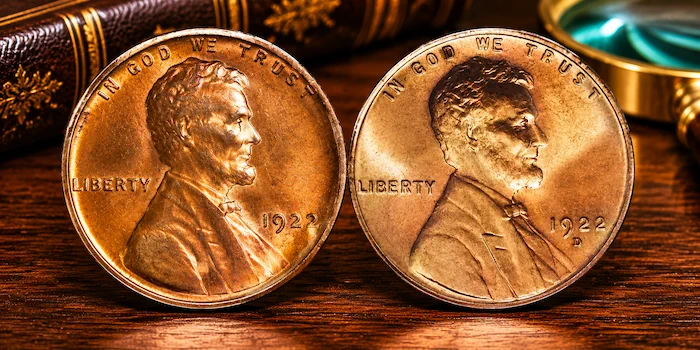
The Four Die Pairs: Which 1922 No D Do You Have?
Attribution is everything with this coin. PCGS and NGC label Die Pair 2 coins as "1922 No D Strong Reverse," while Die Pairs 1, 3, and 4 are labeled "1922 No D Weak Reverse" or "1922 Weak D" depending on how much of the mint mark shows. ANACS takes a stricter approach and only calls Die Pair 2 coins "No D," labeling everything from the other three pairs as "Weak D." That difference alone can explain why two coins that look alike to a beginner sell for very different prices.
Start your attribution on the reverse, not the obverse. A strong, sharp reverse with clear lines in the wheat ears points toward Die Pair 2. A soft, washed-out reverse with little detail in the wheat almost always means Die Pair 1, 3, or 4. Then confirm with the obverse markers below.
Die Pair 2: Strong Reverse
No trace of a D. The second 2 in the date is sharper than the first, every letter of TRUST is crisp, and "WE" is only slightly mushy. The reverse is sharp, with clear lines in the wheat ears.
The valuable one: about $550+ in Good
Die Pair 1: Weak Reverse
The second 2 is weaker than the first, the first T in TRUST is sharper than the other letters, and "WE" is very mushy. Some show a jagged die crack from the L in PLURIBUS to the O in ONE.
A fraction of Strong Reverse prices
Die Pair 3: Weak Reverse
TRUST is weak but sharper than IN GOD WE, and the L in LIBERTY touches the rim. The lower left of the O in ONE spreads into the field for a "wavy" look, and the reverse is slightly rotated.
A fraction of Strong Reverse prices
Die Pair 4: "Coattails"
The front of Lincoln's coat, around the 4 to 5 o'clock position, merges into the rim. The reverse shows weak detail on the high points, much like Die Pairs 1 and 3.
A fraction of Strong Reverse prices
1922 Weak D
Coins from Die Pairs 1, 3, and 4 where part of the D is still visible. They carry a premium over a normal 1922-D but are a separate, much more affordable variety.
Modest premium over a regular 1922-D
Regular 1922-D
A normal, clearly struck D below the date. It's still a better date in the wheat series, but the vast majority of 1922 cents you'll find are this coin.
Tens of dollars in circulated grades
If your coin shows a sharp reverse but you can see even a faint outline of a D, it isn't a Die Pair 2 coin. Die Pair 2 never shows any part of the mint mark. That simple rule clears up a lot of confusion, because many coins advertised as "No D" are actually Weak D pieces with the mint mark worn away by circulation.
How to Spot an Altered or Fake 1922 No D
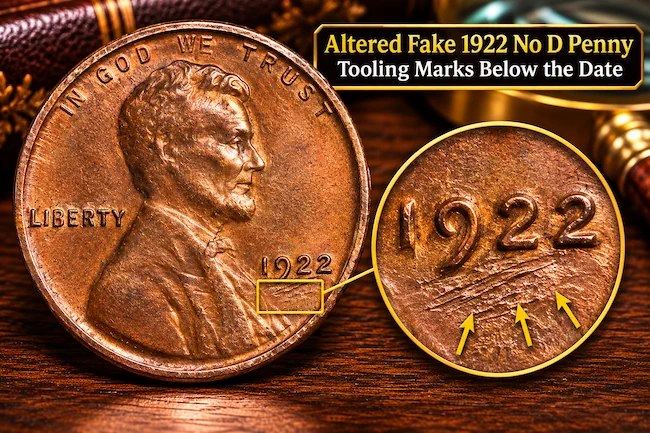
Because a regular 1922-D is worth a small fraction of a Strong Reverse, the most common fake is simply a real 1922-D with the D removed. Someone scrapes, files, or polishes away the mint mark and hopes the buyer doesn't look closely. Under a 5x to 10x loupe, these alterations usually leave evidence: fine parallel scratches, a slightly dished or uneven field below the date, or a patch of color that doesn't match the rest of the coin.
The die pair diagnostics are your best defense. An altered 1922-D was struck by normal dies, so it won't show the specific Die Pair 2 markers: the second 2 sharper than the first, a fully crisp TRUST, and that sharp, detailed reverse. If the D area looks clean but the date and lettering don't match the Die Pair 2 profile, treat the coin as suspect. The same goes for a weak-reverse coin offered as a Strong Reverse, which is the second most common misrepresentation.
A quick checklist before you buy
Check the reverse first; if the wheat lines are mushy, it's not a Strong Reverse. Look at the area below the date under magnification for tooling or color changes. Compare the date, TRUST, and "WE" against the Die Pair 2 markers. Watch for cast counterfeits, which often have a grainy surface, soft edges, or an incorrect weight (a genuine coin weighs 3.11 grams). Finally, for any coin priced as a Strong Reverse, buy it certified by PCGS or NGC with the variety listed on the label. The grading fee is small compared with what's at stake.
Where collectors find them today
Genuine 1922 No D cents still turn up in old wheat penny accumulations, inherited collections, and the occasional bank roll, which is part of their appeal. Most surviving examples are well worn, since few people set them aside in the 1920s. If you're working through a family collection, sort the 1922 cents into their own pile and check each one with a loupe before setting anything aside as "just a 1922-D." Our Error Coin Identifier and Error Coins Value Guide can help with other oddities you find along the way.
The Bottom Line
The 1922 No D is a key date with a real story behind it: a mint stretched thin, worn dies kept in service, and one clashed obverse that lost its mint mark during repair. That story is also why the coin rewards careful study. A Die Pair 2 Strong Reverse is worth hundreds of dollars in low grades and five figures in Mint State, while weak-reverse coins, Weak D pieces, and altered 1922-D cents are worth far less.
Start with the reverse, confirm the obverse markers, check the mint mark area for tooling, and rely on PCGS or NGC certification for any coin priced as the real thing. For the rest of the series, our Wheat Penny Value Chart and Coin Price Guide cover every date from 1909 to 1958.

Related Guides
Frequently Asked Questions
How much is a 1922 No D penny worth?
A genuine 1922 No D Strong Reverse (Die Pair 2) is worth roughly $550 in Good-4, around $900 in Very Fine, about $1,800 in Extremely Fine, and $10,000 or more in Mint State, based on published price guide data. Weak reverse and Weak D coins are worth considerably less. Always confirm current values with PCGS CoinFacts or the NGC Price Guide.
Why is there no mint mark on some 1922 pennies?
All 1922 cents were struck in Denver. On the most valuable variety, a clashed obverse die was polished to remove the clash marks, and the D mint mark was ground away in the process. On other die pairs, grease and debris filled the mint mark punch on worn dies, producing weak or missing D's.
What is the difference between a Strong Reverse and a Weak Reverse 1922 No D?
The Strong Reverse comes from Die Pair 2, which used a fresh reverse die, so the wheat ears show sharp, clear lines. Weak Reverse coins come from Die Pairs 1, 3, and 4, which used worn reverse dies, so the wheat looks soft and mushy. The Strong Reverse is far scarcer in collector demand and much more valuable.
Was a 1922 penny made in Philadelphia?
No. The Philadelphia and San Francisco Mints struck no cents in 1922. Every 1922 Lincoln cent came from Denver, which is why a 1922 cent with no mint mark is a variety rather than a Philadelphia coin.
How can I tell if my 1922 No D is fake?
Look below the date under magnification for scratches, a dished surface, or off-color metal where a D may have been removed. Check that the reverse is sharp and that the date and TRUST match the Die Pair 2 markers. For any coin priced as a Strong Reverse, buy only PCGS or NGC certified examples with the variety on the label.
Is a 1922-D penny with a clear D worth anything?
Yes. A regular 1922-D is a better date in the wheat cent series and is worth well above face value, typically tens of dollars in circulated grades and more in high grades. It is far less valuable than a No D Strong Reverse, but it's still worth keeping.
 '