United States Flying Eagle Cents
1856–1858 • America's First Small Cent • The 1858/7 Overdate
Flying Eagle Cents Value Guide
Every Date and Major Variety, Typical Values by Grade
| Date / Variety | Mintage | Good (G-4) | VF-20 | MS-63 | Shop |
|---|---|---|---|---|---|
| 1856 — Pattern / Key Date | ~1,500–2,150 (est.) | $8,000+ | $10,000+ | $25,000+ | Shop |
| 1857 | 17,450,000 | $30 | $50 | $1,000+ | Shop |
| 1857 Obverse Die Clash (quarter, half or $20) | Included above | $150+ | $400+ | $3,500+ | Shop |
| 1858 Large Letters | 24,600,000 (both types) | $30 | $55 | $1,100+ | Shop |
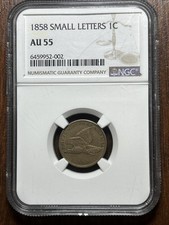
| 1858 Small Letters | Included above | $30 | $55 | $1,100+ | Shop |
| 1858/7 Overdate (Large Letters) | Included above | $85+ | $350+ | $10,000+ | Shop |
Flying eagle cents were the first small cents the United States ever struck for circulation, and they lasted only three years. As a result, the series is short enough to complete, yet it still includes one genuine rarity in the 1856. The values above are approximate retail ranges for problem-free coins. For every other series, see our full U.S. coin price guide, or work through a specific coin step by step with What's My Coin Worth?
Because copper-nickel is a hard alloy, many of these coins came off the press weakly struck, especially on the eagle's head and tail. Sharp examples therefore bring strong premiums over the guide figures, while cleaned or corroded coins sell well below them. For that reason, compare recent sold listings before you buy anything beyond the common dates.




Why the Mint Replaced the Large Cent
By the early 1850s, the old copper large cent had become a problem for everyone involved. Copper prices had climbed to the point where the Mint lost money on each coin, and the public disliked the heavy, oversized piece so much that it barely circulated outside the big eastern cities. Meanwhile, worn Spanish and Mexican silver still made up much of America's small change, even though Congress wanted it gone.
The Act of February 21, 1857 solved both problems at once. It authorized a smaller cent of 88% copper and 12% nickel, and it ended the legal tender status of foreign silver coins. In addition, the law let the public trade old large cents and Spanish silver for the new coin. When the exchange opened at the Philadelphia Mint on May 25, 1857, crowds lined up outside the building, and the Mint paid out its new cents by the bagful.
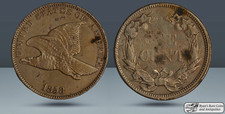
Chief Engraver James B. Longacre adapted the soaring eagle from Christian Gobrecht's design on the 1836–1839 Gobrecht dollar. For the reverse, he used an agricultural wreath of corn, wheat, cotton and tobacco around the words ONE CENT. The design looked handsome, but it had a serious flaw: the eagle's high points sat directly opposite the thick wreath, so the metal could not fill both sides fully. After just two years of regular production, the Mint replaced it with the Indian Head cent in 1859.
The 1856 Flying Eagle Cent — A Pattern That Became a Key Date
Strictly speaking, the 1856 flying eagle cent is a pattern rather than a regular issue. The Mint struck it before Congress had even approved the new cent, mainly so that lawmakers could see and handle the proposed coin. Many examples went to members of Congress and other officials, which explains why so many survivors show light wear from being carried as pocket pieces.
Collector demand soon outran the original supply. As a result, the Mint quietly struck more 1856-dated cents, mostly proofs, for several years afterward, and specialists still debate how many coins came from each period. PCGS cites total production estimates of roughly 1,500 to 2,150 pieces, with around 550 survivors in all grades. Because the coin has appeared alongside regular issues in the Red Book for generations, most collectors treat it as the required key date of the series.
Values reflect that status. Even a heavily worn 1856 brings $8,000 or more, and the PCGS auction record stands at $172,500 for an MS-66 sold by Heritage in January 2004. Counterfeits are common, too, especially 1858 cents with the final 8 tooled into a 6. Genuine coins share die characteristics that an altered 1858 lacks, so buy an 1856 only when PCGS or NGC has certified it.
1858 Large Letters, Small Letters & the 1858/7 Overdate
The Mint used two obverse lettering styles in 1858, and collectors count them as separate types. On the Large Letters variety, the A and M in AMERICA touch at the base. On the Small Letters variety, by contrast, the letters are smaller and the A and M stand clearly apart. A loupe makes the difference easy to see, and both types carry similar values in most grades.
The more valuable 1858 variety is the 1858/7 overdate, found only on Large Letters coins. On this die, an engraver punched an 8 over an earlier 7, and traces of the 7 remain visible at the top of the final 8. Early die states show the overdate clearly, while later states fade as the die wore down. For that reason, the clearest examples command the biggest premiums, and even well-worn pieces sell for several times the price of a normal 1858.
The 1857 also has a well-known family of die clashes. In these cases, the obverse die struck against a reverse die from another denomination, such as a Seated Liberty quarter, a half dollar or a double eagle. The result is faint outlines of the other coin's design around the eagle. Because these clashes are visible without magnification, they make an accessible variety for collectors on a budget. For other mint mistakes, see our error coins value guide.
Grading Flying Eagle Cents
These coins wear first on the eagle's head, the breast and the tips of the wing and tail feathers. On a Fine coin, the major feathers are worn but still separated, while a VF coin shows most of the wing feathers and some detail on the head. By Extremely Fine, nearly all the feathers stand out, with light wear only on the highest points.
Strike matters almost as much as wear on this series. Many coins left the press with mushy feathers on the eagle's head and tail, or a weak wreath on the reverse, even though they never circulated. As a result, a sharply struck coin can be worth noticeably more than a weak one in the same grade. Still, the number on a holder says nothing about the strike, so study the coin itself before you buy.
Surface problems are also common. Copper-nickel tones to a light tan or olive color, and many coins were cleaned at some point to brighten them. A cleaned coin shows tiny parallel hairlines and an unnatural shine, and the major grading services will not give it a straight grade. In addition, watch for corrosion spots and old scratches in the fields, which cut value sharply. Our coin grading photo guide shows what each grade looks like.

 '