United States Indian Head Cents
1859–1909 • Copper-Nickel & Bronze • The 1877 Key Date
Indian Head Cents Value Guide
Copper-Nickel Era (1859–1864)
| Date / Variety | Mintage | Good (G-4) | VF-20 | MS-63 | Shop |
|---|---|---|---|---|---|
| 1859 — Laurel Wreath (one-year type) | 36,400,000 | $18 | $45 | $300+ | Shop |
| 1860 | 20,566,000 | $15 | $30 | $175+ | Shop |
| 1861 | 10,100,000 | $35 | $65 | $250+ | Shop |
| 1862 & 1863 | 28,075,000 / 49,840,000 | $12 | $20 | $110+ | Shop |
| 1864 Copper-Nickel | 13,740,000 | $28 | $60 | $250+ | Shop |
Early Bronze Era (1864–1878)
| Date / Variety | Mintage | Good (G-4) | VF-20 | MS-63 | Shop |
|---|---|---|---|---|---|
| 1864 Bronze — No L | 39,233,714 (all bronze) | $15 | $45 | $125+ | Shop |
| 1864 Bronze — With L | Included above | $60 | $175 | $450+ | Shop |
| 1865 | 35,429,286 | $15 | $30 | $125+ | Shop |
| 1866 | 9,826,500 | $60 | $175 | $500+ | Shop |
| 1867 | 9,821,000 | $60 | $175 | $500+ | Shop |
| 1868 | 10,266,500 | $55 | $160 | $450+ | Shop |
| 1869 | 6,420,000 | $120 | $425 | $900+ | Shop |
| 1870 | 5,275,000 | $95 | $325 | $800+ | Shop |
| 1871 | 3,929,500 | $120 | $425 | $1,000+ | Shop |
| 1872 | 4,042,000 | $150 | $525 | $1,300+ | Shop |
| 1873 Doubled LIBERTY | Included in 11,676,500 | $300+ | $1,500+ | $10,000+ | Shop |
| 1877 — The Key Date | 852,500 | $600+ | $1,500+ | $4,000+ | Shop |
| 1878 | 5,797,500 | $55 | $175 | $450+ | Shop |
Late Bronze Era (1879–1909)
| Date / Variety | Mintage | Good (G-4) | VF-20 | MS-63 | Shop |
|---|---|---|---|---|---|
| Common dates (1879–1907) | Varies | $2 | $6 | $40+ | Shop |
| 1886 Type 2 | Included in 17,650,000 | $25+ | $175+ | $600+ | Shop |
| 1888/7 Overdate | Included in 37,489,832 | $1,000+ | $3,500+ | $25,000+ | Shop |
| 1908-S | 1,115,000 | $100 | $160 | $450+ | Shop |
| 1909-S | 309,000 | $500 | $750 | $1,500+ | Shop |
Indian Head cents ran for 51 years, longer than almost any other American coin design of the 1800s, and they remain one of the most popular series for new collectors. Most dates are affordable in circulated grades. Even so, the series has real challenges in the 1869–1872 run, the 1877 and the two San Francisco issues. The values above are approximate retail ranges for problem-free coins, with Mint State figures for brown (BN) examples. For every other series, see our full U.S. coin price guide, or work through a specific coin step by step with What's My Coin Worth?


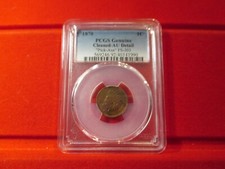


Color drives price on bronze Indian cents. PCGS and NGC label Mint State coins as Brown (BN), Red-Brown (RB) or Red (RD), and a full-red coin can sell for several times the price of a brown one in the same grade. For that reason, check the color designation on any certified coin, and compare recent sold listings before paying a premium.
The Design: Longacre's Liberty in a Feathered Headdress
James B. Longacre designed the Indian Head cent in 1859 to replace the hard-to-strike flying eagle cent. Rather than a portrait of an actual Native American, the obverse shows Lady Liberty wearing a feathered headdress, with UNITED STATES OF AMERICA around the border and LIBERTY on her headband. The lower relief struck up far more reliably than the old eagle, which solved the Mint's biggest production problem.
A popular story claims Longacre modeled the face on his young daughter, Sarah, after she tried on a visiting chief's headdress. However, Longacre himself wrote that he based the profile on a classical statue known as the Venus Accroupie, and historians treat the Sarah story as legend. Either way, the design proved durable enough to last half a century with only minor changes.
The reverse changed after just one year. In 1859, a plain laurel wreath surrounded ONE CENT, which makes the 1859 a one-year type coin. From 1860 onward, the Mint used an oak wreath with a small Union shield at the top, and that reverse stayed in place until the series ended in 1909.
From Copper-Nickel to Bronze — The Civil War Change
When the Civil War began, uncertainty about the outcome led Americans to hoard every coin they could find, including the copper-nickel cent. By mid-1862, small change had nearly vanished from circulation. In response, merchants issued millions of privately made bronze tokens, now known as Civil War tokens, and the public accepted them readily even though they were thinner and lighter than the government cent.
That experience showed the Mint that a lighter bronze cent would work. The Act of April 22, 1864 replaced the copper-nickel alloy with bronze of 95% copper and 5% tin and zinc, and it cut the weight from 4.67 grams to 3.11 grams. The same law also created the two-cent piece. As a result, 1864 cents exist in both compositions, and most collectors want one of each.
Late in 1864, Longacre added his initial L to the ribbon behind Liberty's neck. The 1864 "L" variety is scarcer than the plain bronze 1864 and carries a strong premium, while the few 1864 L proofs rank among the great rarities of the series. To check for the L, look at the end of the ribbon just below the hair. A magnifier helps on worn coins, where the letter can fade almost completely.
The 1877 Indian Head Cent — The Series Key
The 1877 is the key date of the Indian Head series, with just 852,500 business strikes. The low mintage followed the Panic of 1873, which pushed the country into a long depression. Banks and merchants already held large stocks of cents, so the Mint had little reason to strike more, and production fell sharply until demand recovered.
Because so few were made, even a worn 1877 is expensive. Low-grade examples typically start around $600, and coins with a full LIBERTY on the headband bring well over $1,000. At the top of the market, PCGS reports a record of $149,500 for an MS-66 Red example sold by Heritage in 2007, and other MS-66 Red coins have since brought six figures.
The 1877 is also one of the most counterfeited Indian cents. The usual fake is an 1875 cent with the last digit tooled into a 7, although cast copies with soft, grainy surfaces turn up too. Genuine coins share specific die markers that authenticators check, so buy an 1877 only when PCGS or NGC has certified it.
1908-S and 1909-S — The Only Branch Mint Indian Cents
For its first 49 years, every Indian Head cent came from Philadelphia. That changed in 1908, when the San Francisco Mint struck cents for the first time and added a small S mint mark on the reverse below the wreath. The 1908-S had a mintage of 1,115,000, low enough to make it a popular semi-key in every grade.
The 1909-S is scarcer still, with only 309,000 struck before the Lincoln cent replaced the Indian Head design partway through 1909. In fact, it is the lowest-mintage Indian Head cent of all, even lower than the 1877, although more survivors exist because collectors saved it as the last of the series. Today the 1909-S ranks just behind the 1877 in value, and it pairs naturally with the famous 1909-S VDB Lincoln cent struck the same year.
Both S-mint dates draw counterfeiters, too. The typical fake adds an S to a common Philadelphia coin, so check that the mint mark sits in the correct position and shows no tool marks around it. As with the 1877, certification is the safest route for either coin.
Varieties and Errors Worth Knowing
1873 Doubled LIBERTY: One 1873 obverse die shows strong doubling on the word LIBERTY in the headband, visible even without magnification. It is the most dramatic doubled die in the series, and it brings hundreds of dollars even in low grades. The same year also comes in Open 3 and Close 3 date styles, which collectors often pair.
1886 Type 1 and Type 2: Partway through 1886, the Mint modified the obverse. On Type 1 coins, the last feather of the headdress points between the I and C of AMERICA. On Type 2 coins, however, it points between the C and A. Type 2 coins are much scarcer, especially in Mint State, so check every 1886 you find.
1888/7 overdate: On this rare variety, traces of a 7 show beneath the final 8 of the date. It ranks among the most valuable Indian cents after the 1877, yet it is easy to miss without a loupe. In addition, specialists collect repunched dates and misplaced digits catalogued by Rick Snow, whose Snow numbers now appear on many PCGS and NGC holders. For mint mistakes across every series, see our error coins value guide.
Grading Indian Head Cents
The word LIBERTY on the headband is the key to grading circulated Indian cents. On a Good coin, the letters are worn away, while Very Good shows at least three letters. A Fine coin has the full word visible, and a VF coin shows LIBERTY sharply along with clear detail in the feathers and the diamond pattern on the ribbon.
Mint State grading turns on luster, marks and color. Bronze starts out bright red and slowly tones to brown, and the grading services record that change as Red (RD), Red-Brown (RB) or Brown (BN). A full-red coin can be worth several times as much as a brown one in the same grade, so the color designation matters as much as the number on the holder.
Cleaning is the most common problem. Many old cents were polished or dipped to look new, which leaves an unnatural orange-pink color and fine hairlines. Original red, by contrast, has a softer, frosty glow. In addition, watch for green corrosion spots, which are common on bronze and lower value sharply. Our coin grading photo guide shows what each grade looks like.

 '