Old Coins Worth Money —
What Collectors Check Most
The wheat pennies, Kennedy halves, silver dollars, errors & pocket change finds our readers checked most this fall, boiled down into one practical sorting checklist.
Most-Read Value Guides on FindRareCoins.com
Every month I look at which guides on FindRareCoins.com people actually open, and the pattern this fall was hard to miss. Readers aren't hunting for exotic gold rarities. Instead, they're sitting down with a coffee can of grandpa's pennies, a roll of half dollars from the bank, a drawer of silver dollars, or a handful of change from the cup holder, and asking one honest question: is any of this worth money?
The answer is usually "some of it, and here's how to tell." This post rounds up the old coins worth money that readers checked most during October 2026, across six topics: the overall coin price guide, wheat pennies, Kennedy half dollars, silver dollars, error coins, and the valuable coins that still turn up in everyday pocket change. For each one, you'll get the short version of what matters, the dates and features worth a second look, and a link to the full chart when you're ready to price a specific piece. If you already have a coin in hand, our What's My Coin Worth? tool is the quickest starting point.
One note on numbers before we start: the values below are approximate ranges meant to help you sort, not appraisals. Coin prices move with grade, eye appeal, certification, and the silver market. So when a coin looks promising, confirm it against PCGS CoinFacts or the NGC Price Guide before you buy, sell, or submit it for grading.
Key Facts at a Glance
- Grade matters more than age. A common 1950s coin in pristine condition can outsell a worn 1880s coin.
- Mint marks change everything. A tiny "S" or "D" can separate a one-cent coin from a several-hundred-dollar one.
- Silver sets the floor. 1964-and-earlier dimes, quarters, and halves, plus Morgan and Peace dollars, are always worth at least their metal content.
- Errors and varieties carry the biggest surprises. Doubled dies and wrong-metal strikes have turned ordinary pocket change into four-, five-, and six-figure coins.
- Pocket change still pays. Silver coins, wartime nickels, and modern errors still slip into circulation, so check your change before you spend it.
Start With a Price Guide, Not a Guess
A good price guide beats an auction listing every time, because asking prices aren't sale prices. Our Coin Price Guide was the single most-visited page on the site last month, and that tracks with what I see at shows and in my inbox. Most people who inherit coins jump straight to an online listing, see an asking price, and assume that's what their coin is worth. However, a listing for a certified MS-65 coin tells you very little about a worn one from a jar.
The three things every value depends on
Nearly every coin's value comes down to three questions. First, what is it exactly: denomination, date, and mint mark. Second, how many did the Mint make, and how many survive? A low mintage or low survival rate commands a premium even in worn condition. Third, what grade is it in? The 70-point Sheldon scale runs from Poor-1 to Mint State-70, and the jump between grades can be enormous at the top end. If you've never graded a coin before, PCGS Photograde lets you compare your coin side by side with reference photos at each grade.
Melt value is your safety net
For older silver coins, there's always a baseline. Multiply the coin's actual silver weight by the current spot price and you have its melt value, which is the least a dealer should offer. Our Silver Coin Melt Calculator does the math for you, and the Junk Silver Coins guide covers the circulated 90% coins that trade mainly on metal content. Anything above melt is collector premium, and that's where the next sections come in.
Wheat Pennies: The Jar Almost Everyone Inherits
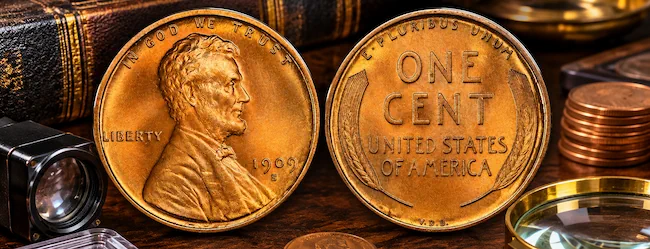
Most wheat cents are worth a few cents each, but a handful of key dates are genuinely scarce and still turn up in old accumulations. The Mint struck Lincoln wheat cents from 1909 through 1958, and families saved hundreds of millions of them after the Memorial reverse arrived in 1959. That's why our Wheat Penny Value Chart stays near the top of our traffic year after year.
Start by sorting the jar by date and mint mark. On wheat cents, the mint mark sits right below the date: "D" for Denver, "S" for San Francisco, and no mark for Philadelphia. Set aside anything from 1909 through 1933, since nearly all the key dates live there. After that, give the later coins a quick look for the error varieties below.
Key dates worth pulling from the jar
1909-S VDB
1914-D
1922 "No D"
1931-S
1955 Doubled Die Obverse
1943 Copper / 1944 Steel
One practical tip: never clean a wheat cent you think might be valuable. Cleaning leaves hairline scratches and an unnatural color that graders spot instantly, and it can cut a key date's value in half. For the full background on the wartime cents, our 1943 Steel Cents guide covers the steel issue and the bronze rarities in detail.
Kennedy Half Dollars: Silver Hiding in Plain Sight
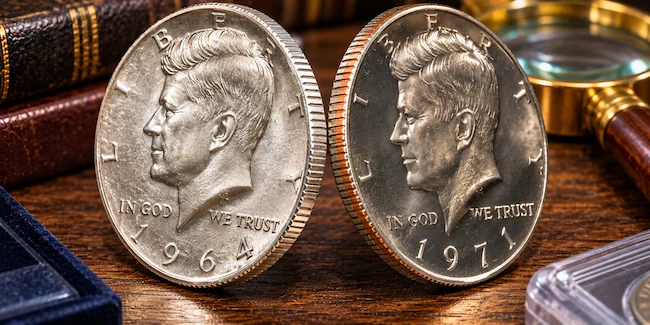
Every Kennedy half dated 1964 through 1970 contains silver, and that's why bank boxes of halves still reward the people who search them. Our Kennedy Half Dollar Value Chart had the highest engagement of any coin page last month. Banks still order boxes of half dollars, and coin roll hunters regularly find silver coins that slipped back into circulation. The Mint first struck the Kennedy half in 1964, just months after President Kennedy's assassination, and it changed the coin's metal content twice in its first eight years.
1964: 90% silver
Every 1964 Kennedy half, from Philadelphia or Denver, is 90% silver and contains about 0.3617 troy ounces of pure silver. As a result, it's worth several times face value at any recent silver price. Circulated 1964 halves trade close to melt, while sharp uncirculated and proof examples carry collector premiums. In particular, look for the 1964 "Accented Hair" proof in old proof sets; the Mint struck it early in the year before softening the design.
1965–1970: 40% silver
From 1965 through 1970, the Mint switched to a 40% silver composition with about 0.1479 troy ounces of silver per coin. These are easy to overlook because they look like later clad halves at a glance. Check the edge: 40% coins show a silvery-gray stripe rather than the bright copper band on 1971-and-later halves. The 1970-D deserves special mention, because the Mint issued it only in mint sets and never released it for circulation.
Modern Kennedy halves worth a second look
Most clad halves from 1971 onward are worth face value in circulated condition, but a few modern issues matter. For example, the 1974-D Doubled Die Obverse shows clear doubling on "IN GOD WE TRUST." The 1998-S Matte Finish half came only in the Kennedy Collector's Set, with roughly 62,000 made. Bicentennial halves dated 1776–1976 are common in clad, but the 40% silver versions from San Francisco sets carry a premium. Our full Half Dollar Coins guide covers every series from Kennedy back to the early busts.
Silver Dollars: Morgan, Peace & Eisenhower
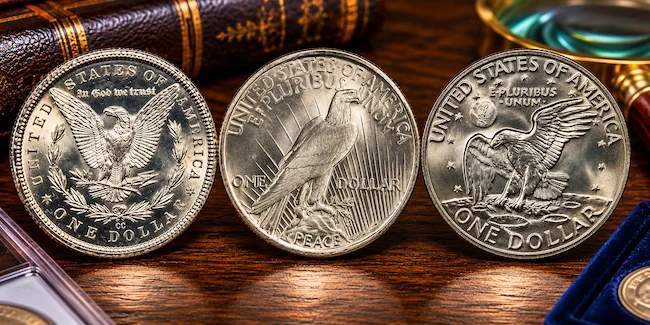
Every Morgan and Peace dollar holds about three-quarters of an ounce of silver, so even the most common date has a solid melt floor. Silver dollars are where history, bullion, and collector demand all meet, which is why our Silver Dollar Value Chart and Morgan Silver Dollars guide both landed in last month's top tier. Both series weigh 26.73 grams at 90% silver. The real question is which dates carry numismatic premiums on top of that.
For Morgans, the mint mark is on the reverse, just above the "DO" in "DOLLAR" and below the wreath. Carson City "CC" coins get the most attention because of their Old West history and lower mintages, but the true rarities come from all four mints. Eisenhower dollars tell a different story: circulating Ikes are copper-nickel clad, while the San Francisco collector issues were 40% silver.
Dates that separate a silver dollar from a rare one
1893-S Morgan
1889-CC Morgan
1895 Morgan
1921 High Relief Peace
1928 Peace
1972 Type 2 Ike
If you're working through a larger group of silver dollars, sort by series first, then by mint mark, then by condition. Common-date Morgans in circulated grades often sell at a modest premium over melt, while the same date in gem uncirculated can bring many times more. Our Eisenhower Dollar guide walks through Type 1 and Type 2 identification, and the broader Dollar Coins series guide covers everything from early Flowing Hair dollars to modern Sacagawea issues.
Error Coins: When the Mint Got It Wrong
Error coins are the one corner of the hobby where a coin from your own pocket change can be worth real money, because the value comes from how the Mint made the coin rather than its date. Three of our top twenty pages last month covered errors, including the Error Coins Value Guide and our complete guide to U.S. Mint mistakes.
The error types that actually sell
Doubled dies happen when the die itself picks up a doubled image during manufacture, so every coin it strikes shows doubling. The 1955 and 1972 Lincoln cents are the classic examples. Off-center strikes occur when the planchet doesn't seat properly, leaving part of the design missing; value climbs when the date still shows and the coin is 30–70% off-center. Wrong planchet errors, like a cent struck on a dime blank, are scarce and highly collectible. Die cracks and cuds are more common and usually carry smaller premiums.
Damage is not an error
This is the most common letdown I see. A coin that someone hammered, ran over, plated, or soaked in chemicals can look strange, but it isn't a Mint error and carries no premium. A good rule: a true error happened inside the Mint, before the coin ever left. If you're not sure what you have, our Error Coin Identifier walks through the most common types step by step. The U.S. Mint coin specifications also help you check whether a coin's weight and composition match what they should be.
Valuable Pocket Change: Coins Still in Circulation
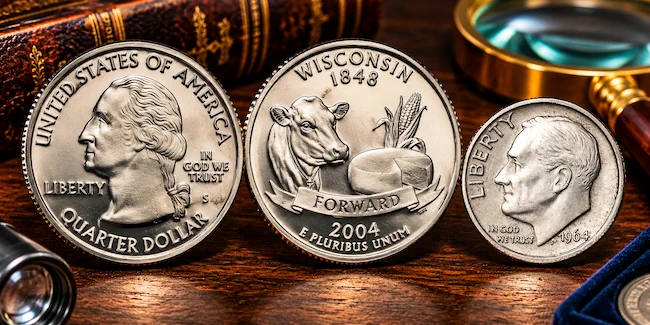
Silver coins, wartime nickels, and a steady trickle of modern errors still turn up in everyday change. Our Valuable Coins in Pocket Change guide is one of the most-read pages on the site, and it's easy to see why. It's the one part of the hobby that costs nothing to start. You don't need an inheritance or a bank box of halves, just the change already sitting in your pocket, car, or junk drawer.
Most of what you'll find is worth face value. Still, silver coins left circulation gradually rather than all at once, and the Mint has produced errors and low-mintage issues that ended up in cash registers. Collectors report finding these coins in change every year, which is what keeps people looking.
What still turns up in circulation
2004-D Wisconsin Extra Leaf
1942–1945 Silver War Nickels
1964-and-Earlier Silver Coins
1972 Doubled Die Cent
2019-W and 2020-W Quarters
2005-P "In God We Rust" Kansas
How to check your change quickly
You don't need to study every coin. Glance at the date and edge first: any dime, quarter, or half dated 1964 or earlier goes straight into the silver pile, and so does any Jefferson nickel dated 1942 through 1945 with a large mint mark over the dome. Then look for the specific designs above, especially Wisconsin quarters and W-mint-mark quarters.
Keep a cheap loupe nearby for doubled dates and lettering on cents. If a coin looks unusual but you can't match it to a known variety, compare it against our error guides before assuming it's valuable, because circulation damage fools a lot of people. Our Junk Silver Coins guide covers what to do once your silver pile starts to grow.
Quick Reference: Key Dates Covered in This Guide
Use this table to decide what deserves a closer look. Values are rough ranges for circulated examples unless noted, so always check a current price guide for your coin's exact grade.
| Coin | What to Check | Approx. Value | Shop |
|---|---|---|---|
| 1909-S VDB Lincoln Cent | S mint mark + VDB initials | $700+ | eBay → |
| 1914-D Lincoln Cent | D mint mark, no altered date | $150+ | eBay → |
| 1931-S Lincoln Cent | S mint mark | $100+ | eBay → |
| 1955 Doubled Die Lincoln Cent | Strong doubling on date | $1,000+ | eBay → |
| 1943 Steel Lincoln Cent | Magnetic, zinc-coated steel | Cents to a few dollars (common dates) | eBay → |
| 2004-D Wisconsin Extra Leaf Quarter | Extra leaf on corn stalk | $100+ | eBay → |
| 1942–1945 Silver War Nickel | Large mint mark above Monticello | Melt value | eBay → |
| 1964 Kennedy Half Dollar | 90% silver, solid edge | Melt + small premium | eBay → |
| 1970-D Kennedy Half Dollar | Mint-set-only 40% silver | Premium over melt | eBay → |
| 1998-S Matte Finish Kennedy Half | Matte surface, S mint mark | Low hundreds | eBay → |
| 1893-S Morgan Dollar | S mint mark on reverse | Thousands+ | eBay → |
| 1889-CC Morgan Dollar | CC mint mark on reverse | $1,000+ | eBay → |
| 1928 Peace Dollar | No mint mark (Philadelphia) | Several hundred | eBay → |
| 1972 Type 2 Eisenhower Dollar | Reverse Earth/island detail | Premium in MS-63+ | eBay → |
A Simple Routine for Sorting What You Have
Whether you're facing a single coffee can or a full estate, the process is the same. I use this routine myself, and I've been doing it since I joined the American Numismatic Association back in 2009.
Step 1: Separate by type and metal
Group cents, nickels, dimes, quarters, halves, and dollars. Pull every dime, quarter, and half dated 1964 or earlier into a silver pile, along with all Morgan and Peace dollars. That pile has guaranteed value no matter what.
Step 2: Sort by date and mint mark
Line coins up by date and note each mint mark. This is where key dates jump out. Compare against the relevant chart, starting with the wheat penny chart or silver dollar chart.
Step 3: Look for errors and varieties
Use a 5x to 10x loupe on the date, lettering, and rims. In particular, scan for doubling, missing design elements, and off-center strikes.
Step 4: Estimate grade honestly
Check the high points of the design for wear, and be conservative, because most people overgrade their own coins. Reference photos from PCGS Photograde keep you honest.
Step 5: Decide what deserves certification
Professional grading from PCGS or NGC costs money, so save it for coins where authentication or a higher grade clearly adds value: key dates, major errors, and high-grade examples. Common coins rarely justify the fee.
The Bottom Line on Old Coins Worth Money
The guides our readers relied on most this fall all point to the same lesson: value lives in the details. A mint mark, a doubled date, a silver edge, or an extra leaf on a state quarter can separate something ordinary from something worth real money. Most coins in an old jar won't make you rich. Even so, sorting them carefully almost always turns up a few worth keeping, and occasionally one worth a lot more.
Start with the silver, check the key dates, and lean on solid references before making any decisions. When you're ready to price a specific coin, head to our Coin Price Guide or plug it into What's My Coin Worth? for a fast estimate.
Ready to Price What You Found?
Pick up the Red Book for a trusted price reference you can keep next to your sorting trays, along with a loupe and a few coin holders to protect anything worth keeping.
Where to Buy Coins and Silver



Free Coin Tools

 '