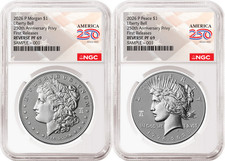
- 2026 Morgan and Peace Dollars carry a one-year-only "1776~2026" dual date and a Liberty Bell "250" privy mark
- Three finishes are being released across 2026: Reverse Proof, Enhanced Uncirculated, and standard Proof
- All 2026 issues strike at the Philadelphia Mint, carrying a "P" mint mark for the first time in the modern reverse proof run
- Each coin has a stated production limit of 250,000 pieces per finish per design
- Struck in .999 fine silver, a step up from the original 90% silver Morgan and Peace Dollars
If you've spent any time in a coin forum, a local club meeting, or your inbox this August, you already know what everyone's talking about: the 2026 Morgan and Peace Silver Dollars. The U.S. Mint's Semiquincentennial program has produced a lot of new coinage this year, but nothing has generated the kind of sustained buzz that these two dollar designs have. That's not surprising. Morgan and Peace Dollars are already two of the most collected series in American numismatics, and pairing them with a one-year-only 250th anniversary treatment was almost guaranteed to move the needle.
This guide walks through what's actually different about the 2026 coins, why collectors are paying close attention to mintage and finish, and how to think about adding them to a collection whether you're just starting out or you've been chasing Morgan Dollar VAM varieties for twenty years. For broader pricing context across the series, our coin price guide and Morgan Silver Dollar collecting hub are good companions to this article.




What Actually Makes the 2026 Coins Different
The Morgan and Peace Dollar designs themselves haven't changed. George T. Morgan's Liberty portrait and heraldic eagle still anchor the Morgan Dollar, and Anthony de Francisci's radiant-crown Liberty still fronts the Peace Dollar. What's new for 2026 is layered on top of those classic designs: a dual date reading "1776~2026" and a small Liberty Bell privy mark containing the numeral "250," both added to mark 250 years since the signing of the Declaration of Independence.
Privy marks are small design elements added to an otherwise standard coin to flag something special about that particular strike, and collectors tend to respond strongly to them because they create a genuinely limited, one-year window. Once 2026 ends, the dual date and privy mark disappear from future Morgan and Peace releases, which is part of why demand has stayed strong through the summer rather than tapering off after the initial release.
The other change worth noting is the mint mark. Recent modern Morgan and Peace Dollar reverse proof sets were struck at San Francisco. For 2026, the Mint moved that reverse proof production to Philadelphia, so collectors are seeing a "P" mint mark on coins that would normally carry an "S." For anyone building a mint-mark run of the modern series, that's a meaningful line item to track.
Three Finishes, Three Release Windows
The Mint didn't release these coins all at once. Instead, 2026 has unfolded as a staggered rollout across three distinct finishes, and each one has its own character.
The Reverse Proof versions came first, going on sale in early July with a household order limit for the opening 24 hours. Reverse proof coins flip the usual proof treatment: the background fields are frosted and the design elements are mirrored, which gives the Liberty Bell privy mark a bit more visual pop than it would have on a standard proof surface.
Next came the Enhanced Uncirculated coins in late August, which mark the first time this modern series has used an enhanced uncirculated finish at all. That finish blends polished and laser-frosted surfaces to sharpen contrast across the design, and it's being treated by a lot of collectors as the "sleeper" release of the three, since enhanced finishes are newer to the series and carry less collecting history to compare against.
The standard Proof coins are expected to close out the year as the final release in the sequence. Traditionally, proof issues in this series have been the most widely available of the finishes, so if you're prioritizing scarcity, the Reverse Proof and Enhanced Uncirculated releases are the ones drawing the most attention right now.


Why Collectors Are Racing on This One
A few things are stacking up to make 2026 feel different from a typical annual Morgan and Peace release. First, there's the one-year-only design element — once it's gone, it's gone, and that scarcity story is easy for even a casual collector to understand. Second, each finish carries a stated production limit per design, and once a limit is reached or a household ordering window closes, secondary market listings tend to carry a premium over the original Mint issue price.
Third, and maybe most importantly for beginners reading this: these coins sit at an accessible price point relative to a lot of "key date" numismatic material. You don't need a five-figure budget to participate in what's arguably the biggest collector story of the year. That's part of why threads about the 2026 Morgan and Peace Dollars have been just as active among newer collectors as among longtime club members. It's a rare topic that genuinely bridges both audiences.
That said, it's worth a note of caution here. Mint issue prices and secondary market premiums move quickly, and by the time you're reading this, the numbers you see quoted in a Facebook group or a YouTube video may already be stale. Rather than anchoring on a specific dollar figure, it's more useful to track sold listings and certified population reports directly through PCGS and NGC, since both services update population data as new submissions come in.
Grading and Value Considerations
Because these are modern Mint products purchased directly from the source, most 2026 Morgan and Peace Dollars start life in excellent condition. The real value differentiation happens at the certification stage. Coins graded PF70 or MS70 by PCGS or NGC — meaning flawless under magnification — typically command a premium over coins graded one point lower, and that gap tends to widen for the Reverse Proof and Enhanced Uncirculated finishes given their tighter mintages.
First Day of Issue and Early Release labels can add further premium for collectors who value that kind of provenance, though it's worth deciding early whether that matters to your own collecting goals versus simply owning the coin itself. If you're planning to submit coins for grading yourself rather than buying pre-certified examples, careful handling from the moment you open Mint packaging matters — a single fingerprint or contact mark on a modern proof surface can be the difference between a 70 and a 69 grade.
| 2026 Release | Finish | Mint Mark | Shop |
|---|---|---|---|
| Morgan Dollar | Reverse Proof | P | eBay → |
| Peace Dollar | Reverse Proof | P | eBay → |
| Morgan Dollar | Enhanced Uncirculated | P | eBay → |
| Peace Dollar | Enhanced Uncirculated | P | eBay → |
| Morgan & Peace Dollar | Proof (2-coin set, pending release) | P | eBay → |
How to Add These Coins to Your Collection
If you're new to the hobby, the simplest entry point is a single coin in the finish that appeals to you most, purchased either directly through the Mint while it remains available or through a reputable certified dealer once Mint inventory sells out. Don't feel pressure to chase all three finishes and both designs at once — plenty of experienced Morgan Dollar collectors are treating 2026 as a "pick one and hold" year rather than a full set completion year.
If you're a more experienced collector already working on a modern Morgan and Peace Dollar run going back to the series' 2021 relaunch, the mint-mark change to Philadelphia is the detail most worth building your 2026 acquisitions around. A complete mint-mark set for this one year will likely be harder to reassemble later than it is to build now, while all three finishes are still moving through the market.
Whichever path you take, buy from sellers who provide clear photos of the actual coin (not stock images), disclose the certification service and grade plainly, and — for raw, ungraded coins — describe handling history honestly. For high-value certified examples, verifying the certification number directly on the PCGS or NGC lookup tools before you buy takes two minutes and can save you from a costly mistake.
Ready to Start Your 2026 Set?
Browse current listings for the 2026 dual-date Morgan and Peace Dollars, all backed by eBay's Money Back Guarantee.
Shop on Amazon
As an eBay and Amazon Associate, FindRareCoins.com may earn a commission from qualifying purchases at no extra cost to you.
Related Guides
Morgan Silver Dollars
The full collecting hub for every Morgan Dollar year and mint mark.
Read the guide →What's My Coin Worth
A starting point for identifying and valuing any coin in your collection.
Read the guide →Silver Coin Melt Calculator
Check the melt value of any silver coin against live spot price.
Read the guide →Junk Silver Coins
A beginner-friendly look at buying silver coins for their metal content.
Read the guide →Frequently Asked Questions
What does the Liberty Bell "250" privy mark actually look like on the coin?
It's a small Liberty Bell design element with the numeral "250" incorporated into it, placed alongside the "1776~2026" dual date. It doesn't replace any part of the original Morgan or Peace Dollar design — it's added in addition to it, similar to how past commemorative privy marks have worked on other Mint products.
Are the 2026 Morgan and Peace Dollars made of the same silver content as the originals?
No. The original Morgan and Peace Dollars from 1878–1935 were struck in 90% silver. The modern 2026 releases are struck in .999 fine silver, which is a higher purity than the historic coins, though the coins are not intended as direct replicas — they're modern tribute issues using the classic designs.
Why did the reverse proof mint mark change from "S" to "P" in 2026?
The Mint moved 2026 reverse proof production to the Philadelphia Mint as part of the Semiquincentennial program, a shift from the San Francisco Mint used for recent reverse proof Morgan and Peace releases. It's the first time in the modern series that reverse proof coins carry a "P" mint mark.
Should I buy the Reverse Proof or the Enhanced Uncirculated finish first?
There's no universally correct answer — it depends on your collecting goals. The Reverse Proof was the first 2026 finish released and has more collecting history to reference. The Enhanced Uncirculated finish is newer to the series and appeals to collectors interested in owning a genuinely first-of-its-kind Mint product.
Do I need to get my 2026 Morgan and Peace Dollars certified by PCGS or NGC?
Certification isn't required to own or enjoy the coins, but it does matter if resale value or long-term investment potential is part of your goal. A PCGS or NGC certified grade, especially at the PF70 or MS70 level, gives buyers confidence in condition that a raw, uncertified coin can't offer on its own.
Will there be more privy mark releases after the Semiquincentennial year ends?
The Mint has not announced continued use of the Liberty Bell "250" privy mark beyond 2026, and the dual date "1776~2026" is specific to this anniversary year by design. Future Morgan and Peace Dollar releases would be expected to return to standard dating and design treatment, which is part of why 2026 is considered a one-year-only release.
 '
'