
United States Silver Dollars
Morgan • Peace • Seated Liberty • Early American Dollars
Two Centuries of American Silver
From the Coinage Act of 1792 to the Last Peace Dollar
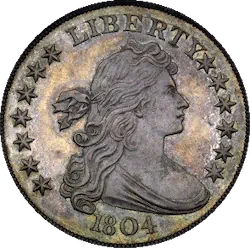
United States silver dollars have captivated collectors since the Coinage Act of 1792 authorized the new nation's first large silver coins. The early Flowing Hair and Draped Bust dollars — struck from 1794 through 1803 — laid the commercial and symbolic foundation of American coinage, establishing the dollar as the central unit of the nation's monetary system. These early issues, produced in modest quantities at the fledgling Philadelphia Mint, are among the most historically significant coins in American numismatics and command extraordinary prices when they appear at auction today.
Their successors — the Seated Liberty dollars of 1840–1873, the Morgan dollars of 1878–1921, and the Peace dollars of 1921–1935 — built on that foundation across nearly a century of American expansion, industrialization, and global conflict. The Morgan dollar became the most famous of all U.S. silver dollars, widely used across the American West and minted in massive quantities at five facilities. Its successor, the Peace dollar, commemorated the armistice ending World War I with a bold Art Deco design that remains one of the most artistically admired in American numismatic history. Together, these series define what collectors mean when they speak of classic American silver.
The U.S. Mint Facilities Behind Every Dollar
Philadelphia, Carson City, New Orleans, San Francisco & Denver
Understanding U.S. silver dollars — especially Morgans — begins with the mint facilities that produced them. Each location contributed uniquely to the nation's coinage history, producing coins with distinct mint marks that allow collectors to identify exactly where and when a piece was struck. The Philadelphia Mint, the nation's first and largest facility, served as the backbone of U.S. coin production from 1792 onward and struck the majority of all silver dollars produced over the series' lifetime. Philadelphia coins carry no mint mark, a convention that persisted for most of the 19th and early 20th centuries.
The branch mints tell equally compelling stories. The New Orleans Mint (O) struck both gold and silver from 1838 through 1909, producing some of the most elusive Morgan dollars in the series — particularly the 1895-O, most of whose mintage was melted. The San Francisco Mint (S) earned a well-deserved reputation for exceptional strike quality, and many of the finest-known Morgans in PCGS and NGC registries are S-mint coins. The Denver Mint (D) struck Morgans only in the final year of production, 1921. And the Charlotte Mint (C) — though it produced only gold, never silver dollars — rounds out the roster of historic pre-Civil War branch mints whose legacy shapes collector interest to this day.
The Carson City Mint — The Crown Jewel of CC Coins
Frontier Silver, the Comstock Lode & the Most Prized Mint Mark in Numismatics
Among all silver dollars, those bearing the CC mint mark from the Carson City Mint hold a special prestige that no other issue can match. Operated from 1870 to 1893 in Carson City, Nevada — just miles from the Comstock Lode silver deposits that were reshaping American wealth — the mint was established specifically to convert regional silver into coinage without the cost and delay of shipping raw metal east to Philadelphia. Its location at the heart of the frontier West gives every coin it struck a provenance unlike anything produced at the older established mints of the East Coast.
Carson City Morgan dollars were produced in relatively modest quantities compared to Philadelphia issues, and many circulated heavily in Nevada mining towns, saloons, and frontier commerce before being spent into near-oblivion. Few were saved by collectors at the time. The combination of lower original mintages, high circulation rates, and the powerful romance of the frontier West has made CC Morgans the most universally prized subset of the entire Morgan dollar series. Key dates — particularly the 1889-CC — command premiums at every grade level, and even common-date CC Morgans consistently bring multiples of their Philadelphia counterparts. PCGS and NGC certification is strongly recommended for any Carson City Morgan above circulated grades, where the premium is greatest and the stakes of accurate grading are highest.
U.S. Silver Dollar Mint Marks at a Glance
What Each Mark Means — and Why It Matters for Value
| Mint | Mark | Active for Silver Dollars | Collector Premium |
|---|---|---|---|
| Philadelphia | None (or P) | 1794–1935 | Standard — benchmark for series |
| Carson City | CC | 1870–1893 | Highest — frontier rarity premium |
| New Orleans | O | 1846–1904 | Moderate to high on key dates |
| San Francisco | S | 1859–1935 | High — quality strike reputation |
| Denver | D | 1921 only | Modest — final year only |
Major U.S. Silver Dollar Series
A Collector's Overview from the Earliest Issues to the Last Classic
Early Dollars (1794–1803)
Flowing Hair and Draped Bust issues — the foundational coins of American commerce, struck in tiny quantities from hand-cut dies.
Seated Liberty (1840–1873)
Christian Gobrecht's elegant seated figure — low mintages throughout, with many dates surviving in only handfuls of examples.
Morgan Dollar (1878–1921)
America's most collected coin series — five mints, dozens of key dates, VAM varieties, and the legendary Carson City issues.
Peace Dollar (1921–1935)
Anthony de Francisci's Art Deco masterpiece — 18 date-and-mint issues, with the 1928 standing apart as the supreme key date.
Trade Dollar (1873–1885)
Heavier than the standard dollar and struck for Asian commerce — with some of the rarest proof-only issues in American numismatics.
Carson City Issues
CC mint marks across Seated Liberty, Trade, and Morgan dollars — each one a tangible piece of American frontier history.
U.S. Silver Dollar Explorer
Browse by Series • Click Any Coin for Details & eBay Listings


Building a Silver Dollar Collection
Where to Start, How to Grade & What to Buy First
Building a silver dollar collection begins with understanding grading, because condition affects value in this series more dramatically than in almost any other area of U.S. numismatics. A common-date Morgan in Fine condition might bring $30 — its approximate silver melt value. The same date in MS65 might bring $500. The same date in MS67 might bring $5,000 or more. The large, flat surfaces of a silver dollar show every contact mark, every bag scratch, and every handling imperfection under magnification, making truly pristine gem examples genuinely scarce even for nominally common dates. PCGS and NGC certification provides trusted, third-party grade evaluations that protect buyers from overgraded raw coins — essential for any silver dollar purchase above $200.
New collectors often begin with common-date Morgan and Peace dollars in circulated condition — Beautiful Fine through Extremely Fine examples that present well without requiring significant investment. These coins offer immediate access to the series' history and artistry while building the collector's eye for quality. From that foundation, most collectors gradually target date-and-mint completeness, upgrading quality over time as budget and expertise grow. The perennial collector's advice applies directly here: buy the coin, not the holder. A common-date Morgan in a genuine MS65 with exceptional luster, strong strike, and clean surfaces is always worth more than a weakly struck, baggy MS65 with a premium label — learn to see the difference before spending serious money.
A Legacy Preserved Through Mint Marks
Reading History in the Small Letters Beneath the Eagle
The mint mark on a U.S. silver dollar is far more than a simple letter of origin — it is a window into the economic geography of an era. A CC on a Morgan dollar speaks to silver miners, frontier saloons, and the transcontinental railroad that connected Nevada's wealth to the nation's commerce. An O on a New Orleans Seated Liberty dollar invokes antebellum cotton commerce, the economic engine of the pre-Civil War South, and the interruption of that mint's operations during the conflict. An S on an 1859 Seated Liberty dollar places that coin in Gold Rush-era San Francisco, where the new branch mint was processing Pacific Coast silver and gold into federal currency for the first time.
These mint facilities collectively shaped the diversity and richness of America's silver dollar story. Their mint marks provide historical context that bare date information cannot convey — tracing a coin's origin to a specific place, a specific economic moment, and a specific chapter in the nation's history. Whether identifying a scarce Carson City Morgan, a high-quality San Francisco strike, or a rare New Orleans Seated Liberty, the mint mark transforms a coin from a piece of metal into a primary historical document. That is ultimately why U.S. silver dollars remain a cornerstone of American numismatics — not just for their silver content or their rarity, but for the irreplaceable stories they carry.
Shop U.S. Silver Dollars on eBay
Browse thousands of certified Morgan, Peace, Seated Liberty, and early dollars — key dates, CC mint marks, gem uncirculated examples, and affordable circulated coins from specialist dealers nationwide.
🛍️ Shop Silver Dollars on eBay 📚 Silver Dollar References on AmazonFindRareCoins.com participates in the eBay Partner Network and Amazon Associates program. Purchases made through links on this page may earn us a commission at no additional cost to you.
Frequently Asked Questions
How much silver is in a U.S. silver dollar?
All U.S. silver dollars from the Flowing Hair type of 1794 through the last Peace dollar of 1935 contain 0.7734 troy ounces of pure silver, struck in a coin that is 90% silver and 10% copper. At a silver spot price of $30 per troy ounce, the melt value of any 90% silver dollar is approximately $23. Trade dollars (1873–1885) are slightly heavier at 0.7876 troy ounces of pure silver — they were intentionally made heavier to compete with the Mexican peso in Asian trade. Modern clad dollar coins (Eisenhower, Sacagawea, Presidential) contain no silver unless they are specifically designated 40% silver or 90% silver proof issues sold directly by the U.S. Mint.
What silver dollars are worth the most money?
At the extreme high end, the 1794 Flowing Hair Dollar — the first U.S. silver dollar — is worth over $10 million in top condition. The 1804 Draped Bust Dollar (15 known, struck years after the date) ranges from $2 million to $10 million+. Among Morgan dollars, the 1893-S (100,000 mintage) and the 1895 proof-only (880 known) are the supreme rarities, with auction records well into six figures. Among Peace dollars, the 1928 key date is the most valuable regular issue. For Carson City Morgans, the 1889-CC stands alone — 350,000 struck but most circulated heavily, making high-grade examples exceptionally rare and valuable. Condition is equally critical: the same date in MS65 versus MS63 can differ in value by a factor of ten or more.
What makes Carson City Morgan dollars special?
The Carson City Mint operated from 1870 to 1893 in Carson City, Nevada — the capital of a state that existed primarily because of the Comstock Lode silver strike. The mint was built specifically to convert that regional silver into federal coinage, and the CC mint mark it placed on its coins has carried the romance of the American frontier ever since. Carson City Morgans were produced in lower quantities than Philadelphia issues and circulated heavily in the frontier economy, meaning fewer survived in high grades. The combination of lower original mintages, high circulation rates, and the powerful historical associations of the frontier West makes CC Morgans the most universally sought subset of the series — commanding premiums at every grade level and driving some of the most competitive bidding in U.S. numismatic auctions.
Is PCGS or NGC certification necessary for silver dollars?
For any silver dollar valued above $100–$200, PCGS or NGC certification is strongly recommended. The Morgan and Peace dollar series have been heavily targeted by cleaners and artificially toned coins for decades — a coin that looks beautiful to the naked eye may have been chemically treated or whizzed in ways that are immediately apparent to a trained grader but invisible to most buyers. Third-party grading provides an objective, guaranteed grade that significantly increases both buyer confidence and resale liquidity. For key dates like the 1893-S, 1889-CC, or 1895 proof, certification is not optional — it is essential. No serious collector or dealer will purchase a key-date Morgan in a raw, uncertified holder without a substantial discount reflecting the authentication risk.
What is the difference between a Morgan dollar and a Peace dollar?
The Morgan dollar (1878–1921) features George T. Morgan's left-facing Liberty portrait with a crowned eagle on the reverse. The Peace dollar (1921–1935) replaced it with Anthony de Francisci's right-facing Liberty wearing a radiant crown — modeled after his wife, Teresa — and a perched eagle holding an olive branch inscribed PEACE. Both coins contain identical silver content (0.7734 oz pure silver in 90% silver). The design change was driven by a post-World War I movement to replace the martial Morgan eagle with a more peaceful image reflecting the armistice. The Peace dollar's Art Deco aesthetics are widely considered more artistically sophisticated; collectors actively pursue both series, and many assemble complete sets of each.
How do I start collecting U.S. silver dollars?
The most practical starting point is to choose a series — Morgan dollars for maximum variety and depth, Peace dollars for a shorter, more completable set, or early dollars if budget and interest point toward American history before the Civil War. For Morgan or Peace dollars, begin with common dates in circulated condition: a VF or EF Morgan from a common date gives you a genuine 90% silver coin with real history at a modest price, while you learn to identify the series' characteristics. Invest in a copy of the Red Book (A Guide Book of United States Coins) for mintage figures and baseline values, and use the PCGS and NGC online price guides for current market data. When you're ready to spend more, buy certified — PCGS and NGC certification protects your investment and ensures the grade you're paying for is the grade you're getting.

Based on M.H. Bolender's 1950 classic, this comprehensive study sheds new light on one of the most treasured realms of American coin collecting
 '
'