United States Franklin Half Dollar
1948–1963 • 90% Silver • Full Bell Lines • Key Dates & Varieties
Franklin Half Dollar Key Dates & Values
Standard & Full Bell Lines Prices by Date
| Date & Mint | Mintage | VF-20 | MS-63 | MS-65 FBL | Shop |
|---|---|---|---|---|---|
| 1948 (P) — First Year | 3,006,814 | $23 | $55 | $2,500+ | eBay → |
| 1948-D | 4,028,600 | $23 | $45 | $750+ | eBay → |
| 1949 (P) | 5,614,000 | $23 | $60 | $4,000+ | eBay → |
| 1949-S — Key Date | 3,744,000 | $25 | $100 | $6,500+ | eBay → |
| 1950 (P) | 7,742,123 | $23 | $45 | $1,200+ | eBay → |
| 1953 (P) — Low Mintage | 2,796,920 | $23 | $50 | $5,000+ | eBay → |
| 1953-S — FBL King | 4,148,000 | $23 | $45 | $30,000+ | eBay → |
| 1955 (P) — Lowest Mintage | 2,498,181 | $25 | $80 | $75+ | eBay → |
| 1955 Bugs Bunny Variety | Subset | $50 | $200 | $3,000+ | eBay → |
| 1963 (P) — Last Year | 22,164,000 | $23 | $35 | $400+ | eBay → |
| Common Date (avg) | Various | $22 | $30 | $200–$800 | eBay → |
Half Dollar Explorer
Benjamin Franklin in Silver — America's Mid-Century Half Dollar
History, Design & Why Collectors Still Pursue the Series
The Franklin Half Dollar, minted from 1948 to 1963, replaced the beloved Walking Liberty design and honored one of America's most consequential Founding Fathers. Designed by Chief Engraver John R. Sinnock — whose JRS initials appear on the obverse truncation — the coin features Franklin's portrait derived from Jean-Antoine Houdon's famous bust, with the Liberty Bell on the reverse. A small eagle appears at lower right, added to satisfy a legal requirement that the reverse of half dollars bear an eagle. The result is a clean, classically composed coin that has only grown in collector appeal over the decades since its discontinuation. If you already have one in hand, our What's My Coin Worth guide walks you through identifying and valuing it.
The series ran for just 15 years before the Kennedy half dollar replaced it in 1964, following President Kennedy's assassination. That short production window, combined with the coin's 90% silver composition and the challenge of finding well-struck, high-grade examples, has made the Franklin half dollar a cornerstone of mid-20th century U.S. coin collecting. Every Franklin contains 0.3617 troy ounces of pure silver — providing a meaningful metal floor — while the numismatic premiums on Full Bell Lines examples and key dates can reach multiples of that base value.


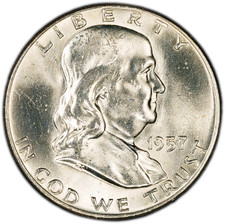


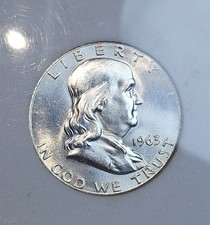


Franklin Half Dollar Collecting Categories
What Collectors Pursue in This Series
Full Bell Lines
Key Dates
Bugs Bunny Variety
Proof Issues
90% Silver
High-Grade Gems

Full Bell Lines: The Key Value Factor
Why FBL Designation Can Multiply a Coin's Value Ten Times Over
No single factor affects Franklin half dollar values more than the Full Bell Lines designation. The Liberty Bell on the reverse has two sets of horizontal lines near the bottom — and on well-struck coins, these lines are sharp, complete, and unbroken from edge to edge. PCGS and NGC award the "Full Bell Lines" (FBL) designation only to coins meeting this standard, and the price premium can be dramatic. Many common dates in MS-65 FBL sell for under $100, while the toughest dates run into the thousands — and the 1953-S sits in a class of its own.
The challenge is that the Franklin half dollar was notoriously poorly struck throughout the series. The design required extremely high striking pressure to bring up the bell lines fully, and most production coins show some degree of weakness in this area. The 1953-S is the classic example: plenty of Mint State coins survive, yet Full Bell Lines examples are rare, and gem pieces trade around $30,000. A PCGS MS-66 FBL set the date's record at $69,000 in a 2001 Bowers & Merena sale, and a PCGS MS-65+ FBL brought $38,000 at GreatCollections. By contrast, the low-mintage 1955-P is relatively easy to find with full lines.
The 1955 Bugs Bunny Franklin — America's Most Famous Half Dollar Variety
Die Clash, Buck Teeth & Why Collectors Love This Error
The 1955 Bugs Bunny Franklin is one of the most beloved die variety coins in American numismatics. The variety results from a die clash — when obverse and reverse dies strike each other without a planchet between them, leaving impressions of each die on the other. On the 1955 Bugs Bunny, the clash left raised lines across Franklin's upper lip that resemble buck teeth, earning the instantly recognizable nickname. A similar die clash variety exists on the 1956 Franklin.
The 1955 Bugs Bunny commands a significant premium over non-variety 1955 Franklins in all grades. Pairing the lowest-mintage Franklin date with the most famous Franklin variety makes the 1955 Bugs Bunny one of the most actively traded Franklin half dollars. It's accessible enough in lower grades to be within reach of most collectors while providing a genuine challenge in gem condition.
Collecting the Franklin Half Dollar
Where to Start & What to Focus On
The Franklin half dollar is an excellent series for intermediate collectors who want a completable silver set at a reasonable budget. A full date-and-mint set of circulated Franklins — all 35 date-and-mint combinations — can be assembled with patience for not much more than its silver value. The challenge accelerates dramatically when seeking uncirculated examples with Full Bell Lines, where dates like the 1949-S and especially the 1953-S become genuinely difficult and expensive.
Begin with a Dansco or Whitman Franklin half dollar album for the visual satisfaction of a complete set taking shape. Focus condition discipline from the start: a fully struck MS-63 FBL with good luster is almost always a better long-term purchase than a flatly struck MS-65 without FBL. PCGS and NGC population reports reveal which dates are truly scarce in FBL grades versus which are simply underrepresented on the market. Check current certified values before any significant purchase.
Where to Buy Franklin Half Dollars
Trusted Sources for FBL Examples, Key Dates & Silver Issues
JM Bullion
Money Metals Exchange
SD Bullion
Silver Gold Bull
eBay
Amazon
Related Half Dollar Guides

Frequently Asked Questions
How much is a Franklin half dollar worth?
What is Full Bell Lines (FBL) on a Franklin half dollar?
What is the rarest Franklin half dollar?
What is the Bugs Bunny Franklin half dollar?
Is a Franklin half dollar 90% silver?
How do I start collecting Franklin half dollars?

Guide Book of Franklin, Kennedy Half Dollars - Features hundreds of full-color photographs plus new research on 1964 Specimen Kennedy halves, Tomaska Signature Series, and other discoveries.
 '