Standing Liberty Quarters
1916–1930 • Type 1 Bare Breast • Type 2 Mailed Breast • Full Head Varieties
The History of Standing Liberty Quarters
The Standing Liberty quarter, struck from 1916 to 1930, emerged from a deliberate U.S. Mint initiative to modernize American coin design in the early 20th century, following the artistic success of the Saint-Gaudens double eagle and the Lincoln cent. Sculptor Hermon A. MacNeil won the commission with a design depicting Liberty standing in a gateway, holding a shield in her left hand (symbolizing preparedness) and an olive branch in her right (symbolizing peace) — an allegorical statement about America's posture on the eve of its entry into World War I. The design's artistic ambition marked a clear departure from the more restrained Barber quarter it replaced.
Struck at the Philadelphia, Denver, and San Francisco mints across its 15-year run, the Standing Liberty quarter is prized by collectors both for its artistic merit and for the genuine mid-series design revision that created two distinct types within the same 15-year series — a relatively unusual occurrence that adds meaningful collecting depth. The series ended in 1930 when the Washington quarter, introduced for the bicentennial of George Washington's birth, permanently replaced it, closing out one of the most artistically celebrated short runs in U.S. coin history.
Type 1 and Type 2 — A Mid-Series Redesign
The original 1916–1917 "Type 1" design depicted Liberty with her right breast bare — a design choice that, while consistent with classical allegorical art traditions, drew public criticism as the coin entered wider circulation. In mid-1917, the Mint modified the design, adding chainmail armor (a "mailed breast") to Liberty's exposed side — the "Type 2" variety that continued for the remainder of the series' run through 1930. This mid-year 1917 change means both types exist for that single year, creating a natural and popular type-collecting target.
Beyond the breast covering, the Type 2 redesign also added three stars beneath the eagle on the reverse and slightly repositioned the eagle itself — changes made partly for artistic refinement and partly, some numismatists believe, to improve the coin's ability to stack properly in mint bags, a practical production concern for a design that had proven challenging in its original form. Both types are actively collected, and Type 1 examples — with a much shorter two-year production window — generally command higher premiums than their more common Type 2 counterparts in equivalent grades.
Type 1 (1916–1917)
The original "bare breast" design — a much shorter production window that commands higher collector premiums.
Type 2 (1917–1930)
The redesigned "mailed breast" variety with added chainmail and reverse stars — the more common type overall.
1916 Key Date
Just 52,000 minted before the mid-year design change — the series' single most valuable regular-issue date.
Full Head Designation
A premium grading designation for coins with full detail on Liberty's helmet — dramatically increases value.
1918/17-S Overdate
A famous doubled-date error where a 1917 die was re-punched with 1918 — one of the series' most collected varieties.
Hermon MacNeil Design
Part of the early-20th-century artistic renaissance in U.S. coinage alongside the Saint-Gaudens double eagle and Buffalo nickel.
Key Dates and Notable Rarities
The 1916 quarter stands as the unquestioned key date of the entire series — with a mintage of just 52,000 coins struck in the closing weeks of the year before the mid-year design revision the following year, it is both scarce and highly sought, commanding strong four- and five-figure prices even in worn condition, with exceptional Full Head examples reaching well into six figures. This tiny mintage, combined with the coin's status as the series' true first-year issue, makes it the aspirational centerpiece of any complete Standing Liberty quarter collection.
Beyond 1916, the series contains several other genuinely important dates. The 1918/17-S overdate — created when a 1917-dated die was re-punched with 1918 digits, leaving remnants of both dates visible under magnification — is one of the most famous and actively collected overdate varieties in American numismatics. The 1919-D, 1919-S, 1921, and 1927-S are all low-mintage dates that command significant premiums, particularly in the Full Head condition that many advanced collectors specifically pursue. Collectors should note that Denver and San Francisco issues throughout the series are frequently found with weak strikes, making well-struck examples of any date genuinely scarce relative to total mintage figures.
Value Guide
Values shown are approximate market ranges for authentic examples in collectible condition. Full Head (FH) designated examples command substantial premiums over standard strikes in the same numeric grade.
| Date / Type | Mint | Mintage | Good–VG | Value Range | Shop |
|---|---|---|---|---|---|
| 1916 Type 1 KEY | Philadelphia | 52,000 | $4,000–$7,000 | $4,000–$100,000+ | eBay → |
| 1917 Type 1 | Philadelphia | 8,740,000 | $25–$50 | $25–$800+ | eBay → |
| 1917 Type 2 (first year) | Philadelphia | 13,880,000 | $20–$40 | $20–$600+ | eBay → |
| 1918/17-S Overdate KEY | San Francisco | Included in S mintage | $2,000–$4,000 | $2,000–$40,000+ | eBay → |
| 1919-D | Denver | 1,944,000 | $150–$300 | $150–$3,000+ | eBay → |
| 1921 | Philadelphia | 1,916,000 | $150–$300 | $150–$3,000+ | eBay → |
| 1927-S | San Francisco | 396,000 | $60–$150 | $60–$3,500+ | eBay → |
| 1930 (final year) | Philadelphia | 5,632,000 | $15–$25 | $15–$400+ | eBay → |

1917 S Type 1 Standing Liberty Quarter PCGS XF 40, Low Mintage, Semi-Key Date
USD $300.00

1917-D Type 1 Standing Liberty Quarter PCGS VG Details Cleaned, US Type Coin!
USD $80.00
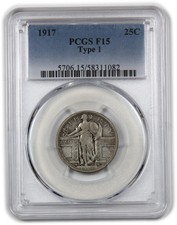
1917 P PCGS F15 Type 1 - Silver Standing Liberty Quarter 25C US Coin #62455B
USD $119.95

1930-P PCGS AU58 Standing Liberty Quarter | Blast White | 40th Anniversary Label
USD $299.00

1917-D Type 1 Standing Liberty Quarter, PCGS XF45 Nice And Original
USD $238.97

1917 P PCGS VF20 Type 1 - Silver Standing Liberty Quarter 25C US Coin #63495B
USD $149.95

1917-S 25C Type 1 Standing Liberty Quarter Dollar - PCGS VG10 0.9 Silver US Coin
USD $190.00

1917-D Standing Liberty Quarter PCGS VF-20 Type 1 CAC Green Bean | Red Core
USD $275.00

1917-P Type 1 Standing Liberty Quarter PCGS VF Details Nice Strike
USD $101.00
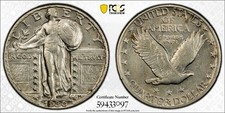
1830 STANDING LIBERTY QUARTER PCGS XF DET. (CLEANED)
USD $100.00
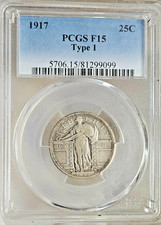
1917 TYPE 1 STANDING LIBERTY QUARTER PCGS F15 Philadelphia Mint Collector Coin
USD $136.91
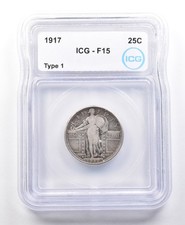
1917 Standing Liberty Quarter Type 1 F15 ICG *4129
USD $79.95
Full Head Grading — A Premium Designation
The "Full Head" (FH) designation is a specialized grading distinction unique to the Standing Liberty quarter series, applied by PCGS and NGC when Liberty's helmet shows complete, sharp detail — specifically three visible leaf-like elements and a clearly defined ear hole. Because so many Standing Liberty quarters were struck with weak dies or insufficient striking pressure (a chronic production issue throughout the series, particularly at the Denver and San Francisco mints), truly Full Head examples are dramatically scarcer than the coin's numeric grade alone would suggest, and command substantial premiums — often multiples of the value of a non-FH coin in the identical numeric grade.
This premium can be dramatic: a common date in MS-64 might trade for $150–$250 in standard condition but $1,000 or more with Full Head designation for the same date and grade. Serious Standing Liberty quarter collectors typically prioritize Full Head examples specifically, making FH certification one of the most valuable premium designations in the entire series and a critical factor to verify before any significant purchase.
Where to Buy Standing Liberty Quarters
eBay — Certified Standing Liberty Quarters
PCGS and NGC certified examples across all dates and mints. Filter by Full Head designation, date, and grade for the most reliable buying experience.
Shop Certified Coins →eBay — Full Head Examples
Search specifically for Full Head certified examples — the premium designation that dramatically increases value across the entire series.
Shop Full Head Coins →JM Bullion
Pre-1965 U.S. 90% silver quarters are widely available through bullion dealers as "junk silver" — a straightforward way to acquire common dates near melt value.
Shop JM Bullion →Kitco
Live silver spot pricing alongside pre-1965 90% silver U.S. coinage — useful for tracking melt value on common-date Standing Liberty quarters.
Shop Kitco →Money Metals Exchange
Competitive pricing on 90% silver U.S. coinage, including common-date Standing Liberty quarters sold by weight.
Shop Money Metals →SD Bullion
Transparent, spot-based pricing on pre-1965 90% silver quarters sold as junk silver by weight.
Shop SD Bullion →Silver Gold Bull
International bullion dealer carrying 90% silver U.S. coinage with competitive pricing and worldwide shipping options.
Shop Silver Gold Bull →FRC Coin Price Guide
Research certified values for Standing Liberty quarters and other U.S. denominations before you buy or sell.
View Price Guide →Related Coin Guides
Frequently Asked Questions
What is the most valuable Standing Liberty quarter?
The 1916 quarter is the undisputed key date of the series, with a mintage of just 52,000 coins struck in the final weeks of the year before the following year's design revision. Even heavily circulated examples command several thousand dollars, and Full Head examples in high mint state grades have sold for well over $100,000. The 1918/17-S overdate is the second most significant rarity, prized both for its scarcity and its status as a famous, actively collected overdate variety.
What does "Full Head" mean on a Standing Liberty quarter?
Full Head (FH) is a premium grading designation applied when Liberty's helmet on the obverse shows complete, sharp detail — specifically three distinct leaf-like elements and a clearly defined ear hole. Because striking quality varied significantly throughout the series' production, particularly at the Denver and San Francisco mints, truly Full Head examples are much scarcer than a coin's numeric grade alone suggests, and they command substantial price premiums — sometimes several times the value of a non-FH example in the same numeric grade.
Why does Liberty's design change partway through the series?
The original 1916–1917 "Type 1" design depicted Liberty with her right breast exposed, a classical allegorical convention that nonetheless drew public criticism once the coin entered wide circulation. In mid-1917, the Mint modified the design to add chainmail armor covering Liberty's exposed side — creating the "Type 2" variety that continued for the remainder of the series. Both types were struck in 1917, making that year's coins collectible by type as well as by date and mint.
Are Standing Liberty quarters made of silver?
Yes — Standing Liberty quarters are 90% silver and 10% copper, containing approximately 0.1808 troy ounces of pure silver, identical to the silver content of the Seated Liberty, Barber, and early Washington quarters. This gives common-date examples real bullion value beyond their numismatic worth, and worn low-grade examples of common dates are often sold as "junk silver" near melt value.
What is the 1918/17-S overdate and why is it valuable?
The 1918/17-S is a famous overdate variety created when a leftover 1917-dated working die was re-punched with 1918 digits at the San Francisco Mint, leaving faint remnants of the original 7 visible beneath the 8 under magnification. This kind of overdate error — caused by mint workers reusing dies to save on production costs — creates a genuinely distinct and highly collectible variety. Its combination of scarcity, visual verifiability, and historical interest makes it one of the most actively sought varieties in the entire Standing Liberty quarter series.
What is a good starting point for collecting this series?
Common-date Type 2 examples from the 1920s in circulated grades are widely available and affordable, typically $15–$40, making them an accessible entry point. Collectors interested in type collecting should pursue one Type 1 and one Type 2 example to represent the full design history. For those specifically interested in the Full Head designation, starting with a common date to understand what genuine Full Head detail looks like — before pursuing scarcer FH key dates — is a sensible approach given how much FH status affects value.
 Find Standing Liberty Quarters on eBayMoney Back Guarantee
FindRareCoins.com participates in the eBay Partner Network, Amazon Associates, and AWIN affiliate programs. Purchases made through links on this page may earn us a commission at no additional cost to you.
Comprehensive Reference – Covers Mercury dimes, Standing Liberty quarters, and Liberty Walking half dollars, minted from 1916 to 1947. Hundreds of high-resolution, full-color photographs
 '
'