Kennedy Half Dollars — Key Dates, Silver Content & Complete Collector Guide
1964–Present • 90% Silver • 40% Silver • Key Dates • Walking Liberty • Franklin
Kennedy Half Dollar — Key Dates & Values
| Date / Type | Silver | Notes | Value Range | Shop |
|---|---|---|---|---|
| 1964 (P & D) | 90% | First year — 273M struck; widely saved | $10–$5,000+ | eBay → |
| 1964 Accented Hair Proof | 90% | Early proof variety — heavier hair detail | $50–$2,000+ | eBay → |
| 1965–1969 | 40% | Transition era — 40% silver clad | $5–$50+ | eBay → |
| 1970-D | 40% | Mint sets only — never released for circulation | $50–$500+ | eBay → |
| 1976 Bicentennial | Clad | Independence Hall reverse; silver versions struck for sets | $2–$100+ | eBay → |
| 1998-S Matte Proof | 90% | Kennedy Collector's Set only — 62,000 struck | $100–$1,000+ | eBay → |
Kennedy Half Dollar Key Issues
1964 — First Year, 90% Silver
1970-D — Mint Set Key Date
1976 Bicentennial
1998-S Matte Proof
1965–1969 — 40% Silver Era
2014 50th Anniversary Gold
A Tribute to a Fallen Leader
The Kennedy Half Dollar was created in early 1964 as a national tribute to President John F. Kennedy following his assassination in November 1963. Americans sought a meaningful way to honor their fallen leader, and the US Mint responded swiftly by redesigning the half-dollar to preserve his legacy. The coin became an immediate symbol of unity and remembrance, reflecting the country's collective grief and admiration for Kennedy's leadership.
Chief Engraver Gilroy Roberts crafted the obverse portrait of Kennedy by adapting his own earlier sculptural work from the 1961 John F. Kennedy Presidential Inaugural Medal, while Frank Gasparro — then Assistant Engraver — designed the reverse by adapting his Presidential Seal design from that same 1961 medal. With the approval of Jacqueline Kennedy and President Lyndon B. Johnson, the design moved forward quickly and the coin entered circulation in March 1964. Public demand was overwhelming: people lined up at banks nationwide, often saving the coins as keepsakes rather than spending them. As a result, relatively few 1964 Kennedy Half Dollars saw regular circulation despite their large mintage.
Silver Content, Collectibility, and Lasting Appeal
The first-year issues were struck in 90% silver, followed by 40% silver coins from 1965 to 1970, before transitioning to copper-nickel in 1971. Silver-era coins remain especially popular with collectors, along with notable issues such as the 1970-D (available only in mint sets), the 1976 Bicentennial design, and the 1998-S Matte Proof. Affordable for beginners yet rich with historical depth and special varieties, the Kennedy Half Dollar continues to attract collectors who appreciate its symbolism, artistry, and enduring connection to a pivotal moment in American history.
Walking Liberty Half Dollars — America's Most Beautiful Half
1916-S — King of Walkers
1921 & 1921-D — Low Mintage Keys
1938-D — Late Series Key
Common Date Walking Liberty
Franklin Half Dollars — Key Issues
1904-S Barber Half — King of Barbers
Shop Kennedy & Silver Half Dollars on eBay
1964 first-year silver, 1970-D key date, Walking Liberty, Franklin FBL, and classic halves — certified and raw from specialist dealers nationwide.
Half Dollar References on AmazonAffiliate links — FindRareCoins.com may earn a commission when you purchase through links on this site.




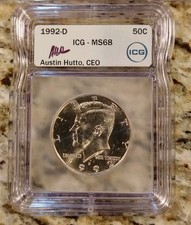
Obverse Design
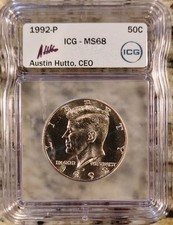
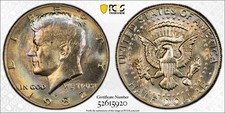
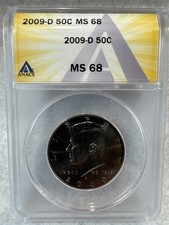
The obverse of the Kennedy Half Dollar features a dignified portrait of President John F. Kennedy, sculpted by Gilroy Roberts. Roberts adapted the profile from his own earlier work for the 1961 John F. Kennedy Presidential Inaugural Medal, revising it to serve as a lasting memorial. Its lifelike detail and emotional resonance made it a fitting tribute to the president and helped cement the coin's immediate popularity with the American public.
Reverse Design
The reverse, created by Frank Gasparro, showcases the Presidential Seal — an eagle clutching a shield, arrows, and an olive branch — symbolizing strength, unity, and the nation's commitment to peace. The banner bearing "E PLURIBUS UNUM" reinforces the idea of a diverse people united as one nation. Together, these elements form a powerful patriotic statement that complements the obverse portrait and reflects the values Kennedy championed.
Symbolism and National Meaning
Both sides of the Kennedy Half Dollar were designed to honor not only the man but also the ideals he represented. The combination of a commanding presidential portrait and the iconic national seal created a coin rich in symbolism, instantly recognizable and deeply meaningful to Americans. Even decades later, the design remains a lasting reminder of Kennedy's legacy and a cherished piece of modern US numismatic history. For related silver half dollar values, see our Kennedy Half Dollar Value Chart and the complete Coin Price Guide.
Where to Buy Kennedy & Silver Half Dollars
eBay — Kennedy Key Dates
eBay — Walking Liberty
JM Bullion
Kitco
Money Metals Exchange
SD Bullion
Silver Gold Bull
Amazon — Half Dollar References
FRC Kennedy Value Chart
 Find These Coins on eBay
Money Back Guarantee
Find These Coins on eBay
Money Back Guarantee
FindRareCoins.com participates in the eBay Partner Network, Amazon Associates, and AWIN affiliate programs. Purchases made through links on this page may earn us a commission at no additional cost to you.
Frequently Asked Questions
Are Kennedy half dollars made of silver?
Only the 1964 Kennedy half dollar is 90% silver (0.3617 oz per coin). From 1965 through 1970, Kennedy halves were struck in a 40% silver clad composition (0.1479 oz). From 1971 onward, circulation Kennedy halves are copper-nickel clad with no silver content. Special collector issues in 90% silver are produced annually by the US Mint for proof sets and special packages, but these are not released for circulation.
What is the most valuable Kennedy half dollar?
The 1998-S Matte Proof Kennedy is the single most valuable post-1964 Kennedy half dollar — available only in the 62,000 Kennedy Collector's Sets produced that year, worth $100–$1,000+ in top condition. Among circulated issues, the 1970-D (available only in mint sets, 2.15 million struck) is the key date, typically worth $50–$500 depending on condition. Gem MS-65 and MS-66 examples of early-1960s and 1964 Kennedy halves in top strike quality also command meaningful premiums.
What are Walking Liberty half dollars worth?
Most circulated Walking Liberty halves (1934–1947 common dates) are worth silver melt value plus a modest collector premium — typically $15–$25 in VF condition. Key dates command far more: the 1916-S starts at $100+ in Good and reaches $20,000 in MS-65; the 1921 and 1921-D start at $150–$200+ in Good. Strike quality matters enormously in this series — the Full Head designation (Liberty's head fully struck) adds significant premium on all dates. Use the Silver Melt Calculator for exact current melt values.
What is a Franklin half dollar Full Bell Lines (FBL)?
Full Bell Lines is a PCGS/NGC designation applied to Franklin half dollars that show complete, unbroken horizontal lines across the lower portion of the Liberty Bell on the reverse. Because the bell's high-relief design was difficult to strike fully, most Franklin halves show weak or incomplete lines in this area. FBL coins — indicating a fully struck reverse — command substantial premiums: a common-date Franklin in MS-65 might be worth $50, but the same coin in MS-65 FBL can be worth $500 or more. The 1949-S, 1953, and 1955 are especially prized in FBL condition.
What is the 1964 Kennedy Accented Hair variety?
The 1964 Accented Hair is a proof variety from early in the year's production — the dies used to strike it show more pronounced, deeply sculpted detail in Kennedy's hair than later proof dies. When Jacqueline Kennedy reviewed the design, she reportedly requested a change to make the hair less stylized, resulting in the revised "regular" proof die. The Accented Hair variety is noticeably scarcer than the standard 1964 proof and trades for a meaningful premium — typically $50–$2,000+ depending on grade, compared to $15–$50 for a standard 1964 proof Kennedy.
Is it worth collecting Kennedy half dollars from circulation?
Kennedy halves dated 1971 and later in circulation are copper-nickel clad and worth face value. Occasionally 40% silver halves from 1965–1970 still surface in circulation change — these are worth $5–$15 in silver content and are worth setting aside. Pre-1971 Kennedy halves are rarely found in circulation today. For building a collection, the most efficient approach is to purchase directly from dealers, coin shows, or eBay where specific dates and grades are available rather than searching through rolls hoping to find silver issues.
The 1964 Kennedy half dollar remains one of the most recognized and widely collected coins in the United States, and it continues to attract collectors, silver stackers, and everyday people who discover these coins.

 '
'