Seated Liberty Half Dollars
1839–1891 • No Motto • With Motto • Arrows & Rays Varieties
The History of Seated Liberty Half Dollars
The Seated Liberty half dollar, struck from 1839 to 1891, represents one of the longest-running designs in U.S. coinage history — over five decades of continuous production spanning the run-up to the Civil War, the war itself, and the Reconstruction era that followed. Designed by Christian Gobrecht, the design shows Liberty seated on a rock, holding a liberty pole topped with a Phrygian cap in one hand and a shield inscribed "LIBERTY" in the other — a design so successful it was also used across the dime, quarter, and dollar denominations of the same era, creating a unified family of "Seated Liberty" coinage that dominated mid-19th-century American silver.
Struck at the Philadelphia, New Orleans, and San Francisco mints, Seated Liberty half dollars document the westward expansion of American minting capacity during a pivotal period of national growth. The series also captures the young nation's monetary turbulence — the coin's design and metal content changed multiple times in response to bullion price fluctuations, foreign coin melting incentives, and the fiscal pressures of the Civil War, making it a genuinely fascinating series for collectors interested in the intersection of coin design and American economic history.
Major Design Varieties
Seated Liberty half dollars are divided into several major type varieties, each reflecting a specific design or composition change. The earliest issues (1839–1853) are known as "No Drapery" and "No Motto" types — the original Gobrecht design without the small drapery fold added at Liberty's elbow in 1840, and without any reference to the national motto, which had not yet been added to circulating coinage. In 1853, in response to rising silver bullion prices that threatened to make melting more profitable than circulating the coins, the Mint reduced the half dollar's weight and added arrows beside the date along with rays around the eagle on the reverse — the short-lived "Arrows and Rays" type, struck for only one year before the rays were dropped (Arrows only, 1854–1855).
The arrows were removed entirely in 1856, and the design continued as the standard "No Motto" type until 1866, when "IN GOD WE TRUST" was added above the eagle on the reverse — a direct response to increased religious sentiment during and after the Civil War. A final weight-related arrows variety appeared briefly in 1873–1874, again responding to bullion price and coinage-standard adjustments under the Coinage Act of 1873. Collectors often pursue Seated Liberty half dollars as a type set — one representative example of each major variety — which provides a manageable and historically rich alternative to attempting a full date-and-mintmark run.
No Drapery (1839)
The original Gobrecht design's first year — before the small drapery fold was added at Liberty's elbow.
No Motto (1839–1866)
The long-running standard type before "IN GOD WE TRUST" was added — the most common Seated Liberty type.
Arrows & Rays (1853)
A one-year-only type responding to rising silver prices — reduced weight, arrows at date, rays on reverse.
Arrows Only (1854–1855)
Rays removed after just one year, arrows retained — a brief transitional variety.
With Motto (1866–1891)
"IN GOD WE TRUST" added above the eagle — a Civil War-era response added to the reverse design.
Arrows (1873–1874)
A second brief arrows variety tied to the Coinage Act of 1873's weight standard adjustments.
Key Dates and Notable Rarities
The Seated Liberty half dollar series contains several genuinely important key dates that reward careful study. The 1846-O Tall Date is a significant condition rarity within an otherwise common date, distinguished by its taller numeral punches — a variety many collectors overlook without careful comparison to reference images. The 1855-S, struck at the fledgling San Francisco Mint during its first year of half dollar production, has a notably low mintage and is scarce in all grades, particularly problematic to find with original surfaces given how heavily the coin circulated on the West Coast during the Gold Rush era.
The 1878-S stands as the single most significant key date in the entire series — an extremely low mintage of just 12,000 coins makes it a genuine condition rarity in any grade, commanding strong four- and five-figure prices even in heavily circulated condition. Proof-only issues from certain years, along with the low-mintage 1870-CC (the first Carson City half dollar, a coin highly sought by both Seated Liberty specialists and Carson City mint collectors), round out the series' most important rarities. For collectors building a complete date-and-mintmark set, these key dates represent the major financial and search-time investment within an otherwise achievable series.
Value Guide
Values shown are approximate market ranges for authentic examples in collectible condition. Silver melt value provides a floor for common dates; key dates and better grades command significant premiums above bullion value.
| Date / Type | Mint | Mintage | Good–VG | Value Range | Shop |
|---|---|---|---|---|---|
| 1839 No Drapery | Philadelphia | ~30,000 | $150–$300 | $150–$3,000+ | eBay → |
| 1846-O Tall Date | New Orleans | Included in O mintage | $100–$200 | $100–$1,500+ | eBay → |
| 1853 Arrows & Rays | Philadelphia | 3,532,708 | $75–$150 | $75–$1,200+ | eBay → |
| 1855-S KEY | San Francisco | 129,950 | $400–$900 | $400–$8,000+ | eBay → |
| 1866 With Motto (first year) | Philadelphia | 745,625 | $100–$200 | $100–$1,500+ | eBay → |
| 1870-CC KEY | Carson City | 54,617 | $2,000–$5,000 | $2,000–$30,000+ | eBay → |
| 1878-S KEY | San Francisco | 12,000 | $5,000–$15,000 | $5,000–$50,000+ | eBay → |
| 1891 (final year) | Philadelphia | 200,600 | $100–$200 | $100–$1,200+ | eBay → |


Grading Seated Liberty Half Dollars
Grading Seated Liberty half dollars follows standard Sheldon-scale conventions, with particular attention to the high points most vulnerable to wear: Liberty's head and knee on the obverse, and the eagle's breast and wing tips on the reverse. Because the series was struck across five decades with varying die quality and mint conditions, strike quality varies considerably by date and mint — New Orleans and San Francisco issues in particular are sometimes found with weaker strikes than their Philadelphia counterparts, which collectors should factor into their grading expectations rather than assuming a weak strike indicates excessive wear.
PCGS and NGC both grade Seated Liberty half dollars, and certification is strongly recommended for any coin above $200–$300, given both the series' age and the meaningful value differences between adjacent grades. Original, unmolested surfaces are particularly prized — many 19th-century silver coins have been cleaned or dipped over the decades, which reduces both grade and value even when the underlying wear is minimal. Collectors should specifically seek out coins with original toning and surfaces rather than assuming a bright, shiny appearance indicates higher quality.
Where to Buy Seated Liberty Half Dollars
eBay — Certified Seated Liberty Half Dollars
PCGS and NGC certified examples across all major varieties and mints. Filter by date, mint mark, and grade for the most reliable buying experience.
Shop Certified Coins →eBay — Key Dates
Search specifically for the 1878-S, 1870-CC, and 1855-S key dates from specialist dealers with strong return policies.
Shop Key Dates →JM Bullion
Pre-1892 U.S. 90% silver half dollars are widely available through bullion dealers as "junk silver" — a straightforward way to acquire common dates near melt value.
Shop JM Bullion →Kitco
Live silver spot pricing alongside pre-1965 90% silver U.S. coinage — useful for tracking melt value on common-date Seated Liberty halves.
Shop Kitco →Money Metals Exchange
Competitive pricing on 90% silver U.S. coinage, including common-date Seated Liberty half dollars sold by weight.
Shop Money Metals →SD Bullion
Transparent, spot-based pricing on pre-1892 90% silver half dollars sold as junk silver by weight.
Shop SD Bullion →Silver Gold Bull
International bullion dealer carrying 90% silver U.S. coinage with competitive pricing and worldwide shipping options.
Shop Silver Gold Bull →FRC Coin Price Guide
Research certified values for Seated Liberty half dollars and other U.S. denominations before you buy or sell.
View Price Guide →Related Coin Guides
Frequently Asked Questions
What is the most valuable Seated Liberty half dollar?
The 1878-S is the most valuable regular-issue Seated Liberty half dollar, with a mintage of just 12,000 coins. Even heavily circulated examples command several thousand dollars, and problem-free coins in higher grades can reach $50,000 or more. The 1870-CC, the first Carson City half dollar, is similarly significant and highly sought by both Seated Liberty specialists and Carson City mint collectors. Rare proof issues and pattern coins from certain years can exceed both of these in exceptional condition.
Are Seated Liberty half dollars made of silver?
Yes — Seated Liberty half dollars are 90% silver and 10% copper, containing approximately 0.3617 troy ounces of pure silver. This means common-date examples carry meaningful bullion value beyond their numismatic worth, and worn, low-grade examples of common dates are often sold as "junk silver" near their melt value. Key dates and higher-grade examples, however, carry numismatic premiums well above bullion value.
What is the difference between "No Motto" and "With Motto" Seated Liberty half dollars?
No Motto half dollars (1839–1866) lack any religious inscription and represent the original design. With Motto half dollars (1866–1891) include "IN GOD WE TRUST" added above the eagle on the reverse, a change made in response to increased religious sentiment during and after the Civil War. This distinction is one of the primary type-collecting categories within the series, and both types are actively pursued by collectors building a complete Seated Liberty type set.
Why do some Seated Liberty half dollars have arrows next to the date?
Arrows beside the date indicate a weight reduction, made in response to rising silver bullion prices that threatened to make melting coins more profitable than using them in commerce. This occurred in two periods: 1853–1855 (the "Arrows and Rays" and "Arrows Only" varieties) and again in 1873–1874, following adjustments made under the Coinage Act of 1873. These arrow varieties are collected as distinct sub-types within the broader Seated Liberty series.
How do I know if my Seated Liberty half dollar has been cleaned?
Cleaned coins typically show unnaturally bright, shiny surfaces with fine hairline scratches visible under magnification, often combined with a flat, lifeless luster compared to an originally toned coin. Original surfaces usually display natural, uneven toning that has developed over decades — grayish, golden, or iridescent hues depending on storage conditions. Cleaning significantly reduces both the technical grade and market value of a coin, even when the underlying wear is minimal, which is why PCGS and NGC certification (which identifies cleaning) is valuable for any coin you're considering as a serious purchase.
What is a good starting point for collecting this series?
Building a type set — one representative example of each major design variety (No Drapery, No Motto, Arrows and Rays, Arrows Only, With Motto, and the 1873–1874 Arrows) — is a popular and achievable starting goal that captures the series' full design history without requiring a complete date-and-mintmark run. Common-date No Motto and With Motto examples in circulated grades are widely available and affordable, typically $75–$150, making this an accessible entry point before pursuing the series' more challenging key dates.
 Find Seated Liberty Half Dollars on eBayMoney Back Guarantee
FindRareCoins.com participates in the eBay Partner Network, Amazon Associates, and AWIN affiliate programs. Purchases made through links on this page may earn us a commission at no additional cost to you.
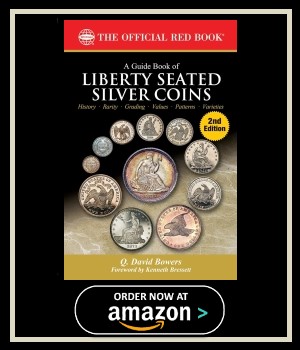
A Guide Book of Liberty Seated Coins. Covers all Liberty Seated denominations (half dimes through trade dollars) minted 1836–1891 Rretail pricing, auction records, rarity ratings, and certified population data to guide collectors and investors.
 '
'