Washington Quarters — Key Dates, Silver Content & Complete Collector Guide
1932–Present • Silver & Clad • State Quarters • The 1932-D Key Date
Washington Quarter Value Guide
Key Dates and Typical Values by Era
| Date / Era | Mintage | Good (G-4) | Fine (F-12) | VF-20 | MS-63+ |
|---|---|---|---|---|---|
| 1932-D — Key Date | 436,800 | $125+ | $250+ | $500+ | $3,000 – $143,000+ |
| 1932-S — Key Date | 408,000 | $150+ | $300+ | $500+ | $2,000 – $30,000+ |
| 1936-D | 5,374,000 | $8 | $20 | $60 | $500+ |
| 1940-S | 1,700,000 | $5 | $8 | $15 | $150+ |
| Common Silver (1932–1964) | Varies | $4 | $5 | $8 | $25+ |
| 1965–1998 Clad | Varies | Face value | Face value | $0.50 | $3+ |
| State Quarters (1999–2008) | Varies | Face value | Face value | $0.50 | $5+ |
| America the Beautiful (2010–2021) | Varies | Face value | Face value | $0.50 | $3+ |
Origins of the Washington Quarter
The Washington Quarter debuted in 1932 to commemorate the bicentennial of George Washington's birth, replacing the Standing Liberty design that had run since 1916. Sculptor John Flanagan's design — a left-facing profile of Washington on the obverse and a heraldic eagle with arrows and an olive branch on the reverse — was originally conceived as a one-year commemorative issue. Its reception was strong enough, however, that the Mint made it the permanent circulating quarter design starting in 1934, a decision that has now held for over 90 years and made it, in modified form, the longest-running quarter design in American history.
The Mint struck no quarters at all in 1933, at any facility — a genuine production gap in an otherwise continuous run from 1934 onward, and worth knowing since any coin claiming to be a 1933 Washington Quarter would be a fabrication. Depression-era economics also explain why the series' two key dates both come from its very first year: 1932 demand from the Denver and San Francisco mints was so limited that the Treasury only kept striking coins there because collectors kept placing small orders, and mintages at both branch mints ended up dramatically lower than Philadelphia's.
The Silver Era (1932–1964)
From the series' 1932 debut through 1964, Washington Quarters were struck in 90% silver and 10% copper, giving each coin 0.1808 troy ounces of pure silver — the same standard used across the silver quarter denomination since the Seated Liberty series in 1838. This 33-year silver run includes the vast majority of the series' meaningful collector value: both key dates (1932-D and 1932-S), several genuine semi-keys (1936-D, 1940-S), and a handful of well-documented doubled die varieties from the 1930s.
Mintages climbed steadily through the era as the U.S. economy recovered from the Depression and then expanded rapidly during and after World War II, meaning most dates from the 1940s and 1950s are common and affordable even in high grade. The 1964 date, the final year of 90% silver production, saw an enormous mintage as the Mint rushed to strike enough silver coinage before the transition to clad composition — making 1964 quarters widely available today despite marking the true end of an era.
The 1965 Clad Transition
Rising silver prices in the early 1960s created a genuine risk that circulating silver coins would be melted for their metal value faster than the Mint could replace them — a real threat to the nation's coin supply. Congress responded with the Coinage Act of 1965, which eliminated silver from the quarter (and dime) entirely, replacing it with a copper-nickel clad "sandwich" composition: outer layers of 75% copper / 25% nickel bonded to a pure copper core. This composition, giving the coin's edge its distinctive copper stripe, remains the standard for circulating U.S. quarters to this day.
This transition means date recognition alone tells you a Washington Quarter's baseline bullion status: any quarter dated 1964 or earlier is 90% silver and carries real melt value; any quarter dated 1965 or later is silver-free clad composition worth face value unless it carries a numismatic premium. Special silver proof versions of some modern quarters have been struck for collectors since 1992, but these are clearly marked and sold separately from circulating coinage.
Modern Commemorative Programs
After nearly seven decades of an unchanging reverse design, the Washington Quarter entered its most design-diverse era in 1999 with the 50 State Quarters program — releasing five new reverse designs per year, one per state, in the order each joined the Union, through 2008. The program was wildly popular, drawing tens of millions of casual and new collectors into the hobby and remaining one of the most successful commemorative coin programs in U.S. Mint history. It was followed by the D.C. and U.S. Territories quarters (2009), then the America the Beautiful Quarters program (2010–2021), which featured a national park or historic site from each state and territory across 56 designs.
Most recently, the American Women Quarters program (2022–2025) has honored notable American women on the reverse while retaining Washington's portrait on the obverse — the first Washington Quarter reverse to feature a subject other than the eagle since 1932's introduction. All of these modern programs are struck in standard clad composition for circulation, with limited silver proof versions available separately for collectors. While individual modern quarters are generally worth face value, complete sets in original packaging and any genuine mint errors from these high-volume programs can carry meaningful collector premiums.
Key Dates and Major Rarities
1932-D
1932-S
1936-D
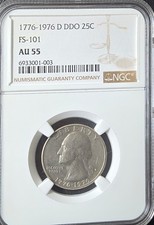
1934 & 1937 Doubled Die Obverse
1950-D/S Overdate
1964 — Last Silver Year
Shop Washington Quarters on eBay
Browse common silver dates to certified key dates including the 1932-D and 1932-S, plus State Quarters and modern commemorative issues.
Washington Quarter References on Amazon

Where to Buy Washington Quarters
These are the marketplaces and resources used by serious Washington Quarter collectors for buying and research.
eBay
eBay — Key Dates
JM Bullion
Kitco
Money Metals Exchange
SD Bullion
Silver Gold Bull
FRC Coin Price Guide
Related Coin Guides
 Find These Coins on eBayMoney Back Guarantee
FindRareCoins.com participates in the eBay Partner Network and Amazon Associates program. Purchases made through links on this page may earn us a commission at no additional cost to you.
Frequently Asked Questions
What is the most valuable Washington Quarter?
The 1932-D is considered the key date of the entire series — with 436,800 struck at Denver, it has the lowest Mint State population of any Washington Quarter, and a single finest-known PCGS MS66 example sold for $143,000 in 2008. The 1932-S, with a technically lower raw mintage of 408,000, is the other undisputed key date, though it's slightly more available than the 1932-D in higher grades since more examples were saved by West Coast collectors at the time.
Why does the 1932-S have a lower mintage than the 1932-D but the 1932-D is considered rarer?
Mintage figures only tell part of the story — survivorship matters just as much. Contemporary collectors in 1932 saved 1932-S quarters at a somewhat higher rate than 1932-D examples, meaning that despite the 1932-D's higher original mintage, fewer high-grade examples survive today. The 1932-D has the lowest Mint State population of any date in the entire series, which is why numismatists consistently describe it as the rarer of the two key dates in practical collecting terms, even though the raw production numbers say otherwise.
How can I tell if my Washington Quarter is silver?
The date tells you almost everything you need to know. Any Washington Quarter dated 1964 or earlier is 90% silver (0.1808 troy ounces per coin). Any quarter dated 1965 or later — including every State Quarter, America the Beautiful Quarter, and American Women Quarter — is copper-nickel clad and contains no silver, unless it's a specially marked silver proof collector issue sold separately since 1992. Clad quarters also show a visible copper stripe on the edge, while silver quarters have a solid silver-colored edge.
Was there a 1933 Washington Quarter?
No. The U.S. Mint struck no quarters at all in 1933, at any of its facilities — a genuine one-year production gap in an otherwise continuous run from 1934 onward. Any coin claiming to be a 1933 Washington Quarter is either a misread date on a genuine coin from another year or an outright fabrication, and should be treated with immediate skepticism.
Are State Quarters worth anything?
Most circulated State Quarters are worth exactly face value — 25 cents — since the program struck billions of coins across all 50 designs. Uncirculated examples in original Mint packaging, complete sets, and genuine mint errors (particularly the well-documented 2004-D Wisconsin "Extra Leaf" varieties) can carry real collector premiums, sometimes into the hundreds of dollars for the scarcest error varieties. As with any modern high-mintage series, condition and genuine rarity — not simply age — drive value.
What is a good entry point for collecting Washington Quarters?
Common-date silver Washington Quarters from the 1940s and 1950s in Fine to Very Fine condition offer an accessible entry point — typically available near silver melt value plus a modest premium. Building a complete date-and-mint set from 1934 (the first year after the 1932 debut and 1933 gap) through 1964 is an achievable goal for most collectors, with the 1932-D and 1932-S standing as the primary financial milestones. State Quarters and America the Beautiful Quarters also remain a popular, essentially free entry point since most can be found directly in circulation.
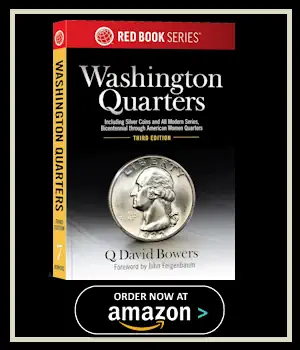
Definitive Reference – Expanded 3rd edition delivers a comprehensive history of Washington quarters from their 1932 debut to today’s modern programs.
 '
'