
United States Large Cent
America's First Coin • A Public Scandal • 64 Years of the Nation's Everyday Penny
Large Cent Value Guide
Key Dates and Typical Values Across the Series
| Date / Type | Mintage | Circulated | High Grade |
|---|---|---|---|
| 1793 Chain Cent (AMERI. & AMERICA) | 36,103 | $15,000+ | $500,000 – $1.5M+ |
| 1793 Wreath Cent | ~63,353 | $3,000+ | $50,000+ |
| 1793–1796 Liberty Cap (common dates) | Varies | $300 | $5,000+ |
| 1796–1807 Draped Bust (common dates) | Varies | $60 | $1,500+ |
| 1799 — Key Date | Reported 904,585 (mostly 1798 dies) | $1,000+ | $14,878 avg – $977,500+ |
| 1804 — Second Rarity | ~756 known survivors | $1,200+ | $50,000+ |
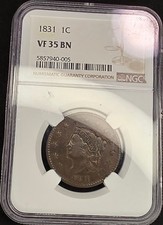
| 1808–1839 Classic & Coronet Head (common) | Varies | $25 | $500+ |
| 1839–1857 Braided Hair (common, last era) | Varies | $15 | $300+ |
The 1793 Chain Cent — America's First Coin, and Its First Scandal
Struck between March 1 and March 12, 1793, the Chain Cent was the very first coin produced by the United States Mint for public circulation, and the first coin struck inside the newly built Philadelphia Mint building. Henry Voigt, the Mint's first Chief Coiner, designed the coin, drawing partial inspiration from the Libertas Americana medal by French engraver Augustin Dupré. The obverse showed Liberty with flowing hair; the reverse displayed a chain of 15 links — one for each state then in the Union — meant to represent the unbreakable unity of the nation.
The public reaction was swift and brutal. The Boston Argus wrote on March 26, 1793 that "the chain on the reverse is but a bad omen for Liberty, and Liberty herself appears to be in a fright" — a double-barreled criticism aimed at both the chain, which many Americans interpreted as an unsettling symbol of bondage rather than unity, and at Liberty's disheveled, wide-eyed portrait, widely attributed to Voigt's inexperience as an engraver. Facing public outcry so soon after a revolution fought in the name of liberty, the Mint scrapped the design entirely within weeks, replacing it with a gentler wreath motif for the remainder of 1793. Of the original 36,103 struck, only a few thousand are believed to survive today, and the coin remains one of the most historically significant — and expensive — one-year type coins in all of American numismatics, with top examples having sold for well over $1 million at auction.






64 Years of Design Evolution
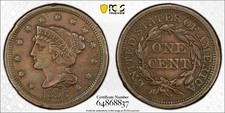
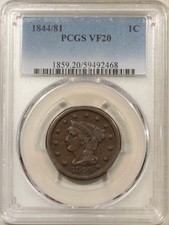
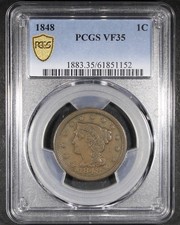
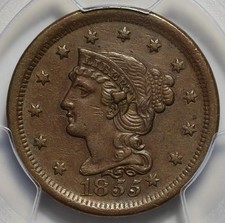
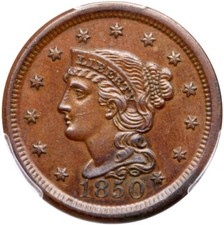
After the brief, controversial Chain Cent, the Large Cent went through six major design types across its 64-year production run. The Wreath Cent (1793) replaced the chain with a simple wreath reverse; the Liberty Cap (1793–1796) added a Phrygian cap to Liberty's portrait; the Draped Bust (1796–1807), adapted from Gilbert Stuart's design for the silver dollar, gave Liberty a more mature, classical appearance and is home to the series' single most famous rarity, discussed below. The Classic Head (1808–1814) followed, then the long-running Coronet or "Matron Head" type (1816–1839), and finally the Braided Hair design (1839–1857), which closed out the series just before the Mint shrank the cent permanently to the smaller, lighter format still used today with the Flying Eagle Cent.
Throughout this entire span, Large Cents were struck exclusively at the Philadelphia Mint — no branch mint ever produced this denomination, since it circulated primarily as everyday small change rather than serving the kind of Western commerce that justified branch mint operations for silver and gold coinage.
The 1799 — One of Copper Collecting's "Holy Grails"
The 1799 Draped Bust Cent is the undisputed key date of the entire Large Cent series and one of the true legends of early American numismatics. Its rarity traces to a genuinely tangled production story: Mint records show 904,585 cents delivered in 1799, but researchers have concluded that the overwhelming majority were actually struck from leftover 1798 dies — a routine practice at the early Mint, which reused working dies well past their nominal year rather than discarding them. The true number of genuinely 1799-dated cents was far smaller, and fewer than 1,000 examples are estimated to survive today across all grades combined, with over 90% falling in the heavily worn AG-3 to VG-8 range.
The coin's fame dates back to the very origins of American coin collecting as a hobby. Joseph J. Mickley — born in 1799 and later remembered as the "Father of American Coin Collecting" — spent years searching for an example dated to his own birth year, a highly publicized quest that helped popularize numismatics as a pursuit in the mid-19th century. He finally acquired his coin in 1859. Even a coin in Poor condition today commands $1,000 or more, while the finest known survivor — the "Hines specimen," graded MS-61 Brown and unknown in Mint State until it surfaced in the 1920s — sold for $977,500 in 2009. Because of its extraordinary value, the 1799 is also a frequent target for counterfeiters, most commonly via tooled 1798 cents with the "8" altered to look like a "9," making PCGS or NGC certification absolutely essential for any purchase.
Key Dates and Major Rarities
1793 Chain Cent
1799 Draped Bust
1804 Draped Bust
1793 Wreath Cent
1796 LIHERTY Error
1801 Three Errors Reverse
Frequently Asked Questions
What was the first coin struck by the United States Mint?
The 1793 Chain Cent was the first coin struck for public circulation by the newly established United States Mint, produced between March 1 and March 12, 1793, at the Mint's original Philadelphia building. It was quickly withdrawn from production within weeks after public backlash over its design.
Why was the 1793 Chain Cent so controversial?
The reverse featured a chain of 15 links, intended by designer Henry Voigt to symbolize the unbreakable unity of the states. Instead, many Americans — fresh from a revolution fought for liberty — interpreted the chain as an unsettling symbol of bondage or slavery. Combined with widespread criticism of Liberty's disheveled, "frightened" appearance on the obverse, the backlash was swift enough that the Mint scrapped the design entirely within weeks, replacing it with a simple wreath motif.
What is the key date of the Large Cent series?
The 1799 is the undisputed key date across the entire 1793–1857 Large Cent series and one of the true "Holy Grails" of early American copper collecting. Fewer than 1,000 examples survive across all grades, most heavily worn, because the overwhelming majority of the "904,585" cents officially recorded as delivered in 1799 were actually struck from leftover 1798 dies rather than genuinely new 1799 production.
Who was Joseph Mickley and why does he matter to the 1799 cent?
Joseph J. Mickley, born in 1799, is remembered as the "Father of American Coin Collecting." As a young man he set out to acquire a cent dated to his own birth year, and his highly publicized, years-long search for a genuine 1799 cent — which he finally completed in 1859 — helped popularize coin collecting as a serious hobby in mid-19th century America.
How can I tell if a 1799 large cent is genuine?
Given the coin's extraordinary value, it's a frequent target for counterfeiters — most commonly by tooling the "8" on a common 1798 cent to resemble a "9." PCGS or NGC certification is absolutely essential for any purchase claiming to be a genuine 1799 cent; never rely on visual inspection alone at this value level.
What is a good entry point for collecting Large Cents?
Common-date Coronet Head and Braided Hair cents from the 1820s through 1850s in circulated condition offer the most accessible entry point, typically available for $15–$40. From there, most collectors pursue a type set spanning all six major design types before working toward the genuine key dates — the 1799 and 1804 Draped Bust cents chief among them — and eventually the legendary, expensive 1793 Chain Cent as a lifetime collecting goal.

 '
'