Walking Liberty Half Dollars
1916–1947 • 90% Silver • Full Head Designation • Key Dates
Introduction to the Walking Liberty Half Dollar
The Walking Liberty Half Dollar is widely regarded as one of the most beautiful coins ever produced by the United States Mint — a reputation it has held for over a century. Designed by Adolph A. Weinman, the same sculptor who created the Mercury Dime, the coin debuted in 1916 as part of a sweeping artistic renovation of U.S. coinage that also produced the Standing Liberty Quarter. The obverse presents Liberty in full stride, her robes billowing as she walks toward the rising sun, the American flag draped over her shoulder — an image of forward motion, optimism, and national purpose that no earlier American coin had attempted at this scale.
The series ran from 1916 through 1947, spanning both World Wars and the Great Depression. It was struck at Philadelphia, Denver, and San Francisco in 90% silver — the same composition as the Mercury Dime — and circulated as a workhorse coin through some of the most turbulent decades in American history. When the Franklin Half Dollar replaced it in 1948, the Walking Liberty design was widely mourned as a loss of artistic quality. Decades later the design was revived for the American Silver Eagle bullion coin program, confirming its enduring place at the apex of American numismatic art.



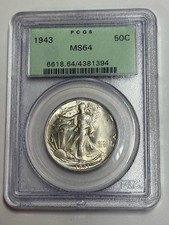

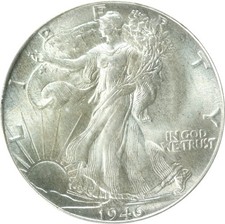
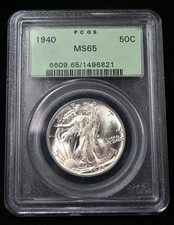


Design Excellence — Obverse and Reverse
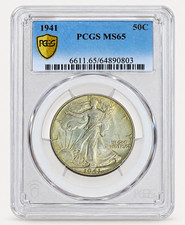
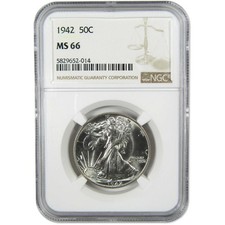
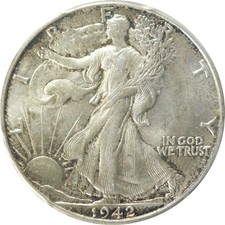
Weinman's obverse design broke radically from the static portrait tradition. Liberty does not sit or stand — she walks, confidently striding left toward a rising sun on the horizon. Her gown flows behind her; the American flag wraps around her body; she carries branches of laurel and oak in her arms. The composition has depth, movement, and narrative — qualities rare in coin design at any era. The thirteen stars representing the original colonies appear around the periphery, and the date sits at the bottom beneath Liberty's feet.
The reverse shows a bald eagle perched on a rocky outcropping with wings spread, not in the aggressive heraldic pose of earlier coin eagles but in a more natural, powerful stance — wings open as if preparing for flight or having just landed. A pine sapling grows at the eagle's feet, symbolizing national growth and renewal. The overall effect is dynamic and three-dimensional, with the eagle's feathers showing remarkable detail on well-struck examples. Strike quality varied considerably across the series' run, which is why the "Full Head" designation plays such an important role in Walking Liberty valuation.
Key Dates and Notable Issues
The 1916 First Year and Major Keys
1916-S Walking Liberty
1916 & 1916-D
1921, 1921-D & 1921-S
Semi-Keys and Condition Rarities
1938-D Walking Liberty
1919-D & 1919-S
1917-S Obverse Mint Mark
The Full Head Designation and Strike Quality
Strike quality on Walking Liberty Half Dollars is critically important to value, and no designation reflects this more clearly than Full Head (FH). The high points of Liberty's head — particularly the eagle feather details in her hair and the face definition — were the last areas to receive metal during striking and the first to show weakness on poorly struck coins. PCGS and NGC award the Full Head designation to Walking Liberty halves where these details are sharply defined and complete.
The premium for Full Head certification can be enormous — a common-date Walker in MS65 might be worth $100 in standard grade, while MS65 FH could reach $500 or more. On key dates the spread is even wider. Denver issues from the late 1910s and early 1920s are the most consistently weakly struck; late 1930s and 1940s Philadelphia issues tend to be better. Building a complete date-and-mint set in Full Head is considered one of the most demanding challenges in American coin collecting. For certified values by date, mint, and Full Head designation, the FRC Coin Price Guide is a useful reference. Related guides: Seated Liberty Half Dollars, Kennedy Half Dollars, and Half Dollar overview.

Frequently Asked Questions
Why is the Walking Liberty Half Dollar considered so beautiful?
The Walking Liberty Half Dollar is consistently ranked among the most beautiful U.S. coins ever produced because of Adolph Weinman's exceptional compositional skill. Unlike earlier American coins that showed static portraits or heraldic symbols, the Walking Liberty design has movement, depth, and narrative — Liberty strides forward toward the sunrise, robes flowing, the American flag draped across her body. The reverse eagle is equally dynamic, perched in a naturalistic pose that conveys power without aggression. The design works at the coin's actual size as a functional piece of currency, yet holds up as fine art under close examination. When the American Silver Eagle program needed a flagship design in 1986, the Walking Liberty obverse was the natural choice — a recognition of its timeless quality.
What is Full Head on a Walking Liberty Half Dollar?
Full Head (FH) refers to the complete, sharp definition of Liberty's head on the obverse — particularly the eagle feather details in her hair, the separation of hair strands above her face, and the clarity of her facial features. These high-relief areas were the most difficult to strike fully and were the first to show weakness on coins struck from worn or improperly prepared dies. PCGS and NGC apply the Full Head designation to examples meeting their standards for complete head detail. The premium can be substantial — sometimes 3× to 10× the non-FH value at the same numeric grade — making Full Head a critically important consideration when buying or selling Walking Liberty Half Dollars in Mint State.
Why are the 1921 Walking Liberty Half Dollars so rare?
The three 1921 Walking Liberty Half Dollars — Philadelphia, Denver, and San Francisco — are all key dates because of the severe economic recession that hit the United States after World War I. The Mint dramatically reduced coin production across all denominations in 1921 as the post-war economy contracted. Philadelphia struck only 246,000 halves; Denver just 208,000 — both among the lowest mintages in the entire series. The 1921-D is additionally challenging because Denver's strike quality was generally poor, meaning even surviving Mint State examples often lack the definition on Liberty's head that collectors prize. All three 1921 dates require PCGS or NGC certification for any significant purchase.
How much silver is in a Walking Liberty Half Dollar?
Every Walking Liberty Half Dollar contains 0.3617 troy ounces of pure silver, based on the coin's weight of 12.5 grams at 90% silver purity. This silver floor gives every Walking Liberty a base metal value above face value — at $30 per troy ounce silver, that's approximately $10.85 in silver content per coin regardless of numismatic grade. This precious metal foundation makes Walking Liberty Half Dollars appealing to both collectors and silver investors. They are widely sold as "junk silver" in circulated grades by bullion dealers like JM Bullion, Money Metals Exchange, and Kitco at modest premiums above spot silver price.
What years had the mint mark on the obverse?
In 1916 and part of 1917, branch mint Walking Liberty Half Dollars had their mint marks placed on the obverse — specifically at the bottom left of the obverse design near Liberty's hand. Starting in mid-1917, the mint mark was moved to the reverse below the eagle's tail feathers, where it remained for the rest of the series through 1947. This creates a small but important collecting specialty: the 1916-S, 1916-D, 1917-S obverse, and 1917-D obverse varieties all carry the mint mark on the front of the coin, distinguishing them from the same year's reverse-mintmark coins. The 1917-S and 1917-D obverse mintmark varieties are genuinely scarcer than their reverse counterparts and carry premiums reflecting that scarcity.
How do I start collecting Walking Liberty Half Dollars?
The most accessible entry point is a common-date Philadelphia issue from the late 1930s or 1940s in circulated grades — coins like the 1941, 1942, or 1945 in Very Fine to Extremely Fine condition typically cost $12–$20 and provide a genuine large 90% silver coin with beautiful design. A Dansco or Whitman album for Walking Liberty Half Dollars provides the structure for set building and is available on Amazon for under $30. The three 1921 key dates and the 1916-S represent the most significant financial hurdles; the 1938-D is an expensive surprise that catches many set builders off guard. For any key date or Full Head example, PCGS or NGC certification is strongly recommended. The David Akers reference book on Walking Liberty Half Dollars is the definitive specialist guide.
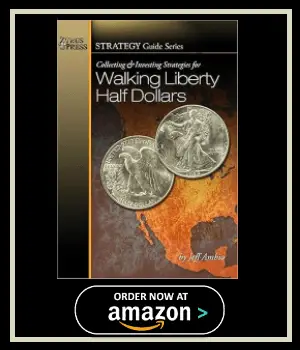
Walking Liberty Half Dollars. Beautiful to behold, the artistic skill and depth of symbolism represented in these coins marks a golden age in United States coin design.
 '
'