
United States Paper Money
Rare Currency • Investment Grade Notes • Collector's Guide
America's Paper Currency Heritage
From Colonial Notes to Federal Reserve Bills
United States paper money tells the story of a nation's financial evolution — from the desperate wartime scrip of the colonial era to the security-laden Federal Reserve Notes that fill wallets today. Each generation of American currency reflects the economic pressures, political ambitions, and artistic sensibilities of its time, making U.S. paper money one of the most historically rich collecting fields in numismatics.
The earliest colonial notes were born of necessity: trading companies and colonial governments needed a portable medium of exchange when hard coin was scarce. Counterfeiting plagued these early issues almost immediately, and confidence in paper currency remained fragile for centuries. It took the Civil War — and its enormous appetite for government financing — to establish paper money as a permanent fixture of American economic life.
Civil War Greenbacks & National Currency
The Birth of Federally Issued Paper Money
When Southern states seceded in 1861, the Union faced a fiscal crisis. The Legal Tender Acts authorized the Treasury to issue Demand Notes — the first federally printed paper currency — followed by United States Notes (Greenbacks) beginning in 1862. These were not backed by gold or silver but were declared legal tender by act of Congress, a revolutionary and controversial step that shaped American monetary policy for decades.
National Bank Notes followed, issued by federally chartered private banks and backed by government bonds. This system provided regional diversity in currency design while maintaining federal oversight. Today, large-size National Bank Notes — especially those from small Western towns or banks with short charter histories — rank among the most desirable and valuable pieces in American paper money collecting.
Silver Certificates & Gold Certificates
Commodity-Backed Currency at Its Most Beautiful
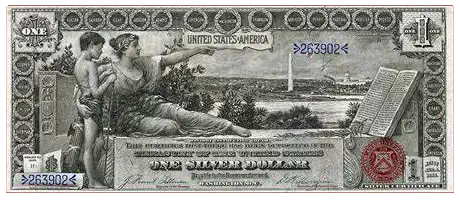
Silver Certificates, issued from 1878 through 1964, represented one of the most artistically ambitious periods in U.S. currency design. The 1896 "Educational Series" — featuring allegorical scenes of History Instructing Youth, Electricity Presenting Light, and Science Presenting Steam and Electricity — remains widely regarded as the most beautiful paper money ever produced by the United States government.
Gold Certificates, printed from 1882 through 1934, carried the promise of redemption in gold coin. High-denomination Gold Certificates — $500, $1,000, $5,000, and $10,000 — were primarily used for large bank transfers rather than everyday commerce. Today those high denominations are extraordinarily rare in private hands and command six- and seven-figure prices at major auction houses.
Key Series & Collector Value Guide
What Major Series Bring at Auction
| Series / Type | Era | Typical Value Range | Notable Factor |
|---|---|---|---|
| 1896 Educational Silver Certificates | Large Size | $500 – $100,000+ | Considered finest U.S. currency art |
| 1901 $10 Bison / Lewis & Clark Note | Large Size | $1,500 – $100,000+ | Iconic American wildlife imagery |
| 1869 "Rainbow Notes" Legal Tender | Large Size | $2,000 – $100,000+ | Multi-color vignette printing |
| 1890 "Grand Watermelon" $1,000 | Treasury Note | $3,000,000+ | Fewer than 7 known; rarest U.S. note |
| 1934 $10,000 Federal Reserve Note | High Denomination | $50,000 – $200,000+ | Highest denomination ever publicly circulated |
| 1935A $1 Experimental R&S | Small Size Silver Cert. | $50 – $2,000+ | Rare paper experiment overprints |
| Error Notes (Missing Print, Fold-Over) | Various Modern | $100 – $25,000+ | Severity and type of error determine value |
| Low Serial Number / Fancy Serials | Modern Federal Reserve | $50 – $10,000+ | Radar notes, repeaters, solid digits |
Top Collecting Categories
Where Collectors Focus Their Pursuits
Large Size Notes
Pre-1929 currency — oversized and ornately engraved. Includes Legal Tender, Silver Certificates, Gold Certificates, and National Bank Notes.
Silver Certificates
Blue-seal notes redeemable in silver. The series spans 1878–1964 with dozens of collectible sub-types and star note rarities.
National Bank Notes
Issued by locally chartered banks 1863–1935. Small-town and Western banks produced highly scarce, regionally significant notes.
Error Notes & Stars
BEP printing mistakes and star replacement notes. Errors range from minor miscuts to dramatic missing-print specimens.
High Denominations
$500, $1,000, $5,000, and $10,000 notes discontinued in 1969. Legal tender but valued far above face by collectors.
Fancy Serials
Low numbers, radars, repeaters, solid digits, and binary notes on modern FRNs. A growing and accessible collecting niche.
U.S. Currency Explorer
Browse by Category • Click Any Note for Details & eBay Listings
The Federal Reserve Era
1913 to Present — Security, Stability & Design
The Federal Reserve Act of 1913 created America's central banking system and, with it, the Federal Reserve Note — the form of currency Americans use today. Initially redeemable in gold or silver, FRNs became pure fiat currency after the U.S. departed the gold standard in 1971. Since then, the Bureau of Engraving and Printing has continually upgraded security features to stay ahead of sophisticated counterfeiters.
Modern $100 bills incorporate a 3D security ribbon woven into the paper, color-shifting ink on the numeral, microprinting, and an embedded security thread that glows pink under ultraviolet light. These features represent decades of research at the Treasury and are among the most advanced anti-counterfeiting measures on any banknote in the world.
Grading, Certification & Preservation
PMG, PCGS Currency & Proper Storage
Paper money condition is graded on a 70-point scale by professional third-party services — primarily PMG (Paper Money Guaranty) and PCGS Currency. A gem-uncirculated (MS-65 or higher) note from a classic series can be worth 10–50 times the value of the same note in circulated condition. Certification verifies authenticity, provides tamper-evident holders, and dramatically increases buyer confidence at auction and in private sales.
Preservation basics are straightforward but critical. Store notes in acid-free Mylar currency holders — never PVC sleeves, which off-gas acids that damage paper over time. Maintain stable humidity between 45–55% and avoid temperature extremes. Handle notes only by the edges, and never fold or press a note you intend to preserve at current grade. Light — especially UV — is a long-term enemy of paper money pigments and should be minimized for display pieces.
Find U.S. Paper Money on eBay
Browse thousands of certified and raw notes — Silver Certificates, National Bank Notes, error currency, high denominations, and more.
🛍️ Shop U.S. Paper Money on eBayFindRareCoins.com is a participant in the eBay Partner Network. Purchases made through links on this page may earn us a commission at no additional cost to you.
Frequently Asked Questions
What makes a piece of U.S. paper money valuable to collectors?
Rarity, condition, and historical significance are the three primary drivers of value. A note from a small bank with a short charter history in 1880s Montana is rarer than one from a major New York bank. Condition matters enormously — the same note in gem uncirculated can be worth 10–100 times a worn circulated example. Certification from PMG or PCGS Currency adds credibility and usually increases realized prices. Error notes, low serial numbers, and unusual die varieties add additional premium regardless of denomination.
Are high denomination notes ($500, $1,000, $5,000, $10,000) still legal tender?
Yes — all genuine U.S. Federal Reserve Notes are legal tender regardless of denomination. A $1,000 bill is worth at minimum $1,000 in face value. However, circulated examples routinely sell for $1,500–$4,000 depending on series and condition, and gem-quality examples of scarcer series can be worth multiples of that. It is always more financially sound to sell these notes to a dealer or auction house rather than spend them at face value.
What is a "star note" and why are they collectible?
Star notes are replacement notes printed by the Bureau of Engraving and Printing to substitute for sheets rejected during quality control. They carry a star symbol (★) at the beginning or end of the serial number instead of a letter. Because fewer star notes are printed than regular notes, they are inherently scarcer. Rarity varies dramatically by series — some modern FRN star notes have print runs under 100,000 and can sell for 10–50 times face value, while common series stars may bring only modest premiums.
How do I get my paper money certified by PMG or PCGS?
Both PMG (papermoneygauranty.com) and PCGS Currency (pcgscurrency.com) offer direct submission services. You create an account, package your notes following their guidelines — typically in protective holders within rigid card stock — and ship to their grading facility. Turnaround times and fees vary by service tier, from economy (several weeks) to express (a few days). For notes valued above $500, professional certification is almost always worth the cost in terms of added market value and buyer confidence.
What are the most common storage mistakes collectors make?
The most damaging error is using PVC (vinyl) currency holders — these are soft and flexible, and they off-gas hydrochloric acid over time, causing notes to become sticky, discolored, and permanently damaged. Use only Mylar (polyester) or polypropylene holders. Other common mistakes include storing notes in direct sunlight, in basements with humidity fluctuations, or in old photo albums with paper pages that contain acids. Rubber bands are extremely damaging. For significant notes, acid-free archival boxes in a climate-controlled environment are ideal.
What are "fancy serial numbers" and are they worth more?
Fancy serial numbers are collector-desirable patterns on otherwise standard modern Federal Reserve Notes. Common types include: low numbers (00000001–00000099), solid digits (77777777), radar notes (palindromes like 12344321), repeaters (12341234), and ladders (12345678). The value depends on the specific pattern and how "perfect" it is — a true solid (eight identical digits) is worth significantly more than a near-solid with one different digit. This has become a mainstream collecting niche, and dedicated websites and communities track reported finds.


 '
'