Early American Colonial Coins
Massachusetts Bay Silver • State Coppers • Continental Currency • Fugio Cent
Colonial Coins Value Guide
First, the table below gives approximate market ranges for authentic colonial coins, from well-worn pieces to top certified specimens. Because colonial coins are a heavily counterfeited field, certification is strongly recommended for anything above a few hundred dollars. For later American coins, see our full coin price guide, or try What's My Coin Worth?
| Coin | Years | Metal | Value Range | Shop |
|---|---|---|---|---|
| Massachusetts Bay Silver | ||||
| NE Shilling | 1652 (undated) | Silver | $50,000–$400,000+ | eBay → |
| Willow Tree Shilling | 1653–1660 (dated 1652) | Silver | $10,000–$300,000+ | eBay → |
| Oak Tree Shilling | 1660–1667 (dated 1652) | Silver | $1,000–$15,000+ | eBay → |
| Pine Tree Shilling | 1667–1682 (dated 1652) | Silver | $500–$10,000+ | eBay → |
| State Coppers | ||||
| Connecticut Copper | 1785–1788 | Copper | $75–$2,000+ | eBay → |
| New Jersey Copper | 1786–1788 | Copper | $100–$3,000+ | eBay → |
| Vermont Copper | 1785–1788 | Copper | $150–$4,000+ | eBay → |
| Massachusetts Cent | 1787–1788 | Copper | $100–$2,000+ | eBay → |
| Continental & Confederation Issues | ||||
| Virginia Halfpenny | 1773 | Copper | $50–$800+ | eBay → |
| Continental Currency Dollar | 1776 | Pewter, brass, silver | $5,000–$100,000+ | eBay → |
| Confederatio Copper | 1785 | Copper | $10,000–$100,000+ | eBay → |
| Fugio Cent | 1787 | Copper | $200–$5,000+ | eBay → |
Record prices: a newly found 1652 NE threepence sold for $2.52 million (Stack's Bowers, November 2024), a Willow Tree threepence brought $632,500, and an NE shilling topped $400,000 at $414,000. Die variety can also swing state copper values dramatically.
Coinage in Colonial America
At its heart, colonial American coinage tells the story of a fledgling economy struggling to create a functional monetary system without the authority to strike its own official coins. Indeed, for most of the colonial period, England prohibited its American colonies from operating mints, forcing colonists to rely on a chaotic mix of foreign coins, barter, commodity money (tobacco, wampum, and beaver pelts all served as currency at various times), and locally produced tokens of uncertain legal standing. Spanish colonial silver — the famous pieces of eight minted in Mexico and South America — became the de facto standard currency throughout the American colonies precisely because official British coinage was so scarce.
As a result, this scarcity of circulating coin created persistent economic hardship and drove several colonies to take matters into their own hands, producing coinage in defiance of or in gray areas around royal authority. Because they were struck in small quantities, often crudely, and were frequently short-lived, the resulting coins are today among the most historically significant and eagerly sought pieces in all of American numismatics. Colonial coins represent tangible artifacts of the earliest chapters of American economic self-determination, decades before the Revolution and the founding of the federal Mint.
Foreign Coins in Colonial Pockets
In fact, most of the money that actually changed hands in the colonies was foreign. Spanish pieces of eight from the mints of Mexico City, Lima and Potosí were the most common, but Dutch lion dollars and guilders, Portuguese gold johannes ("joes") and French coins also circulated. Because none of them carried a colonial value, merchants judged each coin by its weight and the fineness of its metal, and each colony set its own exchange rates.
As a result, a Spanish dollar could be worth a different number of shillings in Boston than in Philadelphia or Charleston, which made trade between the colonies awkward. Even so, the Spanish dollar became so familiar that it shaped the new nation's money. When Congress passed the Coinage Act of 1792, it modeled the U.S. dollar on the Spanish milled dollar, and Spanish silver stayed legal tender in the United States until 1857.


Massachusetts Bay Silver Coinage
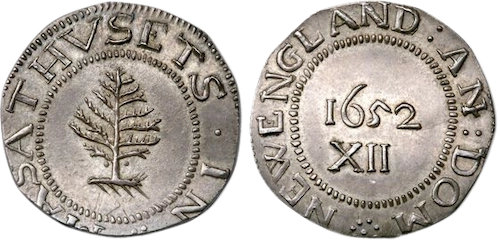
Above all, the Massachusetts Bay Colony holds the distinction of operating the first mint in British North America, established in Boston in 1652 under the direction of silversmith John Hull. However, the mint operated in open defiance of the English Crown's monopoly on coinage. To obscure that, the colony kept the date "1652" on its tree coins regardless of the year they were struck, so production looked like a brief episode when in fact it continued for three decades. Even so, the Boston mint produced a series of silver coins that remain among the most celebrated in American numismatics.
The mint's output evolved through several design types, from the plain NE (New England) coinage of 1652 to the famous Pine Tree series that continued until the mint's closure around 1682. Of these, the Pine Tree Shilling is the most iconic and most collected of all Massachusetts silver, its stylized tree design instantly recognizable to American numismatists. These coins circulated not just in Massachusetts but throughout New England, filling a genuine economic need in a colony far removed from London's monetary attention. Surviving examples — particularly the earlier and rarer NE and Willow Tree types — command substantial premiums, while Pine Tree Shillings remain more available and serve as an accessible entry point into serious colonial collecting.
The Tree Coinage Sequence
The NE coins came first, struck for only a few months in 1652 with nothing but "NE" and the value, and no date at all. After that, John Hull and his partner Robert Sanderson moved to designs with a tree at the center, struck in this order:
- Willow Tree (about 1653–1660): the crudest and rarest of the tree types.
- Oak Tree (about 1660–1667): a sharper design, and the series that added a twopence.
- Pine Tree (about 1667–1682): the last and most plentiful type, struck on large and later small planchets.
Meanwhile, every shilling, sixpence and threepence of the tree series carries the date 1652, the year the mint was authorized. The one exception is the Oak Tree twopence, which is dated 1662 because the colony authorized that denomination in 1662.
Other Colonial and Private Coinage
Massachusetts was the exception, not the rule. In fact, British law and policy kept the colonies from running their own mints, and Boston's mint closed around 1682, shortly before the Crown revoked the colony's charter in 1684. As a result, the other coins made for colonial America were either struck in England with royal approval or made privately, often with uncertain legal standing.
For example, Maryland's proprietor, Cecil Calvert, Lord Baltimore, had silver shillings, sixpence and fourpence struck in London around 1659 for use in his colony. Later, the Rosa Americana coins of 1722–1724 were struck in England by William Wood under a royal patent for circulation in the American colonies, though they were unpopular because they weighed less than British coins. Similarly, the 1773 Virginia halfpenny was made at the Tower Mint in London under George III, one of the few colonial coins struck with full royal authority.
Higley Coppers
Still, the most colorful private effort came from Connecticut. Dr. Samuel Higley owned a copper mine near Granby, and from 1737 he struck copper tokens from his own ore, among the first base-metal coins made in the British American colonies. His first pieces claimed THE VALUE OF THREEPENCE, but merchants balked at that price for a halfpenny-sized coin.
Higley answered with a new legend, VALUE ME AS YOU PLEASE, while the reverse declared I AM GOOD COPPER. After Samuel died in 1737, his brother John continued the coinage, and a final issue is dated 1739. Today, Higley coppers are great rarities, and genuine examples sell for five or six figures, so authentication is essential, since electrotypes and cast copies exist.
State Coinage After Independence
Following the Revolution, the fledgling United States lacked a national mint, and the Articles of Confederation left coinage authority ambiguously divided between the states and the weak central government. As a result, several states seized the opportunity to authorize their own copper coinage to address the chronic shortage of small change. In particular, Connecticut, New Jersey, Vermont and Massachusetts (in its second coinage era, this time as an independent state) all produced distinctive copper coins between 1785 and 1789, each reflecting its own design sensibilities and often struck by private contractors under state license.
This period produced extraordinary variety — Connecticut coppers alone exist in hundreds of documented die varieties, a level of complexity that has made them a specialized collecting field in their own right. Meanwhile, New Jersey coppers feature a horse's head and plow design tied to the state's agricultural identity. Vermont coppers, struck for a state that was not yet part of the Union, include some of the most visually distinctive designs of the era, including sun-rays-over-mountains motifs. This chaotic, decentralized coinage era — with dozens of authorized and unauthorized issuers all producing copper coins of varying weight and quality — was itself one of the strongest arguments for establishing a unified national currency, which arrived with the Coinage Act of 1792.
Notable Colonial and Early American Coins
The following represent key issues across the colonial period — click any eBay link to see current certified listings.
Early Colonial Silver
Massachusetts NE Shilling
Pine Tree Shilling
Willow Tree Shilling
Oak Tree Shilling
State Coppers
Connecticut Copper
New Jersey Copper
Vermont Copper
Massachusetts Cent (1787–1788)
Continental & Confederation Issues
Continental Currency Dollar
Fugio Cent
Confederatio Copper
Virginia Halfpenny
Continental Currency and the Fugio Cent
In many ways, the Continental Currency dollar of 1776 stands as one of the most historically loaded objects in American numismatics — proposed at the very outset of the Revolutionary War, likely designed with input from Benjamin Franklin, and bearing mottos ("Mind Your Business" and "We Are One" / "Continental Currency") that captured the spirit of the moment. Struck in small numbers in pewter, brass, and rare silver examples, these coins were more likely patterns or presentation pieces than a circulating currency, but their symbolic weight as an emblem of American independence has made them enduringly significant to collectors, regardless of their uncertain original purpose.
The Fugio cent of 1787 holds a firmer claim to numismatic significance: it was the first coin officially authorized by the United States government, struck under contract by James Jarvis following authorization from the Continental Congress. Its design — a sundial with the Latin motto "Fugio" (I flee, referencing the passage of time) alongside "Mind Your Business," again attributed to Franklin's design sensibility — captures the practical Yankee wisdom of the era. Produced in significant quantities compared to earlier colonial issues, Fugio cents are more available to collectors than Massachusetts silver or state coppers, making them an accessible bridge between colonial coinage and the federal coinage that began in earnest after the Coinage Act of 1792.

Frequently Asked Questions
What are colonial coins?
Why did Massachusetts date all its silver coins 1652?
What is the most valuable colonial coin?
How do I authenticate a colonial coin?
What is the Fugio cent and why is it historically significant?
What are the best colonial coins for beginning collectors?
Colonial and Early American Coins - This fully revised and updated edition on colonial and early American coins, tokens, and related issues.

 '