
Early American Silver Dollars
Flowing Hair • Draped Bust • Gobrecht • Seated Liberty • Morgan • Peace
The First Dollar — America's Founding Coin
The Coinage Act of 1792 • The Philadelphia Mint • 1794 Flowing Hair Dollar
The story of the American silver dollar begins not with a coin but with a law. The Coinage Act of 1792 established the United States Mint, defined the nation's decimal currency system, and specified that the dollar — derived from the Spanish milled dollar that had circulated through the colonial economy — would be the fundamental unit of American money, containing 371.25 grains of pure silver. Before this act, Americans conducted commerce with a chaotic mixture of foreign coins, state-issued currency, and private tokens. The new silver dollar was intended to assert something beyond mere commercial convenience: it was a statement of national sovereignty, financial independence, and confidence in the young republic's economic future.
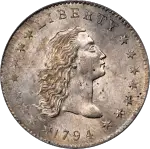
The first silver dollars rolled off the presses at the Philadelphia Mint in 1794 — the Flowing Hair dollar, designed by Robert Scot with a portrait of Liberty bearing wind-swept hair on the obverse and a small, scrappy eagle on the reverse. Fewer than 1,800 pieces were struck in that first year, and fewer than 150 survive today in any condition. One example sold at auction in 2013 for just over $10 million, making it the most valuable coin ever sold at the time. The 1794 dollar is not merely the most important American silver coin — it is, by many measures, the most important American coin of any denomination, a direct physical link to the founding of the nation's monetary system.
From Flowing Hair to Draped Bust — The Early Design Evolution
1794–1804 • Robert Scot's Portraits • Small Eagle and Heraldic Eagle Reverses
The Flowing Hair dollar survived for only two years — 1794 and 1795 — before Robert Scot revised the design in response to criticism that the Liberty portrait was insufficiently refined. The replacement, the Draped Bust dollar, introduced a more classical, dignified portrait of Liberty inspired by a sketch by the noted portrait artist Gilbert Stuart — the same painter whose unfinished portrait of George Washington appears on the one-dollar bill. The Draped Bust dollar was struck in two reverse configurations: the early Small Eagle reverse (1795–1798), featuring a naturalistic but modest eagle set within a wreath, and the later Heraldic Eagle reverse (1798–1804), which replaced the small eagle with the bold, shield-bearing heraldic eagle that would become a defining motif of American coinage. The Heraldic Eagle reverse gave the dollar a visual grandeur commensurate with the young nation's growing ambitions.
Silver dollar production at the Philadelphia Mint came to an abrupt halt after 1804 — not because any official decision was made to end the series, but because Gresham's Law was doing its work: silver dollars were being systematically exported and melted because their silver content made them worth more as bullion than as face-value currency, particularly in the Caribbean trade. The Mint simply stopped producing coins that were immediately disappearing from circulation. The gap in dollar production that followed would last, with minor interruptions, for more than thirty years. The notorious 1804 dollar — dated 1804 but actually struck in 1834–1835 as diplomatic presentation pieces — emerged from this gap, and its fifteen known examples constitute perhaps the most famous numismatic rarity in American history.
The Gobrecht Dollar, Seated Liberty & the Trade Dollar
1836–1873 • Christian Gobrecht's Legacy • Silver for Asian Commerce
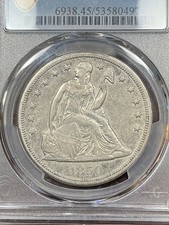
The dollar's long hiatus ended in the mid-1830s with the introduction of the Gobrecht dollar — a transitional design by engraver Christian Gobrecht that featured a dramatically new flying eagle on the reverse, departing completely from the heraldic eagle tradition that had defined American coinage for four decades. The Gobrecht dollars of 1836–1839 were produced in small quantities as pattern coins and limited circulation strikes, with their exact production status debated by specialists to this day. Their primary purpose was to demonstrate and test the new design before full production of the Seated Liberty dollar began in 1840. The Seated Liberty dollar — with Liberty seated on a rock, holding a shield and a pole topped with a liberty cap, surrounded by stars — served as the standard silver dollar design for thirty-three years, from 1840 through 1873, produced at Philadelphia and several branch mints with many dates of extraordinary scarcity.
The Trade dollar, introduced in 1873 as the Seated Liberty dollar was discontinued, was an unusual departure in American coinage: a silver coin designed not for domestic circulation but specifically for export to Asia, where it would compete with the Mexican peso in the China trade. Slightly heavier than the standard silver dollar, the Trade dollar circulated primarily in Chinese ports where its weight could be directly compared and verified against competing coins. It was the only U.S. coin ever officially demonetized for domestic use during its own production run — Congress removed its legal tender status in 1876 after silver prices fell and the coins began flooding back into U.S. commerce at below face value. The proof-only issues of 1884 and 1885, struck in tiny quantities of five and ten pieces respectively, are among the rarest coins in American numismatics.
U.S. Silver Dollar Series at a Glance
Design, Dates & Key Numismatic Significance
| Series | Years | Designer | Key Highlight |
|---|---|---|---|
| Flowing Hair Dollar | 1794–1795 | Robert Scot | First U.S. dollar; 1794 worth $10M+ |
| Draped Bust — Small Eagle | 1795–1798 | Robert Scot / Gilbert Stuart | Transitional type; scarce in all grades |
| Draped Bust — Heraldic Eagle | 1798–1804 | Robert Scot | 1804 dollar: rarest, most famous U.S. coin |
| Gobrecht Dollar | 1836–1839 | Christian Gobrecht | Pattern / transitional; flying eagle reverse |
| Seated Liberty Dollar | 1840–1873 | Christian Gobrecht | 1870-S: fewer than 15 known; major rarity |
| Trade Dollar | 1873–1885 | William Barber | 1884–1885 proofs: among rarest U.S. coins |
| Morgan Dollar | 1878–1921 | George T. Morgan | 1893-S King of Morgans; 1895 proof-only |
| Peace Dollar | 1921–1935 | Anthony de Francisci | 1928 King of Peace; 1921 high relief type |
The Morgan Dollar — America's Silver Dollar
George T. Morgan's Design • 1878–1921 • Five Mints • The Most Collected U.S. Coin
When the Bland-Allison Act of 1878 required the U.S. Treasury to purchase and coin millions of ounces of silver annually — legislation driven by Western silver mining interests seeking a guaranteed government market for their product — the result was the most widely produced, most actively collected, and most enduringly beloved coin in American numismatic history: the Morgan dollar. Designed by George T. Morgan and first struck in 1878 at the Philadelphia, Carson City, and San Francisco mints (New Orleans and Denver would be added to the production roster in subsequent years), the Morgan dollar features Morgan's careful portrait of Liberty — modeled from Philadelphia schoolteacher Anna Willess Williams — on the obverse, and a bold spread-winged eagle with arrows and olive branch on the reverse. The design is masterful: it balances classical numismatic convention with a freshness and naturalism that earlier American coin portraits had not achieved.
Morgan dollar production ran from 1878 through 1904, when falling silver prices led Congress to end the Bland-Allison Act's mandate. The series was revived for one final year in 1921 — the last year before the Peace dollar replaced it — producing the largest single-year mintage in the series' history. In between those production years, the Morgan dollar played a central role in one of American numismatics' most significant events: the great silver dollar meltings authorized by the Pittman Act of 1918, which sent 270 million Morgan dollars to the melting pot to provide silver for Allied purchases during World War I. Millions more were melted in subsequent decades under the Treasury's silver programs. The result is a series where common-date coins are genuinely common, key dates are genuinely scarce, and a complete date-and-mint-mark set represents a serious collecting achievement at any grade level.
The Peace Dollar — Silver's Farewell
Anthony de Francisci • 1921–1935 • Post-War Idealism in Silver
The Peace dollar, introduced in late 1921 to replace the Morgan, was the product of an unusual combination of numismatic idealism and post-war sentiment. The American Numismatic Association and U.S. Mint collaborated to hold a competition for a new silver dollar design that would commemorate the end of World War I — the "war to end all wars" — and reflect a national mood of relief and hope for a lasting peace. Sculptor Anthony de Francisci won the competition with a design featuring his wife Teresa as the model for Liberty's portrait and a perched eagle on the reverse with the inscription PEACE. The 1921 first-year issue was struck in high relief, similar to the Saint-Gaudens gold eagle concept, but the dies wore too rapidly for mass production and the relief was reduced for all subsequent years.
The Peace dollar series is shorter and more concentrated than the Morgan — fifteen years of production (1921–1935) with many fewer dates and mints — but its key dates are genuinely formidable. The 1928 Philadelphia issue, with a mintage of only 360,649 pieces, is the undisputed key to the series and one of the scarcer regular-issue 20th-century U.S. coins in gem condition. The 1934-S and 1927-S and 1927-D are the principal semi-key dates. Gem uncirculated Peace dollars are generally harder to find with sharp strikes than Morgan dollars of comparable dates — the Peace design's flat, broad fields show every contact mark and the eagle's feathers require precise die alignment to strike up fully, making certified MS65 examples of even common-date Peace dollars genuinely collectible.
Flowing Hair Dollar (1794–1795)
America's first silver dollar — fewer than 150 known 1794 examples survive. The 1794 dollar is considered by many specialists the most important American coin ever struck.
Draped Bust Dollar (1795–1804)
Two reverse types in nine years — Small Eagle then Heraldic Eagle — culminating in the legendary 1804 dollar, one of only fifteen known, last sold for $7.68 million.
Gobrecht & Seated Liberty (1836–1873)
Christian Gobrecht's transitional flying eagle design led into thirty years of Seated Liberty production with extraordinary rarity concentrated in the Civil War era issues.
Trade Dollar (1873–1885)
America's only coin designed for export — struck heavier than standard for the Asian silver trade, demonetized domestically in 1876, with the 1884–1885 proofs among the rarest U.S. coins.
Morgan Dollar (1878–1921)
The most collected U.S. coin — five mints, dozens of key and semi-key dates, VAM varieties, and 270 million pieces melted in 1918 creating the scarcities that define the series today.
Peace Dollar (1921–1935)
Post-World War I silver dollar — first year high relief quickly changed for production, with the 1928 as the key date of a series where gem examples with sharp strikes are genuinely scarce.
U.S. Silver Dollar Explorer
Browse by Series • Click Any Coin for Details & eBay Listings




The 1804 Dollar — The King of American Coins
Fifteen Known • Struck in 1834–1835 • Diplomatic Presentation Pieces
The 1804 Draped Bust dollar occupies a unique position in American numismatics — it is simultaneously the most famous rarity in U.S. coinage, one of the most historically misunderstood coins ever struck, and the subject of the most celebrated single-coin auction sale in modern numismatic history. The paradox at the heart of the 1804 dollar is that no dollar was actually struck and dated 1804 in the year 1804. The last Draped Bust dollars produced during regular Mint operations were dated 1803. The coins we call "1804 dollars" were struck decades later — beginning in 1834, when the State Department requested specially prepared coin sets as diplomatic gifts for the rulers of Muscat and Siam. Mint officials, working from production records that listed dollars as having been coined in 1804 (without noting that those coins had actually been dated 1803), struck new dollars bearing the date 1804 for inclusion in these gift sets.
Today, fifteen 1804 dollars are known to exist, divided into three classes based on when and how they were struck. The eight Class I originals — made in 1834–1835 for the diplomatic sets — are the most valuable, with single examples selling for $4 million to $7.68 million at major auctions. The Class II and Class III restrikes, produced at various points in the 1850s and 1860s as Mint officials essentially created additional examples for well-connected collectors, are nearly as valuable. The 1804 dollar is not merely expensive — it is the defining example of American numismatic rarity, the coin that established the auction market for major American rarities and whose story encapsulates the full complexity of early U.S. Mint history.
Building a U.S. Silver Dollar Collection
Type Sets, Date Sets & the Investment Case for Classic American Silver
Few collecting projects in American numismatics offer the combination of historical depth, design beauty, and market liquidity that a well-assembled U.S. silver dollar type set provides. A single-coin representative of each major dollar type — Flowing Hair, Draped Bust Small Eagle, Draped Bust Heraldic Eagle, Gobrecht, Seated Liberty, Trade Dollar, Morgan, and Peace — spans the entire history of American silver coinage from 1794 through 1935 in eight coins. The early types (Flowing Hair and Draped Bust) require meaningful investment even in heavily worn grades, while later types (Seated Liberty, Trade Dollar) can be represented with common-date examples in Very Good to Fine condition at accessible prices. A complete, certified type set in matched grades is one of the most elegant displays in American numismatics and holds its value with exceptional consistency across market cycles.
For collectors building Morgan or Peace dollar date sets, PCGS and NGC certification is the practical infrastructure that makes the market function — it provides grade guarantees, authenticity verification, and the population data that serious buyers and sellers rely on to establish fair prices. The Morgan dollar key dates (1893-S, 1895 proof, 1889-CC, 1884-S) and semi-key dates (1879-CC, 1892-S, 1893-O, 1895-S) represent real collecting challenges that reward patience and careful purchasing. The Peace dollar series is shorter — fifteen regular-issue dates from 1921 through 1935 — but the concentration of difficulty in the 1928 key date and the general scarcity of gem-quality strikes across the series makes a complete certified Peace dollar set in MS64 or better a genuinely ambitious goal. For any purchase above $500, PCGS or NGC certification provides the authentication confidence and market liquidity that uncertified raw coins cannot match.
Shop U.S. Silver Dollars on eBay
Browse thousands of certified Morgan dollars, Peace dollars, early American dollars, and modern issues — PCGS and NGC graded examples from specialist dealers and private collections nationwide.
🛍️ Shop U.S. Silver Dollars on eBay 📚 Silver Dollar References on AmazonFindRareCoins.com participates in the eBay Partner Network and Amazon Associates program. Purchases made through links on this page may earn us a commission at no additional cost to you.
Frequently Asked Questions
What is the most valuable U.S. silver dollar?
The most valuable U.S. silver dollar ever sold at auction is the 1794 Flowing Hair dollar — the first silver dollar struck by the United States Mint. A specific example, believed by some specialists to be the very first silver dollar struck in 1794, sold at auction in January 2013 for $10,016,875 — the highest price ever paid for a coin at that time. The 1804 Draped Bust dollar is the most famous rarity in the series, with individual examples (Class I originals) selling for $4 million to $7.68 million. Among more accessible major rarities, the 1893-S Morgan dollar in circulated grades reaches six figures, and the 1895 Philadelphia Morgan (proof-only, 880 struck) trades for $30,000 to $150,000+ depending on grade and surface quality.
What is the difference between a Morgan dollar and a Peace dollar?
The Morgan dollar (1878–1904, 1921) was designed by George T. Morgan and features a classical Liberty portrait on the obverse with a spread-winged eagle on the reverse — struck in .900 fine silver (90% silver, 10% copper) at a weight of 26.73 grams. The Peace dollar (1921–1935) was designed by Anthony de Francisci and replaced the Morgan to commemorate the end of World War I — its Liberty portrait faces right rather than left, and the reverse features a perched eagle with the word PEACE. Both series share the same 90% silver composition and diameter. Morgans are more actively collected for their VAM variety depth and the stronger collector infrastructure around their key dates; Peace dollars are generally scarcer in gem condition due to striking challenges and are collected primarily as date sets.
What is the 1804 dollar and why are there only 15 known?
The 1804 dollar is the most famous rarity in American numismatics — but no dollar was actually struck and dated 1804 during regular Mint production in 1804. The last Draped Bust dollars from normal production were dated 1803. In 1834, the State Department requested special coin sets as diplomatic gifts for Asian rulers, and Mint officials created new 1804-dated dollars based on production records showing dollars coined in fiscal year 1804 (not realizing those coins had been dated 1803). Eight Class I originals were made for the 1834–1835 diplomatic sets. Additional restrikes (Class II and Class III) were produced in the 1850s–1860s by Mint officials for collectors. Today fifteen total are known. Each is worth millions of dollars, with Class I originals commanding the highest prices.
What makes the 1893-S Morgan dollar so valuable?
The 1893-S Morgan dollar had a mintage of only 100,000 pieces at the San Francisco Mint — the lowest mintage of any date in the Morgan dollar series. That low mintage, combined with the fact that 1893 was a year of severe economic depression (the Panic of 1893), meant most of these coins were placed into circulation and spent rather than saved. Very few examples survive in grades above Fine, and gem uncirculated examples are extraordinarily rare — MS65 specimens trade for $100,000+, and the finest known examples have sold for over $1 million. The 1893-S is one of the three essential Morgan dollar keys (along with the 1895 proof-only and the 1889-CC) that define the upper tier of the series and that no complete Morgan dollar set can be assembled without.
Are Morgan dollars a good investment?
This requires the standard disclosure: nothing here constitutes financial advice, and investment decisions should be made based on individual circumstances with professional guidance. That said, the factual investment case for Morgan dollars rests on several well-established foundations: they are universally recognized and liquid across the entire U.S. coin dealer network; they are composed of 90% silver providing intrinsic metal value as a floor; the certified market (PCGS and NGC population data, auction records) provides transparent price discovery; and demand from both collector and bullion-oriented buyers creates multiple buyer constituencies. Key-date Morgan dollars in certified grades have historically maintained and increased value across long time horizons. Common-date Morgans in circulated grades trade close to silver melt value and are primarily bullion-adjacent rather than numismatic investments.
What is the rarest early American silver dollar besides the 1804?
The 1794 Flowing Hair dollar is the rarest early dollar in terms of numismatic importance — fewer than 150 survive, and the finest known example sold for over $10 million. Among Seated Liberty dollars, the 1870-S is the most dramatic rarity — possibly only 12–15 are known, most believed to have been destroyed in the 1906 San Francisco earthquake and fire (though the Mint fire legend is debated). Among Trade dollars, the 1884 and 1885 proofs are the rarest regular-listed U.S. dollar issues — only 10 and 5 examples known respectively, struck clandestinely by Mint officials and not officially authorized. The 1895 Philadelphia Morgan dollar (880 proofs struck, no business strikes despite the date appearing in records) is the most significant rarity in the Morgan series and the essential centerpiece of any attempt at a complete Morgan date set.

The United States Early Silver Dollars 1794 to 1803 - Covering the first decade of American silver dollars, this book reveals the fascinating story of how a fledgling nation developed its currency and established its first mint. 200 photos.
 '
'