European Coins
Ancient Greek • Roman • Medieval • Royal Gold & Modern
Two Millennia of European Coinage
From the Greek City-States to the Euro — The World's Richest Numismatic Tradition
European coins encompass one of the longest and most historically layered collecting traditions in all of numismatics. The story begins in the Greek city-states of the 6th century BCE, where the concept of standardized metal coinage first took hold in the Western world. The silver tetradrachms of Athens, the gold staters of Macedonia, and the electrum coins of Lydia represent the very origins of the monetary system that would eventually underpin global commerce for more than two thousand years. These earliest European coins were not merely economic instruments — they were miniature works of art, carrying images of gods, heroes, and civic symbols that defined the identity of the cities that struck them.
From that Aegean foundation, coinage spread westward through Rome and northward through the Celtic and Germanic worlds, evolving with every empire and kingdom it passed through. The Roman denarius became the first truly global currency, circulating from Britain to Mesopotamia and establishing the template for Western monetary systems that persisted through the medieval era and into the Renaissance. By the time the great thalers and ducats of the 16th and 17th centuries were flowing through Europe's trade networks, the continent had produced more distinct coin types, more artistic masterpieces in metal, and more historically significant numismatic artifacts than any other region on Earth. Collecting European coins is collecting the history of Western civilization itself.
Ancient Greece — Where Coinage Was Born
Tetradrachms, Staters & the Artistic Peak of Ancient Numismatics
The Greek city-states transformed the concept of coinage from a simple weight standard into a sophisticated system of civic pride and commercial trust. Each polis produced its own distinctive coins, and the designs they chose — Athena's owl for Athens, the winged Pegasus for Corinth, the sea turtle for Aegina — were as much civic logos as monetary marks. The quality of engraving achieved by Greek die cutters in the 5th and 4th centuries BCE has never been surpassed in the history of coinage. The Syracuse decadrachm, the Naxos tetradrachm, and the famous signed dies of Kimon and Euainetos represent a level of artistry in a coin-sized format that remains astonishing to this day.
For collectors, ancient Greek coins present a uniquely accessible entry point into numismatic history — common tetradrachms of Athens can be acquired in circulated grades for a few hundred dollars, while extraordinary specimens with exceptional surfaces and strong strikes command tens of thousands. The Alexander the Great tetradrachm, struck during and after the great king's lifetime across dozens of mints from Greece to Bactria, remains the most widely collected ancient coin series in the world — offering collectors a variety of portraits, reverse types, and mint cities at every price point from beginner to advanced.
Rome — The World's First Global Currency
Denarii, Aurei & the Coins of the Emperors
Rome took the Greek idea of coinage and scaled it across a world empire, creating the first monetary system to function across three continents simultaneously. The silver denarius — introduced around 211 BCE during the Second Punic War — became the backbone of Roman commerce for over four centuries, circulating from Hadrian's Wall in northern Britain to the Euphrates River in the east. Every Roman emperor issued coins bearing his portrait, making Roman numismatics one of the most historically rich collecting fields in existence. A collection of Roman imperial portraits in silver tells the complete story of Roman leadership from Augustus through the chaotic third century and beyond.
The Roman gold aureus, struck at approximately 7.3 grams of nearly pure gold, was the prestige denomination of the empire — a coin that conveyed wealth, authority, and imperial legitimacy in a single object. Today, genuine gold aurei of well-known emperors like Augustus, Nero, Hadrian, and Marcus Aurelius are among the most sought ancient coins in the world, with premium examples routinely realizing six figures at major auction houses. The bronze sestertius — large, heavy, and often magnificently engraved — offers collectors a more accessible entry into Roman portraiture, as high-relief imperial portraits in bronze survive more commonly than their gold and silver counterparts.
European Coinage at a Glance
Major Eras, Key Types & Collector Interest by Period
| Era | Key Types | Date Range | Collector Interest |
|---|---|---|---|
| Ancient Greek | Tetradrachms, Staters | 600–31 BCE | Very High — artistic masterpieces |
| Roman Republic | Denarii, Victoriati | 211–27 BCE | High — historical depth |
| Roman Imperial | Aurei, Denarii, Sestertii | 27 BCE–476 AD | Very High — imperial portraits |
| Byzantine | Solidi, Nomismata | 330–1453 AD | High — stable gold coinage |
| Medieval & Renaissance | Thalers, Ducats, Nobles | 1300–1700 | High — variety and artistry |
| Royal Gold Era | Sovereigns, Francs, Marks | 1800–1933 | Very High — bullion + rarity |
| Modern European | Euro proofs, commemoratives | 2002–present | Moderate — micro-state rarities |
Medieval Silver and the Rise of the Thaler
Thalers, Ducats & the Coins That Shaped Global Trade
After Rome's fall, the centralized coinage system fractured into hundreds of local minting authorities across Europe's emerging kingdoms. Medieval coinage reflected this decentralization — each realm, bishopric, and city-state produced its own coins, creating an extraordinary diversity of types that continues to challenge and reward collectors today. The Venetian gold ducat, introduced in 1284 and struck continuously for nearly five centuries in an almost unchanged design, became medieval Europe's most trusted gold coin and the ancestor of the "ducat" denomination still in use across numismatic literature. Its consistency — both in gold content and in design — made it the dollar of medieval international commerce.
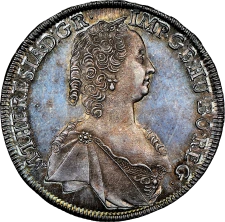
The Renaissance brought both expanded artistic ambition and the silver thaler, which would permanently reshape the coinage world. Struck first from the rich silver deposits of Joachimsthal in Bohemia in 1518, the large silver taler (a contraction of Joachimsthaler) established the template for large-denomination silver coins that spread across Europe and ultimately gave the world the word "dollar." Spanish 8-reale coins — the famous Pieces of Eight — were struck in massive quantities from New World silver and became the first true global trade currency, circulating from Cadiz to Canton and accepted in markets that had never seen a European ship. The Maria Theresa Thaler, struck continuously with the date 1780 to this day, remains one of the most extraordinary monetary artifacts in history — still accepted as currency in parts of East Africa and the Arabian Peninsula.
Ancient Greek Tetradrachms
Athens, Macedonia, Corinth, Syracuse — the most artistically admired coins ever struck, from the golden age of Greek civilization.
Roman Imperial Coins
Gold aurei, silver denarii, and bronze sestertii bearing the portraits of history's most famous emperors — from Augustus to Constantine.
Byzantine Gold Solidi
The stable gold coinage of the Eastern Roman Empire — Christ portraits, imperial regalia, and over a thousand years of monetary continuity.
Medieval Silver Thalers
The large-format silver coins of Renaissance Europe — German states, Austrian domains, and Spanish reales that financed global commerce.
Royal Gold Coins
British sovereigns, French francs, German marks, and Italian lire — the 19th-century gold standard era's most beautiful bullion coins.
Euro Rarities
Vatican, Monaco, and San Marino euros — micro-state issues with tiny mintages that command enormous premiums over face value.
European Coin Explorer
Browse by Era • Click Any Coin for Details & eBay Listings




Royal Gold — Europe's Prestige Coinage
Sovereigns, Francs, Marks & the Gold Standard Era
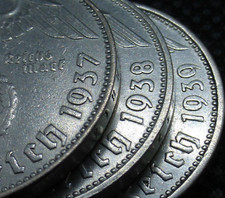
The 19th century produced Europe's most widely collected modern gold coins — the sovereign, the 20-franc piece, the 20-mark, and their counterparts across the continent's monarchies. Struck in standardized weights and fineness across competing national mints, these coins represent the gold standard era at its apex: a period when European nations backed their currencies with actual gold, producing coins of consistent quality and recognized purity that circulated internationally with confidence on both sides of the Atlantic. The British gold sovereign — featuring the iconic Benedetto Pistrucci design of St. George slaying the dragon — is the most recognized and most collected of all European gold coins, struck from 1817 onward and still produced today by the Royal Mint for bullion investors and collectors worldwide.
The French 20-franc gold piece, struck in the Latin Monetary Union's standard of .1867 troy ounces of .900 fine gold, circulated across France, Italy, Switzerland, Belgium, and Greece through an international agreement that predated the euro by over a century. The Rooster (Coq Gaulois) and Marianne designs, along with the Napoleon and Ceres types, are among the most widely available and most affordably priced 19th-century European gold coins today — making them an ideal entry point for collectors interested in quality gold at modest premiums over melt. The German 20-mark gold coins bearing the portraits of Wilhelm I, Friedrich III, and Wilhelm II are equally prized for their portrait quality and the historical weight they carry as artifacts of Imperial Germany.
Building a European Coin Collection
Ancient or Modern — Choosing Your Era and Managing Authenticity
Building a European coin collection requires one critical decision before any purchase: which era or era combination will anchor the collection. Ancient coins — Greek and Roman — offer unparalleled historical depth and genuine connection to classical civilization, but they introduce the challenge of authenticity that no other area of numismatics presents so acutely. The ancient coin market contains a significant number of modern forgeries and ancient imitations, making knowledge and trusted sourcing essential. Reputable ancient coin dealers who are members of the Professional Numismatists Guild (PNG) or the International Association of Professional Numismatists (IAPN) are the starting point; for significant purchases, NGC Ancients certification provides third-party authentication and attribution.
For collectors drawn to medieval and modern European coins, PCGS and NGC certification provides the same protection it offers in American numismatics — an objective grade, authentication confirmation, and the liquidity advantage that comes with a universally recognized holder. The great 19th-century royal gold coins — sovereigns, francs, marks, and their equivalents — are among the most straightforward European coins to collect, as their compositions and weights are standardized and their authentication is generally straightforward for established types. The most rewarding European collections tend to combine era breadth with subject focus: a collection tracing the portrait evolution of Roman emperors, or the thaler series of a specific German state, creates a coherent narrative that makes the collection more than the sum of its individual pieces.
Shop European Coins on eBay
Browse thousands of certified ancient Greek, Roman, medieval, and royal gold coins — PCGS and NGC graded examples, key dates, and scarce issues from specialist dealers worldwide.
🛍️ Shop European Coins on eBay 📚 European Coin References on AmazonFindRareCoins.com participates in the eBay Partner Network and Amazon Associates program. Purchases made through links on this page may earn us a commission at no additional cost to you.
Frequently Asked Questions
What are the most valuable European coins for collectors?
At the top of the market, ancient Greek coins — particularly the Syracuse decadrachm and the Athens Owl tetradrachm in exceptional condition — and rare Roman gold aurei of notable emperors routinely realize six figures at major international auctions. Among medieval coins, the Edward III "Double Leopard" gold florin (only three known) and early Venice ducats in pristine condition are among the most valuable. In the modern royal gold category, a proof British sovereign of the Victorian era in gem condition or a rare German state thaler with low mintage and outstanding surfaces can command many thousands of dollars. The key variables across all European numismatics are rarity, condition, provenance, and historical significance — the intersection of all four produces the most valuable specimens.
How do I know if an ancient European coin is authentic?
Authentication of ancient coins is one of the most important skills in European numismatics, because the market for ancient forgeries is substantial and sophisticated. The most reliable protection for new collectors is purchasing from established dealers who are members of the Professional Numismatists Guild (PNG) or the International Association of Professional Numismatists (IAPN), both of which enforce codes of conduct and authenticity guarantees. NGC Ancients certification provides third-party authentication and attribution for Greek and Roman coins, and an NGC-certified ancient coin carries the authentication guarantee of the world's largest coin grading service. Physical characteristics to examine include die alignment, metal composition, wear patterns consistent with age, and surface details that reflect genuine ancient engraving rather than cast or electrotype reproduction.
What is the difference between a thaler and a dollar?
The word "dollar" is directly derived from "thaler" — specifically from "Joachimsthaler," the name given to large silver coins struck from the silver mines of Joachimsthal (Saint Joachim's Valley) in Bohemia beginning in 1518. The Joachimsthaler set the standard for large silver coinage across Europe, and its name was progressively shortened through "taler," "thaler," "daler," and ultimately "dollar" as the terminology spread through the Dutch, German, Scandinavian, and eventually English-speaking worlds. The Spanish silver 8-reales coin — the famous Piece of Eight — was commonly called a "dollar" in colonial America because of this shared heritage. When the United States established its monetary system in 1792, "dollar" was the natural choice for the primary silver denomination, permanently cementing the linguistic connection between the Bohemian thalers of the 16th century and modern American currency.
Are British gold sovereigns a good investment?
British gold sovereigns occupy a unique position as both numismatic collectibles and bullion coins, which makes them one of the most flexible gold holdings available to collectors. Each sovereign contains .2354 troy ounces of .917 fine gold, giving even common-date examples a meaningful melt value that provides a floor to their market price. Key-date and high-grade specimens carry numismatic premiums well above bullion value. The sovereign's universal recognition — accepted by gold dealers worldwide — ensures excellent liquidity. For collectors interested in the intersection of history, artistry, and gold investment, the sovereign is difficult to match. As with all numismatic purchases, condition is critical: a PCGS or NGC certified MS63 or higher sovereign commands a meaningful premium over the same date in circulated grades. The advice applies here as everywhere — buy the coin, not the holder, and focus on quality strike and original luster.
What European coins are best for beginning collectors?
Beginning European coin collectors have several excellent entry points depending on budget and interest. For ancient coins, common-date Roman imperial denarii in Fine to Very Fine condition represent genuine 2,000-year-old silver at prices starting around $30–$75 for recognizable emperors like Hadrian, Antoninus Pius, or Septimius Severus. These provide immediate connection to classical history at very accessible prices. For medieval and renaissance coins, circulated German states thalers and Maria Theresa Thalers offer large, beautiful silver coins with centuries of history at modest premiums. For modern gold, the French 20-franc "Rooster" gold piece provides genuine 19th-century European gold at very close to melt value — an excellent introduction to collecting gold before moving into rarer and more expensive issues. Regardless of era, joining a numismatic organization like the American Numismatic Association (ANA) provides access to educational resources, publications, and communities of collectors who can accelerate the learning curve significantly.
Why do Vatican, Monaco, and San Marino euro coins command high premiums?
Vatican City, Monaco, and San Marino are sovereign micro-states within or adjacent to Italy that are entitled to mint euro coins under agreements with the European Union. Because their populations are tiny — Vatican City has fewer than 1,000 residents, Monaco around 40,000, San Marino around 34,000 — their annual coin mintages are dramatically smaller than those of major eurozone nations like Germany or France, which produce hundreds of millions of each denomination annually. A Vatican 2-euro coin issued in a commemorative series may have a total mintage of 100,000 or fewer, compared to tens of millions for the same denomination from Germany. This scarcity, combined with the collector appeal of the Holy See's annual designs featuring reigning popes, drives premiums of 10x to 100x face value for common issues and far more for scarce commemoratives. Complete year sets from these micro-states, in original mint packaging, are among the most actively traded items in modern European numismatics.
The definitive illustrated reference to the world’s greatest coins and a professional guide to building a spectacular collection, featuring more than 3000 images
 '
'