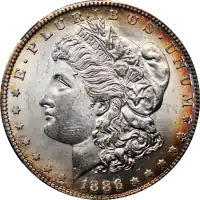
Morgan Dollars
Key Dates • Carson City • VAM Varieties • Gem Uncirculated
America's Most Collected Silver Coin
The Bland-Allison Act, George T. Morgan & the Birth of an Icon
The United States Morgan dollar holds a special place in the annals of American numismatic history, and its fascinating story unfolds through a rich tapestry of legislative acts, economic pressures, and the creative vision of a gifted British-born engraver. Its origins trace to 1878 — a year when the nation was grappling with a pronounced shortage of silver coinage. The silver boom of the 1850s and 1860s had produced a surplus of the metal, and Congress moved to address the imbalance through legislation that would directly shape the next four decades of American coinage.
On February 28, 1878, Congress passed the Bland-Allison Act, mandating the production of a new silver dollar and requiring the Treasury to purchase between two and four million dollars' worth of silver each month for coinage. The new dollar would be named after its designer: George T. Morgan, a highly talented British engraver who had emigrated to the United States and was working at the Philadelphia Mint as an assistant engraver. Morgan's design was a testament to his artistic mastery — a dignified left-facing Liberty portrait on the obverse, modeled after Anna Willess Williams of Philadelphia, and a powerful eagle with spread wings on the reverse. The result was a coin that transcended its legislative origins to become a beloved numismatic icon.
Minting History & Economic Legacy
The Bland-Allison Act, the Pittman Act & Four Decades of Silver
The Morgan dollar was minted continuously from 1878 to 1904, and briefly again in 1921 — a production history closely tied to the nation's fluctuating silver reserves and shifting legislative mandates. The Sherman Silver Purchase Act of 1890 increased required silver purchases, temporarily boosting output at all five minting facilities: Philadelphia, New Orleans, San Francisco, Carson City, and Denver. When silver reserves dwindled by 1904, production halted entirely. The coin's reappearance in 1921 was authorized by the Pittman Act of 1918, which allowed melted silver dollars — many destroyed to supply silver to Britain during World War I — to be recoined. That final year of production gave collectors the highest-mintage Morgans in the entire series.
The Morgan dollar's minting history created enormous variation in rarity. Low-mintage branch mint coins — particularly those from the Carson City Mint, operating in Nevada's silver country from 1870 to 1893 — are the most prized. The CC mint mark on a Morgan dollar signals frontier-era production at one of America's most romantic minting facilities, operating in a silver-boom boomtown just miles from the Comstock Lode. Carson City Morgans carry a premium at virtually every grade level and are among the most avidly collected coins in all of U.S. numismatics.
Morgan Dollar Key Dates & Values
From Common Dates to the King of Morgans
| Date & Mint | Mintage | Notes | Value Range |
|---|---|---|---|
| 1893-S | 100,000 | King of the Morgan series; even low grades worth thousands | $2,000 – $500,000+ |
| 1895 (Proof Only) | 880 proofs | No business strikes; circulation examples are counterfeits | $30,000 – $150,000+ |
| 1889-CC | 350,000 | Most valuable Carson City Morgan; gem examples extremely rare | $3,000 – $300,000+ |
| 1884-S | 3,200,000 | Low survival rate; scarce in all grades above VF | $100 – $50,000+ |
| 1895-O | 450,000 | Most melted; scarce across all grades | $200 – $100,000+ |
| 1903-O | 4,450,000 | High mintage but poorly struck; true gems extraordinarily rare | $100 – $50,000+ |
| 1878-CC | 2,212,000 | First-year Carson City; highly sought as an inaugural CC issue | $150 – $30,000+ |
| 1921 (P/D/S) | 84,000,000+ | Final year; highest mintage; common in most grades | $25 – $500+ |
Morgan Dollar Collecting Categories
How Collectors Approach America's Most Popular Coin Series
Morgan Dollars
Key dates, Carson City rarities, gem Mint State examples — the most collected U.S. coin series by active collectors.
Peace Dollars
The Art Deco successor to the Morgan — 1921 through 1935. The 1928 key date and gem high-grade examples are most sought.
Classic Early Dollars
Flowing Hair, Draped Bust, Seated Liberty, Trade Dollars — America's silver dollar history from 1794 to 1873.
Modern Dollar Coins
Eisenhower, Sacagawea, Presidential, American Innovation — 20th and 21st century U.S. dollar collecting.
VAM Varieties
Van Allen-Mallis varieties — die varieties catalogued by date, mint, and die characteristics. The deepest Morgan rabbit hole.
Carson City Morgans
CC mint mark issues from Nevada's frontier silver capital — among the most romantically significant coins in American numismatics.
U.S. Dollar Coin Explorer
Browse by Series • Click Any Coin for Details & eBay Listings


George T. Morgan's Artistic Legacy
The Engraver Who Defined American Silver Coinage
George T. Morgan arrived in the United States from Birmingham, England, in 1876 — recruited by Mint Director Henry Linderman specifically to bring fresh artistic talent to the Philadelphia Mint. His path to the Morgan dollar began in earnest when he sought a model for his Liberty portrait. He found her in Anna Willess Williams, a Philadelphia schoolteacher whose classical profile caught Morgan's attention. Williams sat for five sittings with Morgan, and her features became the iconic Liberty face that would circulate in American commerce for decades. Williams, a private person who initially wished to remain anonymous, eventually became something of a celebrity once her identity as Morgan's model became public.
Morgan's design was both technically accomplished and artistically bold. The high-relief portrait of Liberty — wearing a coronet inscribed with the word LIBERTY — projected a dignity befitting America's aspirations in the Gilded Age. The reverse eagle, with wings spread and arrows and olive branch clutched in its talons, matched the obverse's authority. Morgan himself was meticulous about his craft, and the quality of his design work — particularly the detail in Liberty's hair and the eagle's feathers — has kept the Morgan dollar beloved by collectors and artists alike for well over a century. His initials, M, appear at the truncation of Liberty's neck on the obverse.
Collector Appeal, Certification & the VAM World
Why Morgan Dollars Dominate American Numismatics
Morgan dollars are by nearly every measure the most actively collected coin series in American numismatics. Their combination of large size, intricate design, historical significance, and extraordinary date-and-mint variety creates a collecting field that can occupy collectors for a lifetime. A complete date-and-mint Morgan set spans 96 distinct issues across five minting facilities — a pursuit that ranges from modestly priced common dates to the supremely rare 1893-S and the proof-only 1895, both of which require serious resources to acquire in any condition.
High-grade certified examples from PCGS and NGC command significant premiums, and the Morgan dollar is one of the most actively contested series in competitive registry set collecting. Beyond standard date-and-mint collecting, the VAM (Van Allen-Mallis) variety collecting system has catalogued hundreds of distinct die varieties within the series — each with its own characteristics, populations, and demand. VAM collectors examine die markers, mintmark positions, and design differences at a microscopic level, finding meaningful distinctions between coins that appear identical to the casual eye. For the most dedicated Morgan collectors, VAM collecting transforms the series into an essentially inexhaustible field of numismatic discovery.
Shop Morgan Dollars on eBay
Browse thousands of certified and raw Morgan dollars — key dates, Carson City rarities, VAM varieties, and gem Mint State examples from specialist dealers and private collections.
🛍️ Shop Morgan Dollars on eBay 📚 Morgan Dollar References on AmazonFindRareCoins.com participates in the eBay Partner Network and Amazon Associates program. Purchases made through links on this page may earn us a commission at no additional cost to you.
Frequently Asked Questions
What is the most valuable Morgan dollar?
The 1893-S Morgan dollar is universally recognized as the king of the series — struck at the San Francisco Mint with only 100,000 coins produced, most of which circulated heavily in the American West. Even in poor condition, the 1893-S is worth thousands of dollars; gem uncirculated examples have sold for over $500,000. The 1895 Morgan is the other supreme rarity — no business strikes were made that year, only 880 proofs, meaning any circulated "1895 Morgan" is a counterfeit. Among Carson City issues, the 1889-CC is the most valuable, with only 350,000 struck and most circulating heavily before being saved by collectors.
How do I know if my Morgan dollar is worth anything?
Start with the date and mint mark: the mint mark (or absence of one) appears on the reverse below the eagle. Philadelphia coins have no mint mark; Carson City coins show CC; San Francisco shows S; New Orleans shows O; Denver shows D (Denver only struck Morgans in 1921). Common dates in heavily circulated condition — VG through Fine — are worth roughly their silver melt value, currently $15–$25 for a 0.7734 oz silver coin. Key and semi-key dates in any condition are worth significantly more. Any coin in truly uncirculated (Mint State) condition, regardless of date, is worth a premium over circulated examples. For a definitive answer, consult the current PCGS or NGC price guide for your specific date, mint mark, and grade.
What does the CC mint mark mean on a Morgan dollar?
The CC mint mark stands for Carson City, Nevada — the site of one of the most historically significant branch mints in American history. The Carson City Mint operated from 1870 to 1893, located in the heart of Nevada's Comstock Lode silver mining country. It was established specifically to process the enormous silver output of the region and convert it directly into coinage, reducing the need to ship raw silver east to Philadelphia. Carson City Morgans are universally valued above their Philadelphia counterparts due to lower mintages, the romance of frontier-era production, and strong collector demand that has persisted for well over a century. The CC mint mark appears on Morgan dollars from 1878 through 1893.
What are VAM Morgan dollars?
VAM stands for Van Allen-Mallis — a reference to Leroy Van Allen and A. George Mallis, who catalogued die varieties for Morgan and Peace dollars in their foundational reference work. Because Morgan dollars were produced at multiple mints using many different working dies over decades, slight differences exist between coins struck from different die pairs — variations in mintmark position and size, repunched dates, die gouges, cracks, and design characteristics. VAM collectors identify and collect these varieties, with some VAMs commanding significant premiums over standard examples. The VAMWorld website is the primary online resource; Morgan and Peace Dollar VAM information is also published by the Society of Silver Dollar Collectors.
Should I have my Morgan dollar certified?
PCGS or NGC certification is strongly recommended for any Morgan dollar worth more than $100–$150. The grade premium on Morgans can be enormous — an MS63 might sell for $150 while the same date in MS65 commands $1,500 or more. Certification provides an objective, third-party grade that increases buyer confidence and liquidity significantly. It also guards against the real risk of cleaned or altered coins in this series — Morgan dollars were frequently cleaned and polished by previous owners, and a cleaned coin in a raw holder can look deceptively appealing while being worth a fraction of an uncleaned example at the same apparent grade. For key dates like the 1893-S or 1889-CC, certification is essential regardless of grade.
What is the difference between a Morgan dollar and a Peace dollar?
The Morgan dollar (1878–1921) features George T. Morgan's left-facing Liberty portrait with an eagle reverse, struck in 90% silver (.7734 oz of silver per coin). The Peace dollar (1921–1935) replaced the Morgan after World War I with a new design by sculptor Anthony de Francisci — a right-facing Liberty with a radiant crown on the obverse and a perched eagle clutching an olive branch with "PEACE" inscribed at the base on the reverse. The Peace dollar's design was specifically intended to commemorate the armistice ending World War I. Both coins contain identical silver content and weight. Collectors typically pursue one or both series, with the Morgan offering far more date-and-mint variety and the Peace dollar's Art Deco design widely considered more artistically sophisticated.

Guide Book of Morgan Silver Dollars - Features hundreds of full-color photographs, including high-quality images of toned coins, Proofs, errors, and rare varieties.
 '
'