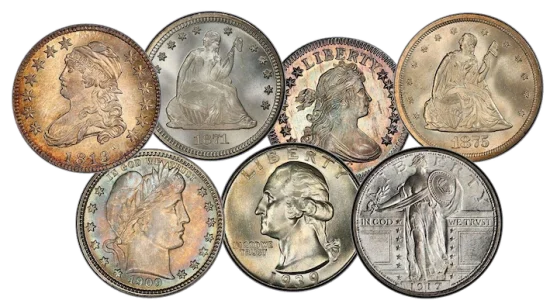
Historic quarter dollar coins in early styles

United States Quarters

Early History of the Quarter Dollar

The quarter coin, also known as the twenty-five-cent piece, has a story that begins in 1796. It was introduced shortly after the Coinage Act of 1792, which was signed by President George Washington. This act established the U.S. Mint and authorized several coin denominations, including the quarter dollar. At first, the design featured Liberty and an eagle, reflecting American ideals. Over time, the quarter evolved to match the changes in culture, politics, and coin technology.

Design Changes Over Time

Throughout its history, the quarter has seen many artistic transformations. Each version represents its era and highlights the values of the time. Notably, quarters have featured these major designs:

Historic Styles and Time Periods

  • Draped Bust (1796โ€“1807): Classic image of Liberty surrounded by stars.
  • Capped Bust (1815โ€“1838): More refined profile with added details.
  • Seated Liberty (1838โ€“1891): Liberty seated with a shield and staff.
  • Barber (1892โ€“1916): Simple and modernized head of Liberty.
  • Washington (1932โ€“present): Introduced during the bicentennial of Washington’s birth and still used today.

Specifications and Composition

Todayโ€™s quarter weighs 5.670 grams and measures 24.26 mm in diameter. Most modern issues are made of copper and nickel, though some proofs use silver. Originally, older quarters were composed of 90% silver, making them prized by collectors.

Minting and Distribution

Quarters are minted at facilities in Philadelphia, Denver, and San Francisco. Mint marks, such as “D” or “S,” help identify the origin. In recent years, circulating quarters often feature state, national park, or innovation themes.

The Evolution of the U.S. Quarter: Unique Designs and Hidden Stories

Collecting United States Quarters

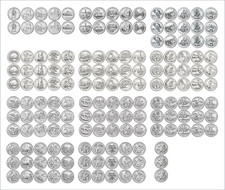
Many collectors start with Washington quarters due to their availability. Rare dates or errors add excitement and value. Additionally, older quarters with silver content hold both historical and investment appeal. Begin with clear, legible coins. Check for original surfaces and avoid cleaned examples. Proof sets, especially those with silver content, offer strong value. You can build sets by date, mint mark, or theme.

A Lasting Legacy

The quarter coin has traveled through centuries of American life. From its roots in early legislation to its role in daily commerce, it remains a powerful symbol. Whether you’re studying history or building a coin collection, the U.S. quarter offers insight, value, and tradition.

The Draped Bust Quarter of 1796

The very first quarters minted in 1796 featured a design that would be referred to as the Draped Bust type. On the obverse side, these early quarters showcased an elegant portrayal of Liberty, who was facing right. Liberty’s depiction included flowing hair and a small cap, symbolizing the spirit of freedom. The reverse side displayed a majestic eagle with outstretched wings, perched upon an olive branch and clutching arrows in its talons, all surrounded by a wreath. These early quarters were composed of a mixture of 89.24% silver and 10.76% copper, and they had a diameter of 27 millimeters, bearing the promise of a young nation.

The Transition to the Capped Bust Quarter

However, coinage design is an ever-evolving art, and in 1804, the quarter underwent a transformation. The Capped Bust type was introduced, featuring a new representation of Liberty. This time, Liberty was depicted wearing a cap and facing to the left. The reverse design still retained the eagle but was updated with a larger, more impressive eagle, and a modified wreath.