
Silver War Nickels: History, Composition & Collector Value
From 1942 to 1945, the U.S. Mint replaced nickel with silver to support the war effort — creating a fascinating subset of Jefferson Nickels that collectors prize for their history, composition, and surprisingly strong value today.
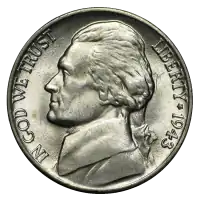
When the United States entered World War II, the demand for strategic metals transformed American coinage in ways that are still visible in coin rolls and junk silver lots today. The five-cent piece — the humble nickel — became a casualty of wartime resource priorities. From mid-1942 through 1945, the U.S. Mint produced Jefferson Nickels with a radically different composition: 35% silver, 56% copper, and 9% manganese. The result was a coin unlike anything before or since in American numismatic history — and one that remains among the most accessible and historically resonant pieces a collector can own.
Silver Content
Years Minted
Troy Oz Silver Each
Total Minted
Why the U.S. Mint Used Silver
Nickel was classified as a critical war material by 1942. The metal was essential for hardening steel used in armor plating, artillery casings, and military vehicle components. With global nickel supplies under severe strain, the War Production Board directed the U.S. Mint to eliminate nickel from the five-cent coin entirely.
The replacement alloy — 56% copper, 35% silver, and 9% manganese — was chosen specifically because it could be distinguished from the standard nickel composition by banks and the Federal Reserve. The plan from the outset was to recover the silver-bearing coins after the war and remelt them. That recovery never happened at scale, which is why Silver War Nickels remain widely available to collectors today — a fortunate accident of wartime policy that created a genuinely historical silver coin at an accessible price point.
Silver 35%
Manganese 9%
How to Identify a Silver War Nickel
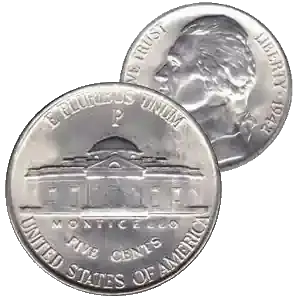
The Large Mint Mark Above Monticello
The single most reliable identifier is the large mint mark on the reverse, positioned directly above the dome of Monticello. War Nickels carry a P, D, or S mint mark in this location — notably, this was the first time in U.S. history that the Philadelphia Mint used a mint mark on any coin. The oversized placement was deliberate, making it easy for banks and tellers to quickly identify the silver-bearing pieces for potential post-war removal.
The 1942 Split Year: Use caution with 1942 nickels — both standard (pre-war) and silver compositions were produced that year. The silver version always has the large mint mark above Monticello. A 1942 nickel without that large overhead mint mark is the standard copper-nickel composition and contains no silver.
Color and Feel
Circulated Silver War Nickels often display a darker, more muted gray tone compared to standard Jefferson Nickels — a result of the manganese content, which oxidizes differently from nickel. In higher grades, they can show a warm silvery luster distinct from either copper-nickel or pure silver coins. The manganese content also makes them slightly more prone to environmental toning over time.
Mintages and Key Dates
| Date & Mint | Mintage | Notes | Approx. Value (Circulated) |
|---|---|---|---|
| 1942-P | 57,900,600 | First year; Philadelphia's first-ever mint mark on a coin | $2–$4 |
| 1942-S | 32,900,000 | Lower mintage first-year issue | $3–$6 |
| 1943-P | 271,165,000 | Highest single mintage of the series | $2–$3 |
| 1943-D | 15,294,000 | Scarcer date, harder to find in high grades | $3–$8 |
| 1943-S | 104,060,000 | Common circulated, premium in MS-65+ | $2–$4 |
| 1944-P | 119,150,000 | Strong collector demand for full steps | $2–$4 |
| 1944-D | 32,309,000 | Scarcer in gem grades | $3–$7 |
| 1944-S | 21,640,000 | Low mintage, popular with West Coast collectors | $3–$8 |
| 1945-P | 119,408,100 | Last high-mintage year | $2–$4 |
| 1945-D | 37,158,000 | Moderate scarcity in gem condition | $3–$7 |
| 1945-S | 58,939,000 | Final year; popular bookend for complete sets | $2–$5 |
Collector Value and Silver Content
Each Silver War Nickel contains approximately 0.0563 troy ounces of silver, giving every circulated example a floor value tied directly to the silver spot price. At $30 silver, that's roughly $1.70 per coin in melt value alone — making junk rolls of Silver War Nickels a straightforward way to accumulate a modest silver position at minimal premium over spot.
But the real collector interest lies above melt value. Certified examples in MS-65 and higher — particularly those earning the coveted Full Steps (FS) designation from PCGS or NGC — can command significant premiums. Full Steps refers to the complete separation of the steps on the reverse depiction of Monticello, a detail that was frequently lost to weak strikes and die wear. A 1943-D in MS-66 Full Steps, for example, is a genuinely rare coin that sells for hundreds of dollars; the same date in circulated condition is worth a few dollars over silver.
At $30/oz silver, each coin contains roughly $1.70 in silver. Circulated rolls trade close to this floor, making them popular for stacking silver on a budget.
Gem uncirculated examples without Full Steps designation typically bring $20–$60 depending on date and mint mark. Well above melt but still accessible.
The premium designation for this series. MS-65 FS examples can bring $50–$500+. Scarcer dates like the 1943-D or 1944-D in MS-66 FS are genuinely rare coins.
An 11-coin complete set covering all dates and mint marks is an achievable collecting goal at modest cost in circulated grades — a popular entry point for new collectors.
Collecting Strategy
Start with a Complete Circulated Set: All 11 date/mint combinations in Very Fine to Extremely Fine condition can be assembled for under $50 total — one of the most affordable complete wartime sets in all of U.S. numismatics. It's an ideal project for newer collectors who want a finished set with historical context.
For collectors pursuing investment-grade examples, focus your attention on the lower-mintage issues in certified grades: the 1943-D, 1944-D, and 1944-S are the most challenging to find in gem condition. Before purchasing any certified example, pull the PCGS or NGC population report for that specific date, mint mark, and grade — for Full Steps designations especially, the certified populations are small enough that condition rarity drives real price premiums.
- Examine mint marks carefully under magnification — clarity and centering affect eye appeal and grade
- Store certified examples in original holders; raw coins benefit from acid-free flips or 2x2 holders
- Avoid cleaning — manganese toning is natural and expected; cleaned coins lose collector premium entirely
- Track silver spot prices if accumulating for bullion value — circulated rolls fluctuate with silver markets
- Consider building a registry set focused on Full Steps designations for a long-term collecting challenge
Shop certified Silver War Nickels — circulated sets, gem examples, and Full Steps coins from verified sellers.
Shop Silver War Nickels on eBay
Shop Certified Full Steps Examples
Frequently Asked Questions
How do I know if my nickel contains silver?
Are Silver War Nickels worth saving from circulation?
What does "Full Steps" mean on a Jefferson Nickel?
Which Silver War Nickel is the hardest to find?
Can I melt Silver War Nickels for their silver content?
More at FindRareCoins.com: 1943 Steel Cents · Mint Error Coins · Precious Metals Guide · Coin Collecting Guide · Investing in Rare Coins
 '
'