
Rainbow Toned Coins: Color, Chemistry & Collector Value
What causes rainbow toning, how to distinguish natural from artificial color, which coins tone most beautifully, and everything you need to build a stunning toned coin collection.
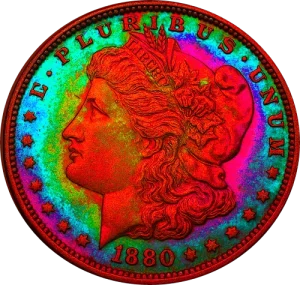
Among all the qualities that drive value in numismatics — rarity, grade, strike quality, provenance — few are as immediately arresting as rainbow toning. A Morgan Dollar shimmering with electric blues, deep purples, and fiery reds across its luster fields stops collectors in their tracks. These coins aren't just rare pieces of monetary history; they're miniature canvases painted by time, chemistry, and circumstance. No two toned coins are alike, and the most spectacular examples command prices that would astonish anyone who thinks of tarnish as a flaw.
This guide covers everything you need to know to collect rainbow toned coins intelligently — from the science behind the colors to identifying artificial toning, from the series that tone most beautifully to building a collection that consistently appreciates in both aesthetic and market value.
The Science Behind Rainbow Toning
Toning is controlled tarnish — and understanding the chemistry helps you evaluate what you're looking at. When silver comes into contact with sulfur compounds present in air, storage materials, or coin holders, it forms silver sulfide (Ag₂S) on the coin's surface. This layer is extraordinarily thin — measurable in nanometers — but its thickness determines exactly which wavelengths of light are reinforced through thin-film interference.
The same principle produces the colors in soap bubbles and oil slicks. As the silver sulfide layer builds up over time:
- Very thin layers (earliest toning) reflect blue and violet — the shortest wavelengths
- Slightly thicker layers shift toward green and teal
- Moderate layers produce gold and amber tones
- Thicker layers shift into red, orange, and russet
- Heavy toning eventually produces dark brown or black — the endpoint of the toning process
Silver sulfide toning progression: blue → purple → teal → green → gold → orange → red → dark russet
The storage environment is the primary driver of toning pattern. Old coin albums — particularly Wayte Raymond holders and National albums from the 1930s–1960s — used sulfur-containing adhesives and paper that reacted with silver over decades, producing the coveted "album toning" seen on so many beautifully toned Morgan and Peace Dollars. Canvas Mint bags, paper rolls, and even wooden storage boxes all impart characteristic toning patterns that experienced collectors can often identify at a glance.
Why location in the roll or album matters: Coins at the ends of a roll or at the edges of an album page are exposed to more reactive compounds than coins in the middle. This is why "end roll toners" and coins stored at album edges often show more dramatic color — and why matching toning patterns within a set can help confirm that coins were stored together in the same original holder.
Natural vs. Artificial Toning: The Most Important Distinction
The single most critical skill in toned coin collecting is distinguishing natural toning from artificial toning. Artificial toning — applied chemically, with heat, or through exposure to reactive substances — is used to deceive buyers into paying premiums for coins that wouldn't otherwise merit them. Grading services catch a significant percentage of artificially toned coins, but some reach the market in raw form, and even certified coins occasionally raise questions.
⚠️ Red flags for artificial toning: Overly uniform color patterns with no variation or gradient — natural toning is irregular and follows the coin's surface topography. Chemical or acidic smell when the holder is opened. Colors that appear "painted on" rather than growing from the luster. Toning that sits on top of marks or hairlines rather than developing around them. Patterns that don't correspond to any known natural storage scenario. When in doubt, buy certified — PCGS and NGC both reject artificially toned coins.
Natural toning, by contrast, has a characteristic depth and integration with the coin's surface. The colors appear to emerge from the luster rather than being applied on top of it. Transitions between color zones are gradual and organic. The toning follows the coin's physical geography — fields tone differently than devices, and recessed areas accumulate color differently than high points.
The "AT" Problem in the Market
Artificially toned coins (abbreviated "AT" in collector shorthand) are a persistent market issue, particularly for Morgan Dollars — the series most aggressively targeted because original toned examples command the highest premiums. Before buying any raw toned Morgan or Peace Dollar above $200, a working knowledge of AT identification is essential. The PCGS and NGC forums maintain extensive photographic references of known AT patterns that are worth studying before you spend serious money.
The Best Series for Rainbow Toning
While any silver coin can develop toning under the right conditions, certain series are celebrated for producing the most spectacular and consistent rainbow examples. Understanding which series to focus on — and why — sharpens your eye and your buying strategy.
The undisputed king of rainbow toning. Large surface area, high luster, and decades of canvas bag and album storage produced the most spectacular toned examples in all of American numismatics. Monster toners routinely sell for 5–10× their untoned value.
Often develop softer, more pastel toning than Morgans due to their higher-relief design and different die preparation. Particularly beautiful examples show gentle blues and golds with excellent eye appeal.
Stored in paper rolls, Franklins frequently develop crescent-shaped toning on the obverse — a highly recognizable and collectible pattern. Full Bell Line Franklins with vivid toning are actively pursued.
Small surface area but capable of surprisingly vivid color. Album-toned Roosevelt dimes in blue and gold are broadly affordable and make an excellent entry point for new toned coin collectors.
Album toning on pre-1965 silver Washingtons ranges from subtle pastels to full-spectrum rainbows. Frequently found in the Wayte Raymond and National albums that produced some of the hobby's most iconic toners.
Brilliant luster and intricate design surfaces interact beautifully with natural toning. Album-toned Mercury dimes in high grades with strong color are among the most visually appealing coins in American numismatics.
Toning Patterns: What Collectors Seek
Not all toning is created equal. Experienced collectors have developed a vocabulary for the patterns they value most — patterns that reflect specific storage histories and produce the most dramatic visual effects.
| Toning Pattern | Characteristics | Typical Origin | Collector Demand |
|---|---|---|---|
| Full Rainbow / "Monster Toner" | Complete spectrum across the full obverse or reverse; bold, saturated hues | Old album storage; canvas bag edge position | Extremely High — strongest premiums |
| Bullseye Toning | Concentric rings of color emanating from the center outward | Album page contact; circular pressure point | Very High — dramatic visual impact |
| Crescent / Edge Toning | Color concentrated along one edge in a crescent shape | End-roll position; partial album exposure | High — especially on Franklins and Morgans |
| Album Toning (Peripheral) | Color develops around the perimeter, fading toward the center | Wayte Raymond / National album storage | High — particularly on Morgan and Peace Dollars |
| Pastel / Soft Toning | Subtle, muted hues — often blues, golds, and pinks — without bold saturation | Gentle long-term aging in benign environments | Moderate — valued for elegance over drama |
| Target / Spotted Toning | Irregular spots or patches of color, often uneven | Environmental exposure; moisture contact | Low to Moderate — depends on overall eye appeal |
Certification: Why PCGS and NGC Matter for Toned Coins
Certification is more important for toned coins than for almost any other numismatic category. Here's why:
- Authenticity of toning: PCGS and NGC reject coins with artificial toning, removing the most significant risk for buyers. A slabbed toned coin has passed expert scrutiny for AT.
- Grade integrity: Toning can obscure surface details — hairlines, cleaning, and contact marks — that affect grade. Certification ensures the grade reflects the actual condition beneath the color.
- Market liquidity: Certified toned coins sell significantly faster and at stronger prices than raw examples. Buyers at auction and on eBay strongly prefer slabs for toned coins above $200.
- Preservation: PCGS and NGC holders protect the coin's toning from further oxidation and atmospheric exposure, preserving the exact color at the time of grading.
The PCGS Population Report shows exactly how many examples of a given coin have been certified at each grade — essential research for understanding relative scarcity in high grades. A toned Morgan in MS-65 might have thousands of certified examples; the same coin in MS-67 with exceptional color might have a handful.
Browse PCGS and NGC certified rainbow toned coins from verified eBay sellers.
Shop Rainbow Toned Morgans on eBay Shop All Certified Toned CoinsBuilding a Toned Coin Collection: Strategy & Tips
- Buy the coin, not just the toning: The underlying coin must be well-struck and problem-free. Rainbow toning on a weakly struck, bagmarked coin is still a weakly struck, bagmarked coin. Grade and strike quality matter regardless of color.
- Start with certified examples: Until your AT-detection skills are solid, buy only PCGS or NGC slabbed toned coins. The premium over raw pays for itself in avoided mistakes.
- Focus your series: Morgan Dollars are the most popular — and the most competitive — market for toned coins. Morgan specialists compete intensely for top examples. Roosevelt dimes, Franklin halves, or Mercury dimes offer equally beautiful toning with far less competition at the high end.
- Study known natural examples: The PCGS CoinFacts image gallery and the Heritage Auctions archive both contain thousands of certified natural toners. Spending time with these images trains your eye for what genuine toning looks like across different series.
- Track provenance when possible: Coins from named collections — "ex-Redfield hoard," "ex-Pittman collection" — carry documented storage histories that support toning authenticity and add collector appeal.
- Network with other toner collectors: The PCGS and CoinTalk forums have active toned coin communities where members share finds, debate authenticity, and trade. The accumulated knowledge in these communities is invaluable for developing your eye.
- Keep records: Document purchase date, seller, price paid, and toning description for every piece. This provenance documentation adds value when you sell and helps you track your own taste development over time.
Where to Find Rainbow Toned Coins
eBay is the largest single marketplace for toned coins — use precise search terms ("rainbow toned Morgan dollar PCGS MS65") and filter by sold listings to benchmark prices before buying. Heritage Auctions and GreatCollections regularly feature high-grade certified toners with excellent photography. Major coin shows (ANA, FUN, Long Beach) let you inspect toning in person under proper lighting — essential for developing your eye. Always request multiple photos when buying online; toning photographs differently under different lighting conditions, and a single image rarely captures the full visual character of a piece.
Frequently Asked Questions
Does toning hurt or help a coin's value?
How can I tell if a toned coin is naturally or artificially toned?
What is a "monster toner"?
Which albums produce the best toning?
Should I try to tone my own coins to increase their value?
More at FindRareCoins.com: How to Buy Coins Online Safely · Mint Error Coins Guide · Investing in Rare Coins · Top 10 Rarest U.S. Coins
 '
'