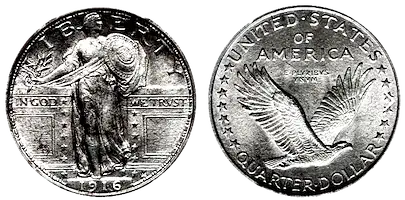
With only 52,000 struck at Philadelphia in December 1916, the Standing Liberty quarter's first-year issue is one of the most coveted key dates in all of American coinage.
Standing Liberty Quarter Value GuideThe 1916 Standing Liberty quarter is the premier key date of the Standing Liberty series — one of the most artistically celebrated coin designs in American numismatic history. Designed by sculptor Hermon Atkins MacNeil, the coin depicts Lady Liberty standing in a gateway with a shield and olive branch, wearing a revealing gown that caused public controversy upon its 1917 release and was modified the following year. Only 52,000 examples were struck at Philadelphia in late 1916, making the 1916 Standing Liberty quarter one of the rarest regularly issued 20th century U.S. coins.
1916 Standing Liberty Quarter Values by Grade
The Design Controversy
MacNeil's original 1916 design depicted Liberty with her right breast exposed — a classical artistic reference to the allegorical figure that generated immediate controversy when the coin reached the public in early 1917. Congress and the public demanded a modification, and in 1917 the design was altered to give Liberty a coat of chain mail covering her breast. This changed design (the Type 2) was used for all subsequent Standing Liberty quarters through 1930.
The 1916 and early 1917 quarters with the exposed-breast design are called Type 1. The 1916 is the only first-year Type 1 coin, struck before the controversy became public. The Type 1 design's limited production window — only late 1916 and the first half of 1917 — creates a naturally restricted supply that underpins the 1916's extraordinary rarity.
The Date Wear Problem
Standing Liberty quarters have a notorious weakness: the date is positioned in a recessed area that wears rapidly in circulation. On many Standing Liberty quarters, the date wears flat long before the rest of the coin shows significant wear — creating coins that appear Very Fine in design detail but show a completely flat, unreadable date. A 1916 with a worn-flat date is still identifiable through die characteristics but loses significant value.
In 1925 the Mint recessed the date further into the design to improve durability — coins dated 1925 and later show better date preservation. But 1916 examples with strong, full readable dates are particularly prized and command meaningful premiums over examples with weak or partially visible dates at equivalent grade levels.
Standing Liberty Quarter Key Dates — Full Series Context
| Date | Mintage | G-4 Value | VF-20 Value |
|---|---|---|---|
| 1916 (key date) | 52,000 | $4,500–$6,000 | $13,000–$18,000 |
| 1918/17-S Overdate | Unknown (variety) | $500–$800 | $3,000–$6,000 |
| 1921 | 1,916,000 | $100–$150 | $350–$500 |
| 1923-S | 1,360,000 | $75–$110 | $275–$400 |
| 1927-S | 396,000 | $75–$100 | $500–$800 |
| Common dates (avg) | 5M–15M+ | $8–$15 | $15–$30 |
Shop certified 1916 Standing Liberty quarters and key date examples.
🛍️ Shop on eBay 📚 Reference Books on AmazonFrequently Asked Questions
How much is a 1916 Standing Liberty quarter worth?
How do I identify the 1916 vs 1917 Type 1 Standing Liberty quarter?
Why does the date wear off Standing Liberty quarters?
Is the 1916 Standing Liberty quarter silver?
Are 1916 Standing Liberty quarters commonly faked?
What is the Full Head (FH) designation on Standing Liberty quarters?
Find your 1916 Standing Liberty quarter — one of American numismatics' finest key dates.
🛍️ Browse on eBay '
'