Quarter Error Coins
From rare State Quarter mistakes to doubled die Washington quarters — discover which 25-cent errors are worth serious money and how to find them.
The quarter is arguably the most searched denomination for error coins in the United States — and for good reason. Between the 50 State Quarters program (1999–2008), the D.C. and U.S. Territories series, and the America the Beautiful quarters, the Mint struck billions of 25-cent pieces over two decades with constantly changing designs. More designs mean more opportunities for errors, and more people actively looking at their quarters for variations.
Washington quarters have also produced some of the most dramatic and valuable errors in modern U.S. coinage — from 1965 quarters struck on leftover silver planchets to State Quarter errors worth thousands. This guide covers every major quarter error type, current values, and exactly what to look for. For regular Washington quarter values, see our coin price guides, and if you aren't sure what you have, our What's My Coin Worth guide walks you through it.
📌 Quarter errors span from common broadstrikes worth $20 to rare wrong-planchet errors worth $10,000+. The State Quarter series alone produced dozens of collectible errors — many still found in circulation today.
Most Valuable Quarter Errors by Date
| Coin | Error Type | Circulated | MS/PR-63+ | Shop |
|---|---|---|---|---|
| 2004-D Wisconsin Quarter | Extra Leaf High or Low | $40 – $100 | $75 – $300 | eBay → |
| 2005-P Kansas Quarter | “In God We Rust” (filled die) | $15 – $60 | $75 – $500 | eBay → |
| 1999-P Delaware Quarter | Spitting Horse (die crack) | $15 – $40 | $75 – $250 | eBay → |
| Any State Quarter | Reverse on Nickel Planchet | $500 | $2,000+ | eBay → |
| Any Date | Missing Clad Layer | $75 | $400 | eBay → |
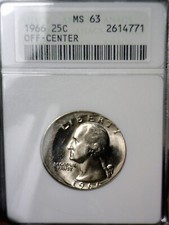
| Any Date | 50%+ Off-Center w/ Date | $75 | $300+ | eBay → |
| 1965 Washington Quarter | Struck on Silver Planchet | $7,000+ | $15,000+ | eBay → |
💡 For current Washington quarter values across all dates, see the FindRareCoins coin values guide. For error coins across all denominations, visit the complete error coins guide.





Most Valuable Quarter Error Types
Doubled Die Obverse or Reverse
Off-Center Strike
Wrong Planchet / Off-Metal
Broadstrike
Clad Layer Missing
Die Cap / Brockage
State Quarter Errors: The Collector's Gold Mine
The 50 State Quarters program (1999–2008) produced more widely collected error coins than any other modern U.S. series. With 50 different reverse designs struck at two mints (Philadelphia and Denver) over a decade, variations and errors were inevitable — and many circulated before anyone noticed.
2004-D Wisconsin Extra Leaf
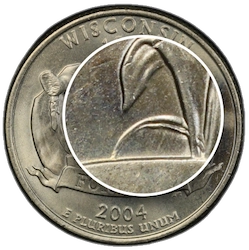
The most famous State Quarter error. On some Wisconsin quarters, an additional corn leaf appears either high or low on the left side of the corn stalk — a die gouge that was apparently not caught before striking. Two varieties exist: the "extra leaf high" and "extra leaf low." Both were found in roll searching in Arizona shortly after release and quickly attracted national attention. Circulated and lightly worn examples typically bring $40–$100, with certified MS-63 to MS-65 examples reaching $75–$300.
Off-Center State Quarters
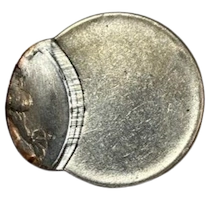
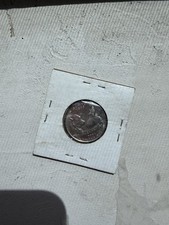
An off-center quarter happens when the blank isn't seated properly between the dies, so part of the design is struck and the rest of the blank is left smooth. State Quarters are especially popular this way, because collectors try to find one for each state. Value depends on how far off the strike is and whether the date and state name still show: a 10–20% off-center quarter typically brings $25–$75, while a dramatic 40–60% strike with a full date can reach $150–$600 or more.
For example, look at the rim first. A genuine off-center strike has a raised rim only on the struck side, while the blank side is flat and round. Coins that were bent, filed or hammered after leaving the Mint are worth face value, so check the edge and weight before paying a premium.
2005-P Kansas “In God We Rust”
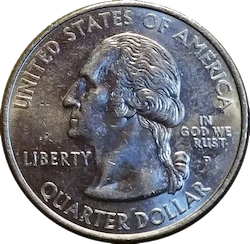
Grease filled part of a Philadelphia die, so the T in TRUST is weak or missing and the motto reads “IN GOD WE RUST.” Because it's a filled die rather than a die variety, strength varies a lot from coin to coin. Circulated examples usually bring $15–$60, while bold uncirculated coins with a fully missing T can reach $75–$500.
1999-P Delaware Spitting Horse
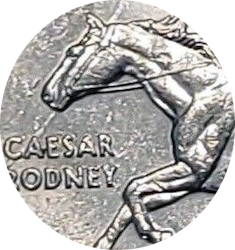
A die crack running from Caesar Rodney's horse's mouth creates the appearance of the horse spitting. An entry-level State Quarter error that's still found in circulation, worth $15–$75 depending on the size and clarity of the crack.
🔎 Pro tip: The best State Quarter errors are still being found in circulation and bank rolls. Focus your searching on Wisconsin (2004-D), Kansas (2005-P “In God We Rust”) and Delaware (1999-P), and set aside any quarter with part of its design missing — these are the most valuable and worth specifically hunting.
How to Check Your Quarters for Errors
The Weight Test
A normal clad Washington quarter weighs 5.67 grams. A quarter with a missing clad layer weighs approximately 4.5 grams. A quarter struck on a dime planchet weighs 2.27 grams. A precise digital scale (0.01g accuracy) is your best first tool for identifying wrong-planchet and missing-clad-layer errors.
The Visual Check
Under good lighting and a 5x loupe, examine the rim first — broadstrikes and missing collar errors are immediately visible. Then check the design elements for doubling, particularly "IN GOD WE TRUST," "LIBERTY," and the date. On State Quarters, scan the reverse design carefully for any extra elements, lines, or die cracks.
The Edge Check
Normal quarters have a reeded (grooved) edge. A quarter with a missing clad layer may show exposed copper on the edge. A broadstruck quarter has a smooth, spread edge with no reeding. Run your thumb around the edge before examining the faces — it's the fastest initial screen.
Related Error Coin Guides

Frequently Asked Questions
What State Quarter errors are worth the most money?
How do I know if my Wisconsin quarter has an extra leaf?
Is a quarter with no mint mark an error?
What is the rarest Washington quarter error?
How much is an off-center quarter worth?
Where can I find more coin values?
The Ultimate U.S. Error Coin Guide 2027 is a practical and easy-to-use reference designed to help you confidently identify, evaluate, and collect U.S. error coins.
 '