Advertising Disclosure: This page contains affiliate links. As an eBay Partner Network affiliate, FindRareCoins.com earns from qualifying purchases. As an Amazon Associate, we earn from qualifying purchases. We may also earn commissions from other dealers linked on this site, at no extra cost to you. Full disclosure
Half Dollar Error Coins
What each major error and variety is, how to spot it, and what it really sells for.
Collector's Value Guide
Half Dollar Error Coins Value Chart
Half dollar error coins range from $10 finds in a bank roll to five-figure proof rarities. The chart below covers the errors and varieties collectors ask about most. For a regular date, check the coin price guide, or run any coin through What's My Coin Worth. For every series and date, see the U.S. half dollar guide.
Values are approximate retail ranges for certified, problem-free coins. Top-grade pieces sell far higher: a 1964 Accented Hair graded PR-69 Deep Cameo brought $46,800 at Heritage in January 2024.
Half dollars sit in a sweet spot for error collectors. They are large enough that most errors show clearly to the naked eye. Even so, far fewer people search them than cents or quarters, so genuine finds still turn up in bank rolls and estate lots.
The series also covers three very different eras. Walking Liberty and Franklin halves are 90% silver, while most Kennedy halves are copper-nickel clad. As a result, you can build a set of errors by type, by series, or by both.
Quick value benchmark: Most circulated half dollar errors are worth $20–$200. In particular, dramatic errors on silver halves, such as heavy off-center strikes and double strikes, can bring four figures, while the rarest proof varieties go well beyond that.
Kennedy Half Dollar Error Coins (1964–Present)
Kennedy halves have produced more documented errors and varieties than any other half dollar series. The Mint has struck them in huge numbers for six decades, so even a rare error rate leaves a meaningful number of survivors.
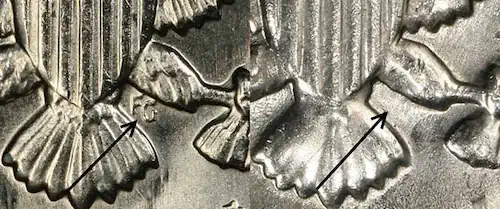
The No FG varieties are the most popular hunt. Only two, the 1972-D and the 1982-P, are widely recognized as true varieties. A weak or partly visible FG is ordinary die wear and carries no premium.
Recommended Reading
Cherrypickers' Guide to Rare Die Varieties
The go-to book for doubled dies, repunched mintmarks and other varieties.
Early 1964 proof dies showed extra lines in JFK's hair. The easiest tell is a weak or broken lower-left serif on the I in LIBERTY. Typical proofs are modest, but Deep Cameo gems sell for thousands.
$40–$1,000+Scarce
1972-D No FG
Over-polishing removed Frank Gasparro's initials from a Denver reverse die. It is the rarest circulation-strike No FG, and an MS-63 has sold for about $2,485.
$150–$2,500+Rare
1974-D Doubled Die Obverse
Doubling shows most clearly on IN GOD WE TRUST. It is easy to identify, and collectors still cherrypick it from 1974 mint sets, which keeps prices affordable.
$10–$150+Scarce
1982-P No FG
The most common No FG and the usual starting point for variety collectors. Mid-grade pieces are inexpensive, but MS-67 examples have sold for $750 and up.
$10–$750+Common
Off-Center Strikes
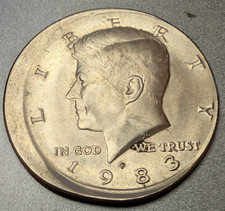
A Kennedy half struck 20–50% off-center with the full date visible is one of the most dramatic modern errors. Value climbs with the percentage off-center and the eye appeal.
$75–$1,500+Scarce
Missing Clad Layer
When the copper-nickel outer layer fails to bond, one face shows bare copper and the coin weighs less. Weigh any suspect coin, because chemically altered fakes are common.
$100–$800+Scarce
Franklin Half Dollar Error Coins (1948–1963)
Franklin halves were struck for only 16 years, yet the series has several well-known varieties. Full Bell Lines (FBL) already splits the market in two, and a variety with full bell lines is worth considerably more.
Most Franklin varieties are proofs, so check old proof sets carefully. Because these halves are 90% silver, every one also carries a solid melt-value floor.
1955 "Bugs Bunny"
A die clash left marks on Franklin's upper lip that look like protruding buck teeth. It is the most famous Franklin variety, and FBL examples bring the strongest prices.
$25–$300+Common
1961 Proof Doubled Die Reverse
Broad doubling across the reverse lettering makes this the key Franklin variety. It ranks among the most visible doubled dies of the 20th century.
$600–$6,000+Rare
Off-Center Strikes
Franklin halves struck 25% or more off-center with the date visible are very popular. Denver halves also show repunched mint marks, which carry smaller premiums.
$150–$3,000+Rare
Walking Liberty Half Dollar Error Coins (1916–1947)
Walking Liberty halves are among the most admired U.S. coin designs, and errors on them are prized. The Mint struck them long before automated quality control. Still, most error coins were caught at the time, so genuine survivors are scarce.
Because the design is so popular, an error Walker attracts both error specialists and series collectors. That double demand is a big reason prices run higher than for comparable Kennedy errors.
Off-Center Strikes
A Walker struck 20–40% off-center is one of the most striking U.S. errors. Pieces that still show the date sell for the most.
$300–$10,000+Rare
Double Strikes
A coin struck twice, especially with clear rotation between strikes, is among the most dramatic errors in the series. Strong examples draw heavy auction bidding.
$300–$8,000+Rare
1946 Doubled Die Reverse
Doubling shows on the reverse lettering and the eagle's feathers. It is the best-known Walking Liberty variety and carries a strong premium in every grade.
$75–$1,000+Scarce
Wrong Planchet
Half dollar dies striking a smaller planchet produce an undersized silver coin with a partial design. Authentication is essential for any claimed example.
$500–$5,000+Rare
Clipped Planchets
A curved or straight "bite" missing from the edge happens when the planchet was cut from overlapping or end-of-strip metal. Look for the weak rim opposite the clip.
$50–$500+Scarce
Die Cracks & Cuds
Late-state dies show raised cracks and rim "cuds" where pieces of the die broke away. Large cuds push values well above the base coin.
$30–$500+Common
Silver melt value note: Walking Liberty, Franklin and 1964 Kennedy halves each contain 0.3617 oz of pure silver, and 1965–1970 Kennedys (40% silver) contain 0.1479 oz. Any error premium sits on top of that melt-value floor. Use the Silver Coin Melt Calculator to see what the silver in your coin is worth today.
How to Find and Grade Half Dollar Errors
Where to Look
Many banks still order $10 rolls of Kennedy halves, although supply varies by branch. These rolls get far less attention than cent or quarter rolls, so No FG halves and minor doubled dies still turn up. Uncirculated mint sets are another good source, especially for the 1974-D doubled die.
Franklin and Walking Liberty halves no longer circulate. Instead, they surface at estate sales, coin shows and in dealer "junk silver" lots. Most of those coins are priced on silver content alone, so a sharp eye can catch varieties the seller missed.
What to Check Under Magnification
On a Kennedy, flip to the reverse and look between the eagle's left leg (your right) and the tail feathers for the FG initials. Next, check the date and mottos for doubling with a 5×–10× loupe. Finally, look at the rim for broadstrikes and clips, and compare the two sides for die rotation.
Error or Post-Mint Damage?
Half dollars are big coins that pick up bag marks, scratches and rim dings. None of those are errors. A genuine mint error shows undisturbed surfaces around the anomaly, because it happened at the Mint. For example, a gouge that cuts through the design and pushes metal aside is almost always damage done after the coin left the Mint.
When to Get It Graded
Errors are graded on the standard 1–70 scale, and the label names the error separately, such as "Off-Center 35%." For any error likely worth $200 or more, PCGS or NGC certification is worth the fee. Both services attribute recognized varieties by their Cherrypickers' Guide (FS) number, and NGC does so through its VarietyPlus service. A No FG half labeled FS-901 sells far more easily than an unattributed coin.
The top prices belong to the 1964 Accented Hair proof in the finest grades. A PR-69 Deep Cameo sold for $46,800 at Heritage in January 2024. Among circulation strikes, the 1972-D No FG leads the field, with an MS-63 bringing about $2,485. Dramatic off-center and double-struck Walking Liberty halves can also reach four figures.
How do I identify a No FG Kennedy half dollar?
Turn the coin to the reverse. Frank Gasparro's initials, FG, normally sit between the eagle's left leg (your right) and the tail feathers. On a true No FG, there is no trace of them, and nearby details such as the wing and stars are often weak too. A partly visible FG is just die wear. The 1972-D and 1982-P are the two recognized dates.
Is the 1974-D doubled die Kennedy worth a lot?
Not usually. It is a real, recognized variety (FS-101), but plenty of examples exist. Most uncirculated pieces sell for about $40–$115, and circulated coins bring $10–$20. Older guides that list it at thousands of dollars are well out of date.
Are silver half dollar errors worth more than clad errors?
Generally, yes. Walking Liberty and Franklin halves are 90% silver, so every one carries a melt-value floor you can check with the Silver Coin Melt Calculator. In addition, their age and smaller surviving populations push error premiums higher than on comparable clad Kennedy errors. Kennedy halves from 1965–1970 are 40% silver and fall in between.
Can I find half dollar errors in circulation today?
Kennedy halves still circulate at low levels, and error and variety Kennedys do surface in bank rolls. Franklin and Walking Liberty halves left circulation decades ago, however. You will find them through dealers, coin shows and estate sales instead. For circulation finds, searching Kennedy bank rolls is your best bet.
What's the difference between a die variety and a mint error?
A die variety, such as the No FG or the Accented Hair, comes from a particular die, so every coin struck by that die shares the feature. A mint error, such as an off-center strike or broadstrike, is a one-off production accident on a single coin. Both are collectible, but grading services and catalogues list them differently.
Should I clean my half dollar error coin before selling it?
No. Cleaning strips original luster and surface, which permanently cuts value, often by half or more. Graders spot it right away, and PCGS and NGC give cleaned coins a "Details" grade. Those coins sell at a steep discount to problem-free examples.
The Ultimate U.S. Error Coin Guide 2027 is a practical and easy-to-use reference designed to help you confidently identify, evaluate, and collect U.S. error coins.
Strategies for Maximizing Returns from Rare Mint Errors is a practical guide designed to help identify mint errors, understand their value, and make informed collecting and selling decisions.
We use cookies for the purposes of statistical analysis, improving the friendliness and usability of our website, tailoring content to your interests and engaging with social media. By visiting and using our website, you consent to our use of cookies as described in our cookie policy.
This website uses cookies to improve your experience while you navigate through the website. Out of these cookies, the cookies that are categorized as necessary are stored on your browser as they are essential for the working of basic functionalities of the website. We also use third-party cookies that help us analyze and understand how you use this website. These cookies will be stored in your browser only with your consent. You also have the option to opt-out of these cookies. But opting out of some of these cookies may have an effect on your browsing experience.
Necessary cookies are absolutely essential for the website to function properly. This category only includes cookies that ensures basic functionalities and security features of the website. These cookies do not store any personal information.
Any cookies that may not be particularly necessary for the website to function and is used specifically to collect user personal data via analytics, ads, other embedded contents are termed as non-necessary cookies. It is mandatory to procure user consent prior to running these cookies on your website.