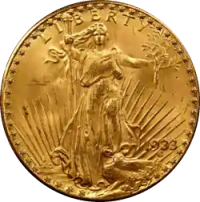
Only one 1933 Saint-Gaudens Double Eagle can legally be owned by a private collector. In 2021 it sold for $18.9 million — the highest price ever paid for a U.S. coin.
Rare Coin Value GuideThe 1933 Saint-Gaudens Double Eagle occupies a category entirely its own in American numismatics. It is simultaneously the most valuable U.S. coin ever sold at auction, the subject of one of the most dramatic legal battles in the history of the hobby, and a coin that most of the world's 445,500 specimens never left government hands — ordered melted in the midst of the Great Depression, at the exact moment the United States abandoned the gold standard.
The Record Sale — $18.9 Million
The Coin's Extraordinary History
The story of the 1933 Double Eagle begins with one of the most beautiful coin designs in American history. Augustus Saint-Gaudens — widely considered the greatest sculptor America has produced — designed the $20 gold piece at President Theodore Roosevelt's personal request. Roosevelt, dissatisfied with the artistic quality of American coinage, specifically asked Saint-Gaudens to create something worthy of an ancient Greek coin. The result, introduced in 1907, featured Lady Liberty striding forward on the obverse and a soaring eagle on the reverse, with no motto (the motto IN GOD WE TRUST was controversial with Roosevelt on religious grounds and was omitted from the original design).
The design remained in production through 1932. In 1933, the Philadelphia Mint struck 445,500 Double Eagles — but before they could be released for circulation, Franklin Roosevelt signed Executive Order 6102, requiring Americans to surrender gold coins to the Federal Reserve as part of his monetary policy response to the Great Depression. All 1933 Double Eagles were ordered melted. Officially, none entered circulation. Officially, none exist outside of government hands.
But two specimens were transferred to the Smithsonian Institution as official government specimens. And an unknown number — believed to be about two dozen — were removed from the Mint before melting through means that have been debated for decades. The cashier of the Philadelphia Mint, George McCann, is widely believed to have facilitated the removal of multiple specimens, though the exact mechanism has never been conclusively documented.
King Farouk and the Trail of Coins
One of the escaped 1933 Double Eagles ended up in the collection of King Farouk of Egypt, who purchased it in 1944 through a Philadelphia coin dealer. In 1952, Farouk was overthrown in a coup and his collection was auctioned. The U.S. government requested the coin's return before the auction; it was pulled from the sale but subsequently disappeared — stolen from the Egyptian national collection and surfacing in the underground numismatic market over the following decades.
In the 1990s, a British coin dealer named Stephen Fenton attempted to sell a 1933 Double Eagle to undercover Secret Service agents in a sting operation at the Waldorf-Astoria Hotel in New York. The coin was seized. Years of litigation followed — the core legal question being whether the coin had ever been lawfully issued and whether private ownership was therefore illegal.
The resolution was remarkable: in 2001, the U.S. government and Fenton reached a settlement. The coin was declared legally monetized — given official U.S. legal tender status — and Fenton was permitted to sell it at auction, with proceeds split between him and the government. The 2002 Sotheby's/Stack's auction brought $7.59 million — the highest price ever paid for a U.S. coin at that time. That same coin sold again at Sotheby's in 2021 for $18.87 million, still the all-time record for any U.S. coin.
The Other Known Specimens — And Why They Can't Be Sold
The 2001 legal settlement established a crucial precedent: only the Farouk coin — the single specimen officially monetized through government agreement — can be legally owned by a private collector. All other 1933 Double Eagles are considered stolen government property, with the U.S. Secret Service and the Mint maintaining that any other examples that surface are subject to seizure without compensation.
This hasn't stopped other coins from surfacing. In 2004, the family of a Philadelphia jeweler named Israel Switt — long suspected as the conduit through which Mint cashier McCann moved the coins — discovered ten 1933 Double Eagles in a bank safe deposit box. The family attempted to have them authenticated and sold. The Secret Service seized all ten. After years of litigation, the Third Circuit Court of Appeals ruled in 2012 that the coins were government property and could not be returned to the Switt family, since they had never been lawfully issued to enter private hands.
The Smithsonian holds two additional specimens as part of the National Numismatic Collection — the only other confirmed examples in existence. These are not for sale under any circumstances and have never been offered at auction.
The Saint-Gaudens Design — Why It Matters
Understanding why collectors and museums value the 1933 Double Eagle so intensely requires understanding what Saint-Gaudens achieved with the design. The coin is 34mm in diameter and was struck in 90% gold — containing 0.9675 troy ounces of pure gold. But its value as a numismatic object vastly exceeds its metal content at any gold price.
The obverse design — Liberty striding forward with a torch in her right hand and an olive branch in her left, the sun rising behind her and the U.S. Capitol visible at her feet — is routinely cited by coin designers, art historians, and collectors as the finest design ever placed on an American coin. The high-relief version struck in 1907 is so sculptural that it is more properly considered a medallic art object than a coin; the production version struck from 1907 through 1933 modifies the relief for mass production but retains the essential power of Saint-Gaudens' original vision.
The reverse features a bold eagle in flight against a sunburst — clean, powerful, and technically demanding to strike well. In high grades, the combination of the two designs on a large gold coin produces an aesthetic effect that few other numismatic objects in the world can match.
Other Dates in the Saint-Gaudens Series — Collectible and Legal
While the 1933 is untouchable for all but one collector, the Saint-Gaudens Double Eagle series from 1907 through 1932 offers genuinely outstanding collecting opportunities across all budget levels.
| Date | Notes | Value Range (by grade) |
|---|---|---|
| 1907 High Relief | Original Saint-Gaudens design, wire rim or flat rim | $8,000 – $200,000+ |
| 1907 Arabic Numerals | First production version, no motto | $1,500 – $10,000+ |
| 1908 No Motto | Final year without IN GOD WE TRUST | $1,500 – $8,000+ |
| 1908-D No Motto | Denver mint, no motto — scarcer than Philly | $1,800 – $15,000+ |
| 1909/8 Overdate | Overdate variety — 8 visible beneath 9 | $2,000 – $20,000+ |
| 1920-S | Major rarity — most were melted abroad | $20,000 – $400,000+ |
| 1921 | Extremely rare — only ~500 known | $50,000 – $500,000+ |
| 1927-D | Near-legendary rarity — most melted | $200,000 – $2,000,000+ |
| 1932 | Final regular issue before the 1933 meltdown | $1,500 – $8,000+ |
| Common dates (1910–1928) | Philadelphia mint, circulated grades | $1,800 – $2,500 (near melt) |
Shop Saint-Gaudens Double Eagles from 1907–1932 — legally transferable and stunning in any grade.
🛍️ Shop on eBay 📚 Reference Books on AmazonFrequently Asked Questions
How much is the 1933 Saint-Gaudens Double Eagle worth?
Why can't I legally own a 1933 Double Eagle?
What is the most beautiful date in the Saint-Gaudens series to collect?
How do I authenticate a Saint-Gaudens Double Eagle?
Is the 1933 Double Eagle insured?
What happened to all the other 1933 Double Eagles that were struck?
Explore the legally collectible Saint-Gaudens series — 1907 through 1932.
🛍️ Browse on eBay '
'