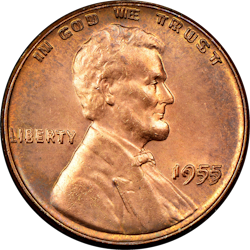
1955 Doubled Die Penny Value
One of the most famous error coins in American history — and one of the few still found in old collections and estate sales. Here's exactly what yours could be worth.
In the fall of 1955, something went wrong at the Philadelphia Mint. A working die for the Lincoln cent was inadvertently hubbed twice, with a slight rotational misalignment between impressions. The result was a penny where every element on the obverse — the date, "LIBERTY," and "IN GOD WE TRUST" — appears dramatically doubled. Before quality control caught the problem, an estimated 20,000 to 24,000 of these coins entered circulation mixed with bags of normal cents. They were found as change at vending machines and in cash registers across the Northeast.
That mistake created one of the most collectible and recognizable error coins in U.S. history. The 1955 Doubled Die Obverse Lincoln cent — universally called the "1955 DDO" — remains a benchmark coin for error collectors nearly 70 years later.
📌 The 1955 DDO is a die error, not a strike error. The doubling is in the die itself, which means every coin struck by that die shows the same dramatic doubling. This distinguishes it from mechanical doubling, which adds almost no value.
1955 Doubled Die Penny Value by Grade
Because these coins circulated heavily when released, most surviving examples show significant wear. Uncirculated examples are genuinely rare — and command extraordinary premiums. Values below reflect current retail market data:
| Grade | Description | Approximate Value |
|---|---|---|
| Good (G-4) | Heavy wear, design outlines visible | $1,000 – $1,400 |
| Very Good (VG-8) | Moderate-heavy wear, main features clear | $1,200 – $1,700 |
| Fine (F-12) | Moderate wear, all details visible | $1,500 – $2,200 |
| Very Fine (VF-20/30) | Light-moderate wear, sharp details | $2,000 – $3,500 |
| Extra Fine (EF-40/45) | Light wear on high points only | $3,500 – $5,500 |
| About Uncirculated (AU-55/58) | Trace wear, most mint luster remains | $6,000 – $12,000 |
| MS-60 to MS-62 | Uncirculated, heavy bag marks | $15,000 – $25,000 |
| MS-63 Red Brown | Choice uncirculated, mixed color | $28,000 – $50,000 |
| MS-64 Red | Choice uncirculated, full red color | $60,000 – $100,000 |
| MS-65 Red | Gem uncirculated, exceptional strike | $100,000 – $150,000+ |
💡 For broader Lincoln cent values across all dates and grades, see the FindRareCoins coin values guide. For a deeper look at error coins across all denominations, visit our error coins guide.
How to Authenticate the 1955 DDO
The 1955 DDO is one of the most counterfeited and misidentified coins in U.S. numismatics. Both outright fakes and genuine coins with mechanical doubling (often mistakenly sold as DDOs) are common. Here's how to tell the real thing from imitations.
What Genuine Doubling Looks Like
On an authentic 1955 DDO, the doubling is dramatic and unmistakable — you don't need a magnifier to see it. The date "1955" shows two fully separated, raised sets of numerals. "LIBERTY" and "IN GOD WE TRUST" both show clear, distinct doubled lettering with separation between the two impressions. The doubling is strongest on the date and "LIBERTY."
What Mechanical Doubling Looks Like
Mechanical doubling (also called machine doubling or strike doubling) is a die shift during the strike. The secondary image appears flat and shelf-like — it has no additional relief and looks like a shadow rather than a separate raised element. Mechanical doubling adds essentially no premium over a normal coin.
⚠️ Fake alert: Altered date coins exist where a normal 1955 penny has been tooled or chemically etched to create the appearance of doubling. These are detectable under magnification — the "doubling" will show tool marks or irregular metal displacement. Always buy raw examples from reputable dealers, and get certified examples from PCGS or NGC for anything over $1,000.
The Quickest Authentication Test
Look at the date with a 5x loupe. On a genuine 1955 DDO, the "5" in the date is the most dramatically doubled element — you'll see two complete, separated number fives. If you see blurry or flat secondary elements rather than raised, separate numerals, you're looking at mechanical doubling or a fake.
🔎 Pro tip: PCGS has certified over 3,000 examples of the 1955 DDO across all grades. If a seller claims to have a raw (uncertified) example worth more than $2,000, insist on PCGS or NGC certification before purchasing. The certification fee is a small fraction of the coin's value at that price point.
Where the 1955 DDO Comes From
Understanding how this error happened helps collectors appreciate what they're holding. During the die preparation process at the Philadelphia Mint, working dies are created by pressing a hardened hub (containing the master design) into a soft die blank. This "hubbing" process sometimes required multiple impressions to transfer the full design depth.
In 1955, a working die received a second hub impression that was slightly rotated relative to the first. The result was a die with two sets of design elements slightly offset from each other. That die then struck thousands of coins before being caught. Because the error was in the die itself — not a one-off accident during striking — every coin from that die showed the same identical doubling.
The coins were packaged in mint bags and distributed through Federal Reserve banks in the Northeast. Many reached circulation through vending machines and coin rolls. A small number were set aside by alert collectors and bank tellers when the error became public knowledge.
Buying & Selling the 1955 Doubled Die Penny
At current market values, the 1955 DDO in any grade is a serious purchase. The buying and selling approach should match the value level.
For Coins Under $3,000 (Circulated Examples)
eBay is the most active marketplace for circulated 1955 DDOs. Always check "sold listings" — not asking prices — to see what coins in similar condition have actually sold for. Look for PCGS or NGC slabbed examples even in lower grades, as certification confirms authenticity and makes the coin easier to resell.
For Coins Over $3,000
Major auction houses — Heritage Auctions, Stack's Bowers, and Great Collections — regularly offer certified examples and attract competitive bidding. For high-grade uncirculated examples, auction is almost always the best option to achieve full market value.
Search 1955 DDO Listings on eBay
Browse active listings and recently sold examples to track the current market.
Search Certified Examples All 1955 DDO ListingsFrequently Asked Questions
How many 1955 doubled die pennies exist?
Estimates suggest 20,000 to 24,000 were originally released into circulation. How many survive today is unknown, but PCGS alone has certified over 3,000 examples across all grades. Many more likely exist in old collections, estate sales, and long-forgotten coin jars — making this one of the more accessible major U.S. error coins despite its high value.
What mint mark does the 1955 DDO have?
The 1955 doubled die is a Philadelphia Mint coin, so it has no mint mark. Denver (D) and San Francisco (S) Lincoln cents from 1955 do not have this variety. If you see a 1955-D or 1955-S penny with apparent doubling, it is either mechanical doubling or an altered coin.
Is the 1955 DDO the rarest doubled die penny?
It is the most famous and most valuable in circulated grades, but not the rarest in absolute terms. The 1969-S doubled die obverse is rarer (fewer than 100 confirmed examples) and commands higher values in top grades. However, the 1955 DDO is more accessible for the average collector and has more dramatic visible doubling.
Should I get my 1955 DDO graded?
Yes, for any example you believe is genuine. PCGS and NGC certification costs $30–$65 for most service levels and provides authentication plus grade determination. For a coin worth $1,200 or more at the low end of the grade scale, the fee is a minimal cost that also makes the coin significantly easier to sell at full value.
What other penny errors are valuable?
Beyond the 1955 DDO, the most valuable penny errors include the 1943 bronze cent (struck on copper instead of steel), the 1944 steel cent, the 1972 doubled die obverse, and off-metal errors where cents were struck on the wrong denomination's planchet. See our complete penny error coins guide for the full list with values.
More Penny Error Coins Worth Money
The 1955 DDO is just one of dozens of Lincoln cent errors that carry real collector value. Explore the complete guide.
Penny Error Coins Guide All Error Coins '
'