Penny Error Coins: Complete Value Guide
From doubled dies to off-center strikes — discover which Lincoln cent errors are worth serious money and how to spot them in your pocket change.
Most people toss pennies aside without a second thought. But buried in circulation — and sometimes sitting in a jar on your kitchen counter — are penny error coins worth anywhere from a few dollars to several thousand. Error coins are produced when something goes wrong during the minting process, creating coins that deviate from the intended design. For Lincoln cents, those mistakes can mean big money.
This guide covers the most valuable penny error types, what they're worth in different grades, and exactly what to look for when checking your coins. Whether you're a seasoned collector or just getting started, understanding penny errors is one of the fastest ways to find real value in ordinary change.
📌 Quick tip: The error coins page at FindRareCoins has the full overview of all error types across denominations. This guide focuses specifically on penny errors — the most collected and widely available error series in U.S. numismatics.
What Makes a Penny an Error Coin?
An error coin is any coin where the minting process produced an unintended result. Unlike varieties (which are die-related differences intentionally or accidentally created but consistently repeated), true errors are one-off or small-batch mistakes that slipped through quality control.
The U.S. Mint produces billions of pennies every year across Philadelphia, Denver, and San Francisco facilities. Even with tight quality controls, a small percentage of coins escape with significant errors. Those are the ones collectors hunt for.
Penny errors fall into three broad categories: planchet errors (problems with the blank before striking), die errors (problems with the die used to strike the coin), and striking errors (problems during the actual strike). Each category produces distinct, recognizable results.
Most Valuable Penny Error Types
Doubled Die Obverse (DDO)
The most famous penny error. The die shifts between impressions during hubbing, causing doubled lettering, date, or design elements visible to the naked eye. The 1955 DDO and 1972 DDO are the most prized examples.
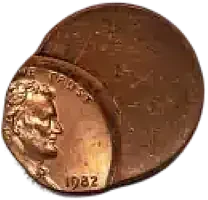
$500 – $150,000+Off-Center Strike
The planchet was misaligned in the press when struck, so the design is off-center. Value depends heavily on percentage off-center — 50% off with a visible date is the collector sweet spot.
$15 – $500+Broadstrike
The coin was struck without the collar die in place, allowing the metal to spread outward. Broadstruck pennies are larger than normal and show a flattened rim all around.
$20 – $150Wrong Planchet / Off-Metal
The most dramatic penny errors — a cent struck on a dime planchet, foreign planchet, or another denomination's blank. These are genuinely rare and command strong premiums.
$200 – $5,000+Die Cap / Die Clash
A die clash occurs when the obverse and reverse dies strike each other with no coin in between, transferring each die's design to the other. Look for ghost images on struck coins from clashed dies.
$25 – $400Lamination Error
The zinc or copper planchet delaminates, creating flaking, peeling, or missing sections of metal. Pre-1982 copper cents show this differently than modern zinc cents, which can corrode severely at lamination points.
$10 – $200Key Date Penny Errors & Their Values
Not all penny errors are created equal. Year and error type together determine value. Here are the most sought-after combinations:
| Coin | Error Type | Fine (F-12) | Extra Fine (EF-40) | MS-63 |
|---|---|---|---|---|
| 1955 Lincoln Cent | Doubled Die Obverse | $1,200 | $2,500 | $15,000+ |
| 1972 Lincoln Cent | Doubled Die Obverse | $150 | $300 | $1,200 |
| 1943 Lincoln Cent | Struck in Bronze (not steel) | $60,000 | $100,000 | $300,000+ |
| 1944 Lincoln Cent | Struck on Steel Planchet | $35,000 | $75,000 | — |
| 1983 Lincoln Cent | Doubled Die Reverse | $100 | $200 | $600 |
| 1995 Lincoln Cent | Doubled Die Obverse | $25 | $50 | $75 |
| Any Date | 50% Off-Center w/ Date | $50 | $100 | $250+ |
| Any Date | Wrong Planchet (dime) | $400 | $800 | $2,000+ |
💡 Note: Values above are approximate retail based on recent auction data. Condition is everything — a well-struck, problem-free example will always command a premium over cleaned or damaged coins of the same type. For current values see our coin values guide.
How to Spot Penny Errors
What You'll Need
You don't need expensive equipment to start. A 5x or 10x loupe (magnifying glass) handles most doubled dies and minor errors. A digital microscope or jeweler's loupe in the 10–30x range is useful for die cracks and smaller varieties. Good lighting — preferably a direct LED lamp — is essential.
Where to Look on the Coin
For doubled dies, focus on the date, "LIBERTY," "IN GOD WE TRUST," and Lincoln's eye. Genuine doubling shows separation between elements, not just a shadow or blurring. Machine doubling (a common fake-out) looks flat and shelf-like — not a separate raised element.
For off-center strikes, the tell is easy — part of the design will be missing, and the coin may not be perfectly round. Measure the percentage by estimating how much of the design is missing.
For wrong planchet errors, weigh the coin. A cent struck on a dime planchet weighs approximately 2.27 grams instead of the standard 2.5 grams. A kitchen scale accurate to 0.01g works fine.
🔎 Pro tip: When checking wheat pennies (1909–1958), pay extra attention to the 1922, 1943, and 1955 dates — those years produced the most significant and valuable errors in the Lincoln cent series.
Where to Buy & Sell Penny Error Coins
eBay remains the best open marketplace for penny error coins — the depth of listings lets you see real sold prices, not just asking prices. Always search "sold listings" to verify what an error has actually brought at auction before buying or pricing your own coins.
For higher-value errors (anything over $500), PCGS or NGC certification is strongly recommended. A slabbed 1955 DDO carries a massive premium over a raw example because the authentication removes all doubt. The grading fee is a worthwhile investment at that price level.
Browse Penny Error Coins on eBay
Search active listings and recently sold examples to track current market values.
Browse eBay Listings Search 1955 DDOFrequently Asked Questions
How do I know if my penny error is genuine?
Genuine mint errors will have consistent weight, proper metal composition, and errors that can be explained by a known minting malfunction. The biggest red flag is damage disguised as an error — tooled doubling, acid etching, or post-mint alterations. When in doubt, get it certified by PCGS or NGC before spending significant money on it.
Are 1982 pennies worth anything as errors?
The 1982 penny is unique because the Mint switched from 95% copper to copper-plated zinc mid-year, and coins were made at both Philadelphia and Denver with both large and small date dies. This creates seven different varieties for that year alone. A 1982 small date copper cent is worth $10–$30 in circulated grades, and an MS-65 red example can bring $10,000 or more.
What is the most valuable penny error ever sold?
The 1943 Bronze Lincoln cent — struck on a copper planchet when the Mint had switched to steel due to WWII metal rationing — holds that title. A PCGS MS-62 Brown example sold for $372,000 at auction. Only about 20 genuine examples are known to exist.
Is machine doubling the same as a doubled die?
No — and this is one of the most important distinctions in error coin collecting. Machine doubling (also called mechanical doubling or strike doubling) happens during the strike itself when the die shifts slightly. It produces flat, shelf-like secondary images with no additional relief. A true doubled die has full, raised, separate elements because the error is in the die itself. Machine doubling adds very little to a coin's value.
Should I clean my penny error coin?
Never. Cleaning a coin — even lightly — destroys its numismatic value permanently. Collectors and grading services can identify cleaning under magnification, and a cleaned coin will be labeled "details" by PCGS or NGC, drastically reducing its market value. Leave error coins exactly as found.
Where can I look up more coin values?
FindRareCoins maintains a regularly updated coin values guide covering major U.S. series. For error-specific pricing, recent eBay sold listings and the PCGS Price Guide are the best real-time references.
Explore More Error Coins
Pennies are just the beginning. Discover error coins across all U.S. denominations — quarters, nickels, dimes, and dollars.
Error Coins Guide Coin Values Guide '
'