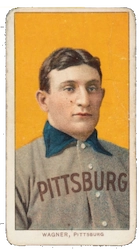
One card. One name. One hundred years of mystique. The T206 Wagner remains the most famous and most valuable baseball card ever produced.
Collectibles Value GuideThe 1909–11 T206 Honus Wagner is not just the most valuable baseball card in existence — it's the most famous collectible in American sports history. A tiny piece of cardboard printed over a century ago, it has sold for millions of dollars, been at the center of ownership controversies and authentication dramas, and become a cultural touchstone for collectors far beyond the world of baseball. Understanding the Wagner card means understanding why rarity, story, and myth combine to create value that transcends conventional market logic.
T206 Honus Wagner: Recent Auction Records
Why Is the T206 Wagner So Rare?
The short answer is that Honus Wagner ordered the American Tobacco Company to stop producing his card — but the full story is more complex than that simple legend. The T206 tobacco card set was produced between 1909 and 1911 by the American Tobacco Company and distributed in cigarette and tobacco packages as premium inserts. Wagner's card was part of the initial production run, but almost immediately the company stopped including it. Only a small number had been printed and distributed before production ceased.
The traditional explanation — repeated for over a century — is that Wagner, a health-conscious non-smoker, objected to his likeness being used to promote tobacco products without his consent or compensation, and demanded the cards be withdrawn. This story is compelling and probably contains elements of truth, but modern researchers have pointed out that Wagner's objections may have been as much about unpaid licensing fees as moral opposition to tobacco. The exact terms of any correspondence between Wagner and the company have never been definitively documented.
Whatever the reason, production was halted early. Today, approximately 50 to 200 T206 Wagner cards are believed to exist — estimates vary widely because the definition of "surviving" includes heavily trimmed, altered, and doctored examples. Among those that clearly survive in anything approaching original condition, the number is considerably smaller. PSA, the leading grading service, has certified only around 50 authentic examples across all grades.
The Gretzky/McNall Wagner
The single card most responsible for turning the Wagner from a numismatic curiosity into a cultural icon is the example purchased by hockey legend Wayne Gretzky and Los Angeles Kings owner Bruce McNall at a 1991 Sotheby's auction. Their purchase price of $451,000 made international headlines and introduced the concept of a million-dollar baseball card to the general public. That same card — PSA-graded NM-MT 8, the highest-graded example — later passed through several high-profile sales and became the benchmark against which every subsequent Wagner sale is measured.
T206 Set Overview
The T206 set is one of the most expansive and beloved of all pre-war tobacco card issues. Produced over three years from 1909 to 1911 with multiple print runs, it ultimately included over 500 subjects — players from the American League, National League, and several minor league teams. The cards measure approximately 1.5 × 2.625 inches and feature lithographic portraits or action poses with the player's name, team, and position on the front, and tobacco brand advertising on the back.
| T206 Card | Player | Typical Value (Good to VG) |
|---|---|---|
| Honus Wagner | SS, Pittsburgh Pirates | $500,000 – $7,000,000+ |
| Eddie Plank | P, Philadelphia Athletics | $10,000 – $150,000+ |
| Sherry Magee (error) | OF, Philadelphia Phillies | $5,000 – $50,000+ |
| Joe Doyle (N.Y. Nat'l error) | P, New York Highlanders | $10,000 – $100,000+ |
| Ty Cobb (portrait) | OF, Detroit Tigers | $500 – $15,000+ |
| Christy Mathewson (portrait) | P, New York Giants | $300 – $5,000+ |
| Cy Young (portrait) | P, Cleveland Naps | $200 – $3,000+ |
| Common player (VG) | Various | $10 – $75 |
Browse T206 Wagner cards and other pre-war baseball card rarities on eBay.
🛍️ Browse on eBay 📚 Guides on AmazonAuthentication and the Controversy Problem
No card in the hobby has been surrounded by more authentication controversy than the T206 Wagner. The most famous case involves an example that was graded PSA NM-MT 8 — the highest grade ever assigned to the card — and sold for $2.8 million in 2007. That card was later determined by PSA to have been trimmed, dramatically reducing its grade and value. The subsequent legal disputes and re-sales became a defining saga of the modern hobby.
Multiple Wagner examples over the decades have been found to be trimmed — cut down from larger dimensions to improve apparent centering or remove damage — which is considered a form of alteration that grading services will note on the certification label. PSA and SGC use "MK" (marked), "T" (trimmed), or similar qualifiers that appear on the slab label and dramatically affect market value.
For collectors encountering a claimed Wagner, professional authentication by PSA, SGC, or Beckett (BVG) is not optional — it's the baseline requirement. Any unslabbed Wagner claiming to be genuine should be treated with extreme skepticism regardless of provenance documentation.
Honus Wagner the Player
Part of the Wagner card's enduring appeal is that the subject himself was genuinely among the greatest players in baseball history. Johannes Peter "Honus" Wagner played shortstop for the Pittsburgh Pirates from 1900 to 1917, winning eight National League batting titles — a record that stood for decades. He was named the greatest shortstop in baseball history by multiple panels of experts and was one of the five inaugural members of the Baseball Hall of Fame in 1936, alongside Babe Ruth, Ty Cobb, Walter Johnson, and Christy Mathewson.
Wagner's combination of hitting ability, speed, and defensive skill was unprecedented for his era. His career batting average of .328 places him among the all-time greats, and his power numbers were exceptional for the dead ball era in which he played. The T206 card captures him in the prime of his career — it was printed when he was already a legend, not merely a promising young player.
Frequently Asked Questions
How many T206 Honus Wagner cards exist?
What is the most expensive T206 Wagner ever sold?
Why did Honus Wagner have his card pulled?
Can I buy a T206 Honus Wagner card?
Are there reproduction or replica Wagner cards?
What other T206 cards are valuable?
Explore vintage baseball cards and other sports collectibles.
🛍️ Browse Pre-War Cards on eBay '
'