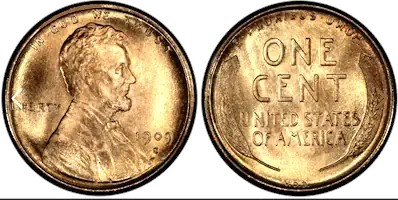
1909-S VDB Lincoln Cent

Only 484,000 were struck at San Francisco — and a public outcry over the designer's initials cut that run short. The 1909-S VDB is the most famous key date in Lincoln cent history.

Lincoln Cent Value Guide

The 1909-S VDB Lincoln cent is the keystone of Lincoln cent collecting — the coin that every serious collector pursues, the one that anchors the value of complete sets, and the date that most frequently appears on lists of the most desirable U.S. coins at any price level. With only 484,000 struck at the San Francisco Mint before production was halted by a public controversy over the designer's initials, genuine examples are scarce at every grade level and command strong premiums even in heavily worn condition.

Building your Lincoln cent collection? See our full Penny Error Coins guide for error varieties across the series, and our posts on the 1955 DDO, 1972 DDO, 1969-S DDO, and 1943 Copper Penny.

1909-S VDB Lincoln Cent Values by Grade

AG-3
$700 – $900
About Good — date & VDB visible
G-4
$900 – $1,200
Good — full outline
VG-8
$1,200 – $1,600
Very Good
F-12
$1,600 – $2,200
Fine — details clear
VF-20
$2,200 – $3,000
Very Fine
EF-40
$3,000 – $4,500
Extremely Fine
AU-55
$4,500 – $7,000
About Uncirculated
MS-63 RB
$8,000 – $12,000
Choice Uncirculated
MS-65 RD
$30,000 – $75,000+
Gem Red — exceptional

What Does VDB Mean?

VDB stands for Victor David Brenner — the sculptor who designed the Lincoln cent at President Theodore Roosevelt's request. Brenner, a Lithuanian-born engraver who had previously created a medal featuring Lincoln's portrait, placed his initials V.D.B. on the reverse of the coin in small letters at the bottom between the two wheat stalks.

When the coin was released on August 2, 1909 — the centennial of Lincoln's birth — the initials immediately generated public controversy. Critics felt Brenner's self-promotion was inappropriate on a circulating coin, and the outcry was significant enough that the U.S. Mint halted production and removed the initials from the dies before resuming strikes. Production at San Francisco had already been limited, and the interrupted run left only 484,000 VDB cents from that mint — compared to over 27 million from Philadelphia in the same period.

The Philadelphia VDB cent (1909-P VDB, no mint mark) is common — over 27 million were struck and it trades for $10–$20 in circulated condition. The San Francisco VDB cent (1909-S VDB) is the rarity. Brenner's initials were eventually restored to the obverse — in tiny letters on Lincoln's shoulder — in 1918, where they remain today.


Key Identification Points

The VDB initials appear on the reverse, centered at the very bottom of the coin between the two wheat stalks, just above the rim. They read V.D.B. in three small capital letters. On genuine coins, these are cleanly struck with consistent depth.

The S mint mark appears on the obverse, below the date. On 1909 Lincoln cents, the mint mark is a relatively large S. On fakes created by adding an S to a common 1909-P VDB cent, the added S often shows different metal flow, slightly different depth, or evidence of tooling visible under a 10x loupe.

Fake alert — added mint marks: The most common fake 1909-S VDB is a genuine 1909 Philadelphia VDB cent with an S mint mark added by engraving or stamping. Examine the area around the mint mark under magnification. A genuine S has clean metal with no disturbance around it. An added S shows disturbed metal, irregular depth, or die-struck characteristics that don't match the rest of the coin's surface. PCGS or NGC authentication is mandatory for any purchase.

Complete 1909 Lincoln Cent Family

VarietyMintageG-4 ValueVF-20 Value
1909-P VDB (no mint mark)27,995,000$10 – $15$15 – $20
1909-S VDB484,000$900 – $1,200$2,200 – $3,000
1909-P (no VDB, no mint mark)72,702,618$2 – $5$5 – $10
1909-S (no VDB)1,825,000$100 – $150$200 – $275

Shop certified 1909-S VDB Lincoln cents — the key date of the series.

🛍️ Shop on eBay 📚 Reference Books on Amazon
Affiliate links — we may earn a commission at no extra cost to you.

Frequently Asked Questions

How much is a 1909-S VDB penny worth?
Even in About Good (AG-3) condition with heavy wear, a genuine PCGS or NGC authenticated 1909-S VDB brings $700–$900. Good-4 examples trade for $900–$1,200. Very Fine (VF-20) commands $2,200–$3,000. Gem uncirculated MS-65 RD examples have sold for $30,000–$75,000+. The finest known specimens in MS-67 RD have exceeded $100,000 at major auctions.
What does VDB stand for on the penny?
VDB stands for Victor David Brenner, the sculptor who designed the Lincoln cent in 1909. He placed his initials on the reverse between the wheat stalks. Public objection to the prominent designer credit caused the Mint to remove the initials shortly after the coin's release — creating the rare 1909-S VDB in the process. Brenner's initials were restored in 1918 in much smaller form on Lincoln's shoulder, where they remain on all Lincoln cents today.
How do I know if my 1909-S VDB is real?
The most common fake is a genuine 1909-P VDB (Philadelphia, common) with an S mint mark added. Under a 10x loupe, examine the S mint mark on the obverse below the date. A genuine S shows clean, undisturbed metal with the same surface texture as the rest of the coin. An added S shows disturbed metal around its base, irregular depth, or tooling marks. PCGS and NGC authentication is the definitive standard — never purchase at significant prices without a certification holder.
Is the 1909-S (without VDB) also valuable?
Yes — the 1909-S without the VDB initials is a separate coin with 1,825,000 struck, making it scarce but not rare. In Good-4 condition it trades for $100–$150; in VF-20 for $200–$275. It's a significant semi-key date and is required for a complete Lincoln cent date-and-mint set. Its value is roughly 10% of the 1909-S VDB at equivalent grades.
Where is the mint mark on a 1909 Lincoln cent?
On all Lincoln cents from 1909 through 1967, the mint mark appears on the obverse (front) of the coin, below the date to the right. On 1909 coins, the S (San Francisco) mint mark is a relatively prominent letter. Philadelphia coins from 1909 have no mint mark — they are identified by the absence of any letter below the date. Starting in 1968, the mint mark moved to the obverse above the date on the right side.
What is a complete Lincoln cent set worth?
A complete Lincoln cent date-and-mint set in average circulated grades (Good to Very Fine) is worth roughly $3,000–$6,000 — with the 1909-S VDB alone accounting for $900–$1,200 of that total, and the 1914-D, 1922 Plain, and 1931-S accounting for much of the rest. In gem uncirculated grades, a complete set's value is dominated by the 1909-S VDB MS-65 RD ($30,000–$75,000) and would total well into six figures for a fully gem set.

Find your 1909-S VDB Lincoln cent — always buy PCGS or NGC certified.

🛍️ Browse on eBay
Affiliate link — we may earn a commission at no extra cost to you.

Similar Posts