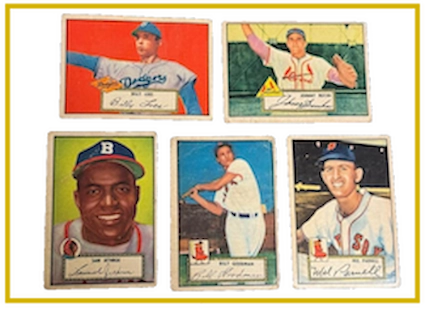
407 cards. One Mickey Mantle. The set that defined the modern hobby and produced the most famous baseball card ever printed.
Vintage Baseball Card GuideThe 1952 Topps baseball card set is not just the most collected vintage set in the hobby — it's the foundation on which the entire modern baseball card market was built. Produced by Topps Chewing Gum Company in its second year of baseball card production, the 1952 set introduced innovations that defined card design for the next three decades: large full-color player photos, statistics on the back, team logos, and facsimile signatures. And at its center sits card #311 — Mickey Mantle — the single most valuable and recognizable baseball card in American history.
Complete Set Value Overview
Assembling a complete 407-card 1952 Topps set is a multi-year project for most collectors. Values depend enormously on the grade of the key cards — particularly Mantle — and whether high-number series cards (311–407) are included in presentable condition.
| Set Condition | Estimated Value Range | Notes |
|---|---|---|
| Raw Good/VG average, all 407 cards | $10,000 – $25,000 | With Mantle VG, high numbers worn |
| Raw EX average, all 407 cards | $30,000 – $75,000 | Mantle EX-MT drives range significantly |
| Graded GD-VG average (PSA registry) | $50,000 – $150,000 | Mantle PSA 3–4 range |
| Graded EX-MT average (PSA registry) | $200,000 – $500,000+ | Mantle PSA 6, key cards EX+ |
| Graded NM average (PSA registry) | $500,000 – $1,500,000+ | Mantle PSA 7–8, top-grade keys |
| Low numbers only (1–310) | $4,000 – $40,000 | Excludes Mantle and high numbers |
| High numbers only (311–407) | $6,000 – $200,000+ | Mantle dominates; other highs scarce |
Key Cards in the 1952 Topps Set
While Mantle is the undisputed centerpiece, the 1952 Topps set contains dozens of Hall of Famers and key cards that drive significant value. Here are the most important:
Shop 1952 Topps singles, key cards, and partial sets from established dealers.
🛍️ Shop on eBay 📚 Guides on AmazonThe High Number Series — Why Cards #311–407 Are Scarce
The 1952 Topps set was printed and distributed in series throughout the baseball season. The first series (cards 1–80) appeared in spring. Subsequent series followed through the summer, with the high number series (311–407) arriving late in the season when retailer demand had already peaked and unsold inventory of earlier series was being returned.
Topps, facing warehouses full of unsold high-number packs, made a fateful decision: they loaded the remaining inventory onto barges and dumped it into the Atlantic Ocean off the New Jersey coast in the mid-1950s. Exactly how many cards were destroyed and in what series is debated among historians, but the result is clear — high-number 1952 Topps cards are significantly scarcer than the low numbers across all grades, and Mantle (#311) survived in high grade in only a tiny fraction of what was produced.
This ocean dumping story adds mythological weight to an already legendary set. The knowledge that most high-number cards were deliberately destroyed — and that the Mantle is the ultimate survivor — gives the card a narrative power that pure scarcity alone can't fully explain.
The Mickey Mantle Card (#311)
Card #311 is the first Topps Mickey Mantle card and the most valuable baseball card in the modern hobby. Mantle was 20 years old when the card was printed, entering his second full season with the New York Yankees. The card features a head-and-shoulders portrait of Mantle in his Yankees cap against a red background — simple, iconic, and immediately recognizable to anyone who has spent five minutes in a card shop.
PSA has graded over 3,500 examples. The distribution runs heavily toward the lower grades: roughly 60% grade below PSA 5, reflecting the ocean dumping losses and the decades the survivors spent in shoeboxes and wallets before collectors recognized their value. PSA 8 examples number in the dozens; PSA 9 examples can be counted on two hands.
| PSA Grade | Approximate Value |
|---|---|
| PSA 1 (Poor) | $5,000 – $10,000 |
| PSA 2 (Good) | $12,000 – $25,000 |
| PSA 3 (VG) | $30,000 – $60,000 |
| PSA 4 (VG-EX) | $60,000 – $120,000 |
| PSA 5 (EX) | $120,000 – $250,000 |
| PSA 6 (EX-MT) | $250,000 – $600,000 |
| PSA 7 (NM) | $600,000 – $2,000,000 |
| PSA 8 (NM-MT) | $2,000,000 – $7,000,000+ |
| PSA 9 (Mint) | $12,000,000+ (single known at this grade) |
Collecting the 1952 Topps Set — Strategies
Build Around the Mantle First
The Mantle's grade determines roughly 60–70% of a complete set's total value. Many serious collectors acquire the Mantle first — at whatever grade their budget allows — then fill in the remaining 406 cards around it. This approach lets you anchor the collection's value immediately rather than spending years assembling supporting cards before tackling the centerpiece.
Focus on the High Numbers
Cards 311–407 are the hardest to complete and the most expensive per card on average. A strategy focused on acquiring all 97 high-number cards first — then filling in the more readily available low numbers — front-loads the difficulty and provides a clear sense of progress toward completion.
Grade-Consistent Registry Sets
The PSA Set Registry allows collectors to build and track complete graded sets ranked against other collectors. A grade-consistent set — where all 407 cards are graded within a narrow range — commands a premium over sets with mixed grades when sold. Collectors building registry sets typically target a specific average grade and source all cards to match.
Low-Number Type Collecting
For collectors who want 1952 Topps exposure without the high-number budget, building a complete low-number set (cards 1–310) is a satisfying and achievable goal. Low numbers in VG-EX condition are broadly available and affordable. This approach delivers the aesthetic of the set — the card design, the statistics backs, the player portraits — while keeping the Mantle and high numbers as future aspirations.
Frequently Asked Questions
How many cards are in the 1952 Topps set?
Why is the 1952 Topps Mantle card so expensive?
What's the difference between the 1952 Topps and 1951 Bowman Mantle?
How can I tell if a 1952 Topps card is authentic?
What is the #1 card (Andy Pafko) worth?
Is it worth assembling a complete 1952 Topps set?
Start or continue your 1952 Topps collection today.
🛍️ Browse on eBay '
'