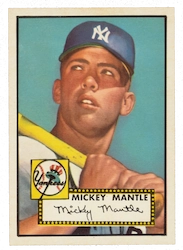
1952 Topps Mickey Mantle Card Value
The holy grail of postwar baseball cards. Here's what the 1952 Topps Mickey Mantle #311 is worth in every grade — and what to watch for before buying or selling.
There is no more iconic postwar baseball card than the 1952 Topps Mickey Mantle. Card #311 in Topps' landmark first major set, the Mantle has anchored the high end of the sports card market for decades. When a PSA 9 example sold for $12.6 million in 2022, it became the most valuable trading card ever sold at auction at that time — and cemented the 1952 Topps Mantle as the benchmark by which all other vintage cards are measured.
But the card's value exists across every grade. Even heavily worn, creased, or off-center examples are legitimate collectibles worth hundreds to thousands of dollars. If you've found one in an old collection, estate sale, or shoeboxful of vintage cards, here's exactly what you have.
📌 The 1952 Topps set contains 407 cards. Mickey Mantle (#311) appears in the high-number series (cards #311–407), which were printed in significantly smaller quantities than low-series cards and are substantially rarer as a result.
1952 Topps Mickey Mantle Value by Grade
PSA (Professional Sports Authenticator) grades are the market standard for this card. Values below reflect recent auction results and current market conditions:
| PSA Grade | Description | Approximate Value |
|---|---|---|
| PSA 1 (Poor) | Heavy wear, creases, possible trimming | $2,000 – $4,000 |
| PSA 2 (Good) | Heavy wear, intact corners, no trimming | $4,000 – $7,000 |
| PSA 3 (VG) | Moderate wear, light creases | $7,000 – $12,000 |
| PSA 4 (VG-EX) | Moderate wear, sharp corners | $12,000 – $20,000 |
| PSA 5 (EX) | Light wear, minor surface issues | $20,000 – $35,000 |
| PSA 6 (EX-MT) | Minimal wear, strong color | $35,000 – $65,000 |
| PSA 7 (NM) | Near mint condition, sharp corners | $65,000 – $150,000 |
| PSA 8 (NM-MT) | Near mint to mint, exceptional eye appeal | $150,000 – $500,000 |
| PSA 9 (MT) | Mint condition — extreme rarity | $5,000,000 – $12,600,000+ |
💡 Only a handful of PSA 9 examples are known. The dramatic jump from PSA 8 to PSA 9 values reflects near-impossibility of finding true mint condition examples of a 70+ year old card. For most collectors, PSA 4–6 examples represent the best value entry point. See the FindRareCoins baseball card price guide for more vintage card values.
What Makes the 1952 Topps Mantle So Valuable
The Set Itself
The 1952 Topps set was Topps' first full-scale nationally distributed baseball card set — larger than anything produced before, with color photographs and complete player statistics on the back. It established the format that baseball cards would follow for generations. The high-number series (cards #311–407) was printed in much smaller quantities and largely destroyed in a famous Topps warehouse purge in the 1960s, when unsold high-number packs were dumped into the Atlantic Ocean.
Mickey Mantle at His Peak
The 1952 Topps Mantle appeared during Mantle's second season with the Yankees — before he became a legend, but at the very moment his career trajectory was becoming clear. His subsequent Triple Crown season (1956), MVP awards, and World Series championships made the 1952 card the definitive early Mantle image. The card shows a young Mantle in a classic posed batting stance, with clean Yankee pinstripes and a simple blue background — a design that holds up as one of the most visually striking of the era.
The Warehouse Purge
In the early 1960s, Topps needed warehouse space. Unsold packs of late-series 1952 cards — including high-number cards — were loaded onto a barge and dumped into the ocean off the New Jersey coast. This dramatically reduced the surviving population of high-series cards. The already-scarce Mantle #311 became significantly rarer overnight, though collectors didn't fully understand the implications for decades.
How to Authenticate Your 1952 Topps Mantle
The value of this card has made it a target for fakes, alterations, and trimmed cards presented as higher-grade examples. Before buying or selling, understanding authentication is essential.
Trimming
Trimming — cutting the edges of a card to remove worn corners and create a sharper appearance — is the most common form of alteration. A trimmed card measures slightly smaller than the standard dimensions. PSA and BGS check card dimensions as part of their grading process; a trimmed card receives an "Authentic" designation rather than a numeric grade, dramatically reducing value.
Color Enhancement and Cleaning
Some unscrupulous sellers brighten faded colors or clean dirty surfaces before sale. These alterations are detectable under UV light and by experienced graders. Always buy significant examples raw only from dealers with established return policies, or — better — buy already certified.
⚠️ Counterfeit alert: High-quality color reproduction fakes exist for the 1952 Topps Mantle. Genuine cards have a specific cardstock feel, printing dot pattern under magnification, and paper composition detectable by experienced graders. Never pay significant money for a raw example without examination by a knowledgeable dealer or PSA/BGS submission.
🔎 Pro tip: PSA has graded over 4,000 examples of the 1952 Topps Mantle. Buying a PSA-slabbed example eliminates authentication risk entirely and makes the card significantly easier to resell. For any card over $5,000, certification is not optional — it's essential.
Other High-Value Cards in the 1952 Topps Set
If you've found a collection of 1952 Topps cards, other high-series numbers are also worth careful attention. Several cards beyond the Mantle carry significant value:
| Card # | Player | PSA 4 Value | PSA 7 Value |
|---|---|---|---|
| #311 | Mickey Mantle | $12,000 – $20,000 | $65,000 – $150,000 |
| #312 | Jackie Robinson | $1,500 – $3,000 | $8,000 – $20,000 |
| #314 | Roy Campanella | $600 – $1,200 | $3,000 – $8,000 |
| #333 | Pee Wee Reese | $400 – $800 | $2,000 – $5,000 |
| #400 | Bill Dickey | $200 – $500 | $1,000 – $3,000 |
Where to Buy & Sell the 1952 Topps Mantle
For lower-grade examples (PSA 1–4), eBay is the most active marketplace with the most price transparency. Sold listings — not asking prices — tell you what the market actually pays. Filter by "sold" and search "1952 Topps Mantle PSA" with your target grade.
For mid-grade examples (PSA 5–7), PWCC Marketplace, Goldin Auctions, and Heritage Auctions all run regular vintage card sales with serious buyer pools. These platforms typically achieve stronger results than eBay for cards in this range.
For PSA 8 and above, major auction houses — Heritage, Goldin, and Sotheby's — are the appropriate venues. These cards require marketing to institutional collectors and high-net-worth buyers that only established auction platforms can reach.
Browse 1952 Topps Mantle Listings
Search active eBay listings and recently sold examples to track the current market.
Browse Certified Listings All 1952 Mantle ListingsFrequently Asked Questions
Is the 1952 Topps Mantle Mickey Mantle's rookie card?
No — and this is a common misconception. Mantle's true rookie cards appeared in the 1951 Bowman set (card #253). The 1952 Topps Mantle is his second-year card and his first Topps appearance, which many collectors actually prefer for its superior design and photography. The "rookie card" label doesn't diminish the 1952 Topps Mantle's value — its combination of scarcity, design, and historical significance makes it the most valuable Mantle card regardless of the rookie distinction.
How many 1952 Topps Mantle cards exist?
The exact original print run is unknown, but the warehouse purge of the 1960s dramatically reduced surviving copies. PSA has graded over 4,000 examples across all grades, with the vast majority grading below PSA 6. PSA 8 examples number fewer than 100, and PSA 9 examples are counted on one hand.
What's the difference between PSA, BGS, and SGC grading?
PSA (Professional Sports Authenticator), BGS (Beckett Grading Services), and SGC (Sportscard Guaranty) are the three major grading companies. PSA is the dominant standard for vintage cards — a PSA grade typically commands the highest resale value for pre-1980 cards. BGS uses a half-point scale and is preferred by many modern card collectors. SGC has gained significant market share and is increasingly accepted as a PSA equivalent for vintage material.
Should I get my ungraded 1952 Topps Mantle graded?
Yes, for any raw example you're considering selling. PSA submission fees run $50–$100 for most service levels. For a card worth $2,000+ at the low end of the grade scale, the fee is minimal and the certified card will be significantly easier to sell at full value. Authentication also protects the buyer, which makes your card more appealing to serious collectors.
What other vintage baseball cards are valuable?
Beyond the 1952 Topps Mantle, the most consistently valuable vintage baseball cards include the 1909-11 T206 Honus Wagner, 1914-15 Cracker Jack sets, 1933 Goudey Babe Ruth cards, 1951 Bowman Mantle rookie, and key rookie cards from the 1950s-1970s Topps sets. See the FindRareCoins baseball card price guide for a full overview.
More Vintage Baseball Card Values
The 1952 Topps Mantle is the pinnacle — but hundreds of other vintage cards carry serious collector value. Explore the complete guide.
Baseball Card Price Guide Browse Vintage Cards on eBay '
'