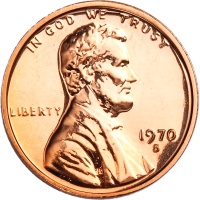
The 1970-S produced two distinct date hub varieties — and the Small Date is the one collectors want. Here's how to tell them apart and what each is worth.
Lincoln Cent Value GuideIn 1970, the San Francisco Mint produced proof Lincoln cents using two different date hubs — one with a larger, higher-positioned date (Large Date) and one with a smaller, more refined date positioned slightly lower (Small Date). The difference in collector value between these two varieties is dramatic: the Large Date is a common proof cent worth a few dollars; the Small Date is a recognized key variety worth $30 to $3,000+ depending on grade. Knowing how to tell them apart is one of the most valuable skills a Lincoln cent collector can have.
1970-S Small Date Penny Values by Grade
All 1970-S Lincoln cents were struck as proofs at the San Francisco Mint — there are no business strike 1970-S cents. Values below reflect the Small Date variety in proof grades. The coin is only found in proof sets or as single coins removed from them.
Deep Cameo (DCAM) Premium
Proof coins with strong frosted devices against mirror fields receive a Deep Cameo (DCAM) or Ultra Cameo designation from PCGS and NGC respectively. A 1970-S Small Date PR-67 DCAM commands significantly more than a standard PR-67 — often 2–3x the non-cameo value. At PR-69 DCAM, values can exceed $5,000. Always check whether a certified example carries the cameo designation when evaluating market prices.
How to Tell Small Date from Large Date
This is the critical skill. Both varieties look nearly identical at a glance, but several diagnostic points separate them reliably:
Large Date (Common)
The top of the 7 in 1970 is level with the top of the 9 — both numbers reach the same height. The date appears larger, bolder, and positioned slightly higher overall. The word LIBERTY appears weak and less defined. Value: $1–$5 in typical proof grades.
Small Date (Valuable)
The top of the 7 in 1970 sits noticeably lower than the top of the 9 — creating a clear height difference between the two digits. The date appears slightly smaller and more refined. LIBERTY is sharp and strongly struck. Value: $30–$3,000+.
The easiest single check: look at the 7 and 9 in the date under a loupe. If the 7 is shorter than the 9 with clear daylight between their tops, you have the Small Date. If they're the same height, it's the Large Date. This one test is definitive for most examples.
Full Value Comparison: Small Date vs. Large Date
| Grade | 1970-S Large Date | 1970-S Small Date | Premium |
|---|---|---|---|
| PR-63 | $1–$3 | $30–$50 | ~15x |
| PR-65 | $2–$5 | $75–$150 | ~20x |
| PR-67 | $5–$10 | $300–$700 | ~50x |
| PR-67 DCAM | $15–$25 | $800–$2,000 | ~60x |
| PR-69 DCAM | $30–$60 | $3,000–$6,000+ | ~80x |
Shop certified 1970-S Small Date proof cents — PCGS and NGC graded examples available.
🛍️ Shop on eBay 📚 Reference Books on AmazonWhere to Find the 1970-S Small Date
Because all 1970-S Lincoln cents are proofs, they exist only in proof sets or as singles broken out of those sets. The 1970 Proof Set contained five coins — cent, nickel, dime, quarter, and half dollar — and was sold by the U.S. Mint directly to collectors. Approximately 2.6 million sets were produced, split between Large Date and Small Date varieties for the cent.
The most practical sources today are: original sealed 1970 proof sets from estate sales and coin shows (which may contain either variety), broken-out singles on eBay (verify the variety before purchasing raw examples), and certified slabs from PCGS or NGC which guarantee attribution. If you're buying a raw Small Date, use the date height test described above to verify before committing.
Old proof sets from the 1970s are commonly found at estate sales, antique stores, and flea markets — often priced generically without attention to the Small Date premium. A 1970 proof set priced at $10–$15 that contains the Small Date cent has the value entirely in that one coin.
Other 1970-S Varieties Worth Knowing
The Small Date / Large Date distinction isn't the only variety story for 1970-S Lincoln cents. A doubled die obverse exists for the 1970-S that shows strong doubling on LIBERTY and the date. When the doubling appears on a Small Date specimen, the combination of two premium varieties on a single coin creates exceptional collector demand. These are rare and always command strong premiums over either variety alone.
Additionally, the 1970-S proof set is one of the earlier years of the modern proof series — older proof sets in their original Mint packaging are increasingly hard to find in perfect condition, which adds a preservation premium to high-grade examples still in their original cases.
Frequently Asked Questions
How do I tell the 1970-S Small Date from the Large Date?
Are all 1970-S Lincoln cents proofs?
What is the 1970-S Small Date worth in a complete proof set?
Should I remove the coin from the set to get it graded?
How does the 1970-S Small Date compare to other key Lincoln cent varieties?
Is there a 1970 Large Date worth collecting?
Add the 1970-S Small Date to your Lincoln cent variety collection.
🛍️ Browse on eBay '
'