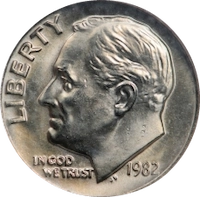
Philadelphia accidentally shipped dies without the required P mint mark in 1982 — creating the most sought-after modern Roosevelt dime error.
Error Coin Value GuideThe 1982 no mint mark Roosevelt dime is one of the most celebrated modern error coins in American numismatics. It came about through a simple but consequential oversight: in 1982, the Philadelphia Mint shipped at least one batch of working dies to the production floor without punching in the required P mint mark. Those dies struck hundreds of thousands of coins before the error was caught, and those coins entered circulation across the northeastern United States.
For collectors, the appeal is strong: it's a findable error (not a rarity of three known), it's immediately verifiable by anyone with a loupe, and it represents a genuine production mistake at one of the world's most historic mints. Values are accessible at the low end and rewarding for gems — making this an ideal entry point into modern error coin collecting.
1982 No Mint Mark Dime Values by Grade
How to Identify the 1982 No Mint Mark Dime
Identification is straightforward once you know exactly where to look. Follow these steps:
- Confirm the year is 1982. Only 1982 Philadelphia dimes can be the no-P error. Any other year or mint is irrelevant.
- Locate the mint mark position. On all Roosevelt dimes from 1968 forward, the mint mark appears on the obverse, above the date to the right. On Philadelphia dimes from 1980 forward, a small P appears in that position.
- Examine with a loupe. Use a 5x or 10x loupe to inspect the area just above and to the right of the date on the obverse. A normal 1982 Philadelphia dime will show a clear P. The error coin has that space completely blank.
- Compare to a normal 1982-P. Side-by-side comparison with a normal 1982-P dime makes the missing mark immediately obvious and eliminates any ambiguity.
- Check for wear in the mint mark area. Heavily circulated examples can have worn-smooth surfaces that make it hard to confirm whether a P was ever present. For worn examples, professional attribution may be needed.
The Full Story Behind the 1982 No-P Dime
Understanding the context adds meaning to any error coin. In 1965, the U.S. Mint removed mint marks from all coins as part of the transition from silver to clad coinage — a practical measure intended to prevent hoarding driven by mint mark variation. Mint marks returned to all denominations in 1968 (except cents), and in 1979, President Jimmy Carter signed legislation requiring a P mint mark on Philadelphia coins beginning in 1980. Every dime, quarter, half dollar, and dollar coin from Philadelphia thereafter was supposed to carry the P mark.
The system worked flawlessly for the first two years — 1980 and 1981. Then in 1982, through a breakdown in the die preparation process that has never been fully publicly explained, at least one batch of dime dies went to production without the P being punched in. The coins produced by those dies entered circulation normally, and it was alert coin collectors and roll searchers — not Mint officials — who first noticed the error and publicized it.
The Mint acknowledged the error but made no effort to recall the affected coins, and subsequent production for 1982 used properly marked P dies. The error coins remained in circulation, gradually dispersing across the country as normal dimes. By the mid-1980s, the hunt was well and truly on.
Comparison: 1982 No-P vs. Other Modern Dime Errors
| Error | Year | Scarcity | Typical MS Value |
|---|---|---|---|
| No Mint Mark (no-P) | 1982 | Uncommon (hundreds of thousands) | $175–$400+ |
| Missing Clad Layer | Various | Scarce | $75–$300+ |
| Off-Center Strike (50%+) | Various | Rare | $75–$250+ |
| Wrong Planchet | Various | Very rare | $200–$2,000+ |
| Doubled Die Obverse | Various | Scarce (variety-dependent) | $50–$500+ |
Where to Find the 1982 No-P Dime Today
The most accessible approach is purchasing a certified example from a reputable coin dealer or through eBay. PCGS- and NGC-certified examples are widely available across a full range of grades. Prices are reasonable for circulated examples, and even high-grade gems aren't out of reach for most budgets.
Roll searching remains possible but increasingly impractical. Most bank tellers won't have 1982 dimes in their drawers, and purchasing pre-rolled customer rolls introduces authentication uncertainty. If you're determined to hunt one from original coin rolls, your best sources are estate sales with old coin collections, antique stores, and dealers who specialize in pre-searched rolls.
Shop certified 1982 no mint mark Roosevelt dimes across all grades.
🛍️ Shop on eBay 📚 Guides on AmazonFrequently Asked Questions
How much is the 1982 no mint mark dime worth?
How do I know if I have the no-P dime vs. a worn-off mint mark?
Are there other years with missing P mint marks on dimes?
Should I get my 1982 no-P dime graded?
How many 1982 no mint mark dimes were made?
What other dime errors are worth collecting?
Start or expand your Roosevelt dime error collection today.
🛍️ Browse on eBay '
'