
Ancient Coins
Greek Classics • Roman Empire • Byzantine Gold • Ancient World
Art, Power & History in the Palm of Your Hand
The World's Oldest Collectible Objects Still Actively Traded
Ancient coins are among the most remarkable artifacts a collector can own — small pieces of metal that have survived more than two thousand years, passing through countless hands across the rise and fall of empires. They were struck not merely as currency but as deliberate instruments of communication. Every portrait, inscription, and reverse design was chosen to project authority, celebrate victory, honor the gods, or reinforce the legitimacy of whoever sat on the throne. Holding an ancient coin is holding a primary source of history that no textbook can replicate.
The collecting field spans an extraordinary range: from the first coins ever struck in 6th-century BCE Lydia, through the dazzling artistic achievements of Greek city-states, the vast imperial output of Rome across seven centuries, the enduring gold coinage of Byzantium, and into the medieval successor kingdoms of the ancient world. No other area of numismatics offers the same combination of historical depth, artistic variety, and accessibility — genuine ancient coins can be found for under $50, while the greatest rarities command millions at the world's top auction houses.
Greek Coinage — The Birth of Numismatic Art
From the First Electrum Strikes to the Silver Masterpieces of Athens & Syracuse
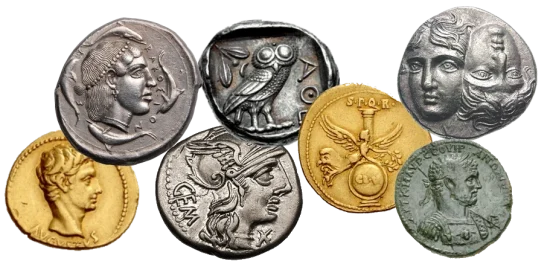
Greek coinage represents the earliest flowering of coin art — a period when engravers working in miniature produced designs of extraordinary beauty that would not be surpassed for centuries. The Athens Owl Tetradrachm, struck from the silver mines of Laurion and bearing the helmeted head of Athena on one side and her sacred owl on the other, became the reserve currency of the ancient Mediterranean world. Hoards of Athenian tetradrachms have been found as far east as Afghanistan, testament to their universal acceptance in trade from Egypt to Persia.
Beyond Athens, the Greek world produced an almost endless variety of coin types — each city-state expressing its identity through its chosen symbols. Corinth placed the winged horse Pegasus on its staters; Syracuse produced the magnificent Decadrachm with its portrait of the nymph Arethusa surrounded by dolphins, widely considered the most beautiful coin ever struck in antiquity. The tetradrachms of Alexander the Great, minted from Macedonia to Persia across three continents, carry the image of Herakles on one side and Zeus enthroned on the other — coins that followed his armies across the known world and were still being struck in his name long after his death.
Roman Coinage — Seven Centuries of Imperial History
Republic Denarii to Late Empire Bronzes — A Complete Historical Record
Rome produced more coinage over a longer period than any empire in the ancient world, and the variety available to collectors is staggering. Roman Republican denarii — struck before the emperors — feature the family emblems, legendary scenes, and political slogans of the great aristocratic houses that competed for power in Rome's final century of republican government. Imperial coinage, beginning with Augustus in 27 BCE, placed the emperor's portrait on virtually every coin struck across the empire — creating an unbroken visual record of over sixty emperors across four centuries of the Principate alone.
Roman coins were explicitly designed as propaganda. Military victories were commemorated with specific reverse types — the famous Judaea Capta sestertius of 70 CE showing a mourning Jewish figure beneath a palm tree is one of the most powerful political statements ever made on a coin. The Tribute Penny of Tiberius — the denarius cited in the Gospels when Jesus says "Render unto Caesar" — connects Roman numismatics directly to the New Testament. The gold Aureus of Constantine the Great, introducing the Chi-Rho symbol of Christianity onto Roman imperial coinage, marks one of the pivotal moments in Western civilization.
Key Ancient Coin Types — Eras & Value Ranges
A Reference Guide for Collectors at Every Level
| Coin Type | Period | Metal | Typical Value Range |
|---|---|---|---|
| Athens Owl Tetradrachm | 480–40 BCE | Silver (17.2g) | $500 – $50,000+ |
| Alexander the Great Tetradrachm | 336–280 BCE | Silver (17.2g) | $500 – $50,000+ |
| Julius Caesar Denarius | 49–44 BCE | Silver (3.9g) | $500 – $25,000+ |
| Roman Republic Denarius | 211–27 BCE | Silver (3.9g) | $100 – $5,000+ |
| Augustus Gold Aureus | 27 BCE – 14 CE | Gold (7.3g) | $3,000 – $100,000+ |
| Tiberius "Tribute Penny" Denarius | 14–37 CE | Silver (3.9g) | $300 – $8,000+ |
| Byzantine Gold Solidus | 324–1453 CE | Gold (4.5g) | $400 – $10,000+ |
| Persian Gold Daric | 5th–4th century BCE | Gold (8.3g) | $1,000 – $30,000+ |
Top Ancient Coin Collecting Categories
Where Ancient Numismatists Focus Their Pursuits
Greek Classics
Athens Owls, Alexander tetradrachms, Syracuse decadrachms — the artistic pinnacle of ancient coinage.
Roman Empire
Emperor portraits from Augustus to Constantine. Denarii, aurei, and sestertii spanning seven centuries of imperial history.
Biblical Coins
Tribute Pennies, Judaea Capta sestertii, Widow's Mites, and Shekels of the Temple — coins mentioned in scripture.
Byzantine Gold
Solidi and histamena from Constantinople — the medieval world's gold standard, struck for over a thousand years.
Ancient World
Persian darics, Sassanian drachms, Parthian coins, Celtic staters — civilizations beyond Greece and Rome.
Roman Republic
Pre-imperial denarii featuring family crests, legendary scenes, and the political rivalries of Rome's last century of freedom.
Ancient Coin Explorer
Browse by Era • Click Any Coin for Details & eBay Listings




Byzantine Gold — A Thousand Years of Monetary Stability
The Solidus, the Histamenon & the Medieval World's Reserve Currency
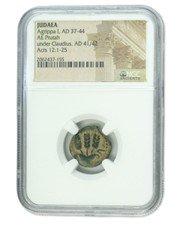
When Constantine the Great introduced the gold solidus in 309 CE, he created one of the most durable monetary standards in history. The solidus — weighing 4.55 grams of nearly pure gold — remained the cornerstone of Mediterranean commerce for over a thousand years, accepted from England to India as a trusted store of value. Byzantine gold coins can be found with remarkable consistency of quality across twelve centuries of production, from the confident full-face portraits of Justinian I in the 6th century to the increasingly stylized Christ Pantocrator images of the later empire.
Byzantine coinage is particularly accessible for beginning ancient coin collectors. Common solidi from mid-period emperors — Basil II, Constantine VII, John I Tzimiskes — can be purchased in fine condition for $400–$800, offering genuine gold coins over a thousand years old at prices that compare favorably with modern bullion premiums. The challenge lies in authentication: Byzantine gold has been extensively counterfeited, making NGC-certified examples strongly preferred for any purchase above $300.
Authenticating & Grading Ancient Coins
Why NGC Certification Matters for Ancient Numismatics
The ancient coin market carries a higher risk of forgery, cleaning, and tooling than virtually any other area of numismatics. Forgeries range from crude tourist replicas sold openly as reproductions to sophisticated deceptions that have fooled experienced dealers. Cleaned coins — stripped of their natural patina with acid or abrasives — lose much of their collector value and can be difficult to distinguish from naturally worn examples without expert examination. Tooled coins, artificially enhanced to improve the appearance of devices, are disturbingly common in higher-grade ancient material.
NGC's Ancient Coin grading service provides professional authentication and assigns a standardized grade that greatly enhances buyer confidence and resale value. For any ancient coin worth more than $200–$300, purchasing an NGC-certified example is strongly recommended — the certification premium is usually worth the cost in terms of both protection and liquidity. For raw (uncertified) coins, buy only from established dealers with clear return policies and provenance documentation, and study the coin's style, flan characteristics, and natural patina carefully before committing to a purchase.
Shop Ancient Coins on eBay
Browse thousands of authenticated Greek, Roman, Byzantine, and ancient world coins from dealers worldwide — certified and raw.
🛍️ Shop Ancient Coins on eBay 📚 Ancient Coin Books on AmazonFindRareCoins.com participates in the eBay Partner Network and Amazon Associates program. Purchases made through links on this page may earn us a commission at no additional cost to you.
Frequently Asked Questions
Are ancient coins legal to buy and own?
Yes — the vast majority of ancient coins are entirely legal to buy, sell, and own in the United States and most countries. Ancient coins have been collected and traded for centuries, and tens of millions of examples circulate freely in the numismatic market. The important legal considerations involve provenance: coins should have documented ownership history predating 1970 (the UNESCO Convention on cultural property), and buyers should avoid coins that may have been illegally excavated or exported from certain countries with strict cultural heritage laws. Purchasing from reputable dealers who provide provenance documentation and buying NGC-certified coins with established collection histories are the best practices for staying on solid legal ground.
What is the Tribute Penny and why is it significant?
The Tribute Penny refers to the silver denarius of the Roman Emperor Tiberius (14–37 CE), widely identified as the coin referenced in the Gospels of Matthew, Mark, and Luke when Jesus is asked about paying taxes to Rome. His response — "Render unto Caesar the things that are Caesar's, and unto God the things that are God's" — is one of the most quoted passages in scripture. The coin features Tiberius's portrait on the obverse and his mother Livia seated as the goddess Pax on the reverse. Genuine Tiberius denarii in circulated condition can be purchased for $300–$1,000, making ownership of a "Biblical coin" accessible to many collectors. Always buy from reputable dealers and consider NGC certification for authenticity assurance.
How do I know if an ancient coin is genuine?
Authentication is the central challenge of ancient coin collecting. Start by purchasing only from established dealers with long track records and clear return policies. Study the coin's style carefully — genuine ancient coins have specific artistic conventions and die characteristics that skilled forgers often get wrong. Natural patina (green, brown, or gray deposits built up over centuries) is difficult to fake convincingly, though artificially patinated coins do exist. Weight and dimensions should match published standards for the type. For any coin of significant value, NGC certification is the gold standard of protection — their ancient coin experts examine every submission for authenticity, cleaning, and tooling before assigning a grade.
What ancient coins are best for beginning collectors?
Late Roman bronze coins (3rd–4th century CE) offer the most accessible entry point — genuine coins of emperors like Constantine, Constantius II, and Theodosius can be purchased in recognizable condition for $10–$50 each. Roman Republican and early Imperial denarii in circulated grades start at $100–$200 for common types and offer tremendous historical interest per dollar spent. For Greek coins, common Alexander the Great tetradrachms in lower grades start around $500 and represent exceptional historical and artistic value. Byzantine bronze folles are plentiful and affordable at $20–$80 for many types. In all cases, buy from reputable established dealers and start with coins that have clear, identifiable portraits before moving into more specialized areas.
What did Roman coins communicate to the people who used them?
Roman coins were one of the ancient world's most effective mass communication tools — essentially the television news of their era, reaching every corner of the empire through everyday commerce. The emperor's portrait established his face and image across territories that might never see him in person. Reverse types announced military victories, commemorated building projects, celebrated divine favor, and proclaimed the virtues the emperor wished to project. The Judaea Capta coins of Vespasian (70 CE) broadcast Rome's crushing of the Jewish Revolt to every person who handled money. Constantine's introduction of Christian symbols onto coinage in the 4th century announced a transformation of the empire's official religion to every Roman citizen simultaneously. No other artifact survives in such quantity from the ancient world as coins — making them an unparalleled historical record.
What is the most valuable ancient coin ever sold?
Among ancient coins, the most valuable individual specimens sold at auction include unique Greek gold pieces and exceptional Roman rarities in the multi-million-dollar range. A unique Athenian gold Dekadrachm realized over $1 million at auction. Certain Roman aurei of rare emperors or in exceptional condition regularly achieve $200,000–$500,000+. The record for any ancient coin is contested depending on category, but the field's true treasures — unique specimens held in major collections — are essentially priceless. For most collectors, the extraordinary news is that genuinely ancient coins of emperors and kings can be purchased for a few hundred dollars, making the ancient coin market one of the most democratically accessible in all of numismatics.
 '
'