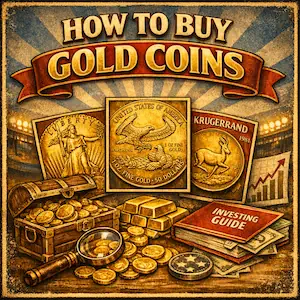
Gold coins offer centuries of proven value, tangible beauty, and ownership you can hold in your hand. Here's everything you need to know before buying your first — or next — gold coin.
Gold Coin Buying Guide · 2026Buying gold coins is one of the oldest wealth preservation strategies in human history — and in 2026, it remains one of the most straightforward ways to own physical gold. Whether you're attracted to investment-grade bullion coins, historic U.S. gold pieces, or collectible numismatic gold, the purchasing process is largely the same: know what you're buying, know what you're paying, and buy from a reputable source. This guide covers everything a first-time buyer needs to know.
Types of Gold Coins to Buy
American Gold Eagle
The most popular U.S. gold bullion coin. Available in 1 oz, 1/2 oz, 1/4 oz, and 1/10 oz. Legal tender with face values of $50, $25, $10, and $5. Premiums run 3–6% over spot for 1 oz coins. Widely recognized and easy to resell.
American Gold Buffalo
The first 24-karat gold coin produced by the U.S. Mint, introduced in 2006. Features the iconic Buffalo Nickel design. Available in 1 oz only ($50 face value). Slightly higher premiums than Eagles due to the purer gold content.
Canadian Gold Maple Leaf
One of the most widely traded gold bullion coins worldwide. Competitive premiums, excellent quality control, and global recognition. Available in multiple sizes. A strong choice for pure gold bullion accumulation.
South African Krugerrand
The world's first modern gold bullion coin (1967). Copper alloy gives it a distinctive reddish gold color. No face value — pure bullion coin. One of the most liquid gold coins in the world with the tightest spreads.
Pre-1933 U.S. Gold Coins
Liberty Head and Saint-Gaudens Double Eagles, Indians, and Eagles struck before FDR's 1933 gold recall. Combine gold content with numismatic collector value. $20 gold pieces contain 0.9675 oz gold; $10 pieces 0.4838 oz.
Gold Proof Sets
Annual proof gold coins struck by the U.S. Mint and others with mirror-like fields and frosted devices. Command premiums above melt for collector appeal. Best purchased for aesthetics and collecting — not pure gold accumulation.
Step-by-Step: How to Buy Gold Coins
- Decide between bullion and numismatic.
Bullion gold coins (Eagles, Buffalos, Maple Leafs) trade primarily on gold content — their value moves with the gold price. Numismatic gold coins (pre-1933 U.S. gold, rare dates, proof coins) trade on collector demand plus gold content. Beginners should start with bullion — the pricing is transparent and resale is straightforward.
- Check the current gold spot price.
Gold spot prices update every minute during market hours. Sites like Kitco.com, APMEX, and JM Bullion display current spot prices for free. Know the spot price before any purchase — premiums are always quoted as a dollar amount or percentage above spot.
- Understand premiums over spot.
No gold coin sells at spot price — dealers add a premium to cover their costs and margin. For 1 oz American Gold Eagles, expect 3–6% over spot from major dealers. Smaller coins (1/4 oz, 1/10 oz) carry higher percentage premiums — 8–15% is typical. The larger the coin, the lower the per-ounce premium.
- Choose your source.
Options include: U.S. Mint (direct, for new issues); authorized bullion dealers (JM Bullion, APMEX, Kitco, Silver Gold Bull); local coin dealers (inspect before purchase, no shipping); coin shows (competitive pricing, immediate delivery); eBay (competitive but requires careful authentication). For first-time buyers, a reputable authorized dealer or local coin shop is recommended.
- Verify authenticity.
Counterfeit gold coins exist, particularly from overseas manufacturers. For new coins from authorized dealers, fakes are rare. For secondary market purchases, use a digital gram scale (gold has very specific weights), a calipers for diameter, and consider a Sigma Metalytics or XRF tester for definitive verification. Never buy gold from unknown private parties without testing.
- Plan for storage.
Home safe, bank safe deposit box, or third-party vault storage (some dealers offer allocated storage). Insurance is essential for significant holdings. Most homeowner's policies have low limits on precious metals — a rider or dedicated policy may be needed.
Gold Content and Melt Value by Coin Type
| Coin | Gold Content (oz) | Value at $2,000/oz | Value at $2,500/oz |
|---|---|---|---|
| 1 oz American Gold Eagle | 1.000 oz (22K) | $2,000 | $2,500 |
| 1 oz American Gold Buffalo | 1.000 oz (24K) | $2,000 | $2,500 |
| 1/2 oz American Gold Eagle | 0.500 oz | $1,000 | $1,250 |
| 1/4 oz American Gold Eagle | 0.250 oz | $500 | $625 |
| 1/10 oz American Gold Eagle | 0.100 oz | $200 | $250 |
| $20 Saint-Gaudens / Liberty | 0.9675 oz (90%) | $1,935 | $2,419 |
| $10 Indian / Liberty Eagle | 0.4838 oz (90%) | $968 | $1,210 |
| $5 Indian / Liberty Half Eagle | 0.2419 oz (90%) | $484 | $605 |
Shop gold coins from trusted dealers — American Eagles, Buffalos, and pre-1933 U.S. gold.
🛍️ Shop on eBay 📚 Gold Investing Books on AmazonFrequently Asked Questions
What is the best gold coin to buy for beginners?
How much does a 1 oz gold coin cost in 2026?
Is it safe to buy gold coins on eBay?
What is the difference between a gold coin and a gold round?
Do I pay taxes on gold coin purchases or sales?
How do I avoid fake gold coins?
Ready to add gold coins to your collection or portfolio?
🛍️ Browse Gold Coins on eBay '
'