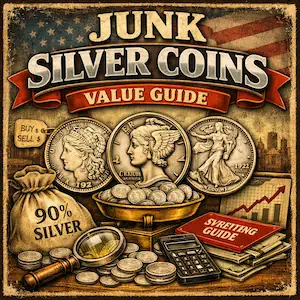
Pre-1965 U.S. coins are 90% silver — and they trade at premiums over face value every day of the week. Here's exactly what every denomination is worth at current silver prices.
Silver Coin Value Guide · 2026Junk silver is the collector term for pre-1965 U.S. coins — dimes, quarters, half dollars, and dollars — that contain 90% silver but have no significant numismatic premium above their metal content. The word "junk" is misleading: these coins are genuinely valuable, widely traded, and represent one of the most accessible ways to own physical silver. A $1,000 face value bag of junk silver contains approximately 715 troy ounces of pure silver — worth roughly $21,000–$28,000 at current silver prices.
📈 Live Precious Metals Prices

Silver Coin Melt Value Calculator
Enter today's silver spot price from above and the quantity of each coin type you have below. All melt values update instantly.
Calculate Your Coins at Today's Spot Price
Enter the current silver spot price and how many of each coin you have. Values update instantly.
| Coin | Silver (oz) | Qty | Melt Value |
|---|
Melt values are estimates based on standard silver content. Actual content may vary slightly by date and mint. Not financial advice.
The $1,000 Face Value Bag — The Standard Unit
Junk silver is commonly bought and sold in $1,000 face value bags — a unit that contains coins totaling $1,000 in face value. A $1,000 bag of 90% silver coins (dimes, quarters, or half dollars) contains approximately 715 troy ounces of pure silver. At $30/oz spot, that bag is worth approximately $21,450 in metal value. Dealers typically sell at a premium above spot — commonly 5–15% for bags — and buy at a slight discount.
| Denomination | Face Value | Coins Needed | Silver Oz | Value at $30/oz |
|---|---|---|---|---|
| Dimes (90%) | $1.00 | 10 coins | 0.723 oz | ~$21.69 |
| Quarters (90%) | $1.00 | 4 coins | 0.723 oz | ~$21.69 |
| Halves (90%) | $1.00 | 2 coins | 0.723 oz | ~$21.69 |
| Halves (40%, 1965–70) | $1.00 | 2 coins | 0.296 oz | ~$8.88 |
| Morgan/Peace Dollar | $1.00 | 1 coin | 0.7735 oz | ~$23.21 |
| $1,000 face bag (90%) | $1,000 | Various | ~715 oz | ~$21,450 |
Which Coins Qualify as Junk Silver?
The term applies to any U.S. coin containing silver that trades at or near its metal content rather than for a numismatic premium. The key dividing line is condition and date — a common-date Washington quarter in VG condition is junk silver; a 1932-D Washington quarter in VF condition is a numismatic collectible worth far more than melt. Here's the standard breakdown:
Dimes: Mercury dimes (1916–1945) and Roosevelt dimes (1946–1964) in circulated condition. The 1916-D and other key dates command numismatic premiums — those are not junk silver.
Quarters: Washington quarters (1932–1964) and Standing Liberty quarters (1916–1930) in circulated condition. Key dates like the 1916 Standing Liberty and 1932-D/S Washington quarters are numismatic, not junk.
Half dollars: Walking Liberty (1916–1947), Franklin (1948–1963), and 1964 Kennedy halves for 90% silver. Kennedy halves from 1965–1970 are 40% silver — worth less per coin than 90% halves. Morgan and Peace dollars also qualify, though their numismatic premium often exceeds pure melt value.
Buying and Selling Junk Silver
Local coin dealers are the most practical source for junk silver — you can inspect coins in person and avoid shipping costs. Premiums over spot at dealers typically run 10–20% for buying and 5–10% below spot when selling back. eBay is an active junk silver market with competitive pricing but adds shipping and buyer's premium considerations. Major online bullion dealers (JM Bullion, Silver Gold Bull, APMEX) sell junk silver bags and rolls at published premiums over spot.
When selling, get quotes from at least two or three sources before committing. Pawn shops typically offer the lowest prices — 60–70% of spot value is common. Coin dealers average 85–90% of spot. Online platforms can achieve spot or better for desirable denominations in well-described lots.
Shop junk silver coins and bags from trusted dealers on eBay.
Shop on eBay Silver Investing Books on Amazon '
'