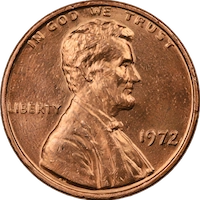
Strong doubling across LIBERTY, the date, and IN GOD WE TRUST makes the 1972 DDO one of the most visually dramatic Lincoln cent errors ever produced.
Error Coin Value GuideThe 1972 doubled die Lincoln cent is the strongest, most dramatic doubled die obverse produced after the famous 1955 and 1969-S examples. Unlike many doubled die varieties that require magnification to appreciate, the 1972 DDO shows bold, naked-eye doubling that almost anyone can see immediately. That combination of visual impact and genuine scarcity is what drives consistent collector demand — and prices that far exceed ordinary 1972 cents.
1972 Doubled Die Penny Values by Grade
Values vary significantly by grade. Circulated examples are accessible for most budgets; high-grade uncirculated specimens are genuinely scarce and command serious premiums. Note that multiple doubled die varieties exist for 1972 — the values below reflect the strongest, most collectible Variety 1 (Hub 1 DDO).
How to Identify the 1972 Doubled Die Penny
The 1972 DDO is a hub doubling variety — the error occurred when the working die was impressed by the hub a second time at a slightly different angle during die preparation, embedding a secondary offset image into the die itself. Every coin struck from that die thereafter carries the doubling permanently.
The doubling on the 1972 DDO Variety 1 is visible to the naked eye and should be immediately apparent when you look at the coin. Here's exactly where to look:
LIBERTY: Each letter shows a distinct, separated secondary image shifted to the northwest. This is the strongest and most dramatic area of doubling on the coin.
IN GOD WE TRUST: All words show clear doubling, particularly strong on GOD and TRUST. The secondary images are shelf-like and clearly separated from the primary lettering.
The Date (1972): Strong doubling on all four digits, most visible on the 9 and 7. The date doubling alone is enough for experienced collectors to attribute the variety without additional examination.
Lincoln's Portrait: Subtle doubling is also visible on Lincoln's ear and along the jawline, though the lettering doubling is the primary identification point.
Multiple 1972 DDO Varieties
CONECA (Combined Organizations of Numismatic Error Collectors of America) catalogues multiple doubled die varieties for the 1972 Lincoln cent. The most collected and valuable is Variety 1, which shows the dramatic naked-eye doubling described above. Several additional varieties exist — Varieties 2 through 8 and beyond — that show less dramatic doubling on different design elements. These command lower premiums but are still collected by variety specialists.
| Variety | Doubling Location | Visibility | Typical Value (VF) |
|---|---|---|---|
| DDO Variety 1 (Hub 1) | LIBERTY, motto, date | Naked eye | $250–$400 |
| DDO Variety 2 | Date, motto | Loupe needed | $25–$75 |
| DDO Variety 3 | Motto, portrait | Loupe needed | $15–$50 |
| DDO Variety 4–8+ | Various | Magnification required | $10–$30 |
Shop certified 1972 DDO cents — Variety 1 and other doubled die examples.
🛍️ Shop on eBay 📚 Reference Books on AmazonDoubled Die vs. Machine Doubling — Critical Difference
The most important skill in evaluating any claimed doubled die penny is distinguishing genuine hub doubling from mechanical doubling (also called machine doubling or MD). This distinction separates a coin worth hundreds of dollars from one worth face value.
Genuine doubled die shows two distinct, separated images with full depth and detail in both. Under magnification, each secondary letter or digit has its own complete edge profile. The doubling was embedded into the die itself during manufacture and is completely consistent across all coins struck from that die.
Machine doubling produces a flat, smeared secondary image — sometimes called "shelf doubling" because the secondary image looks like a flat shelf pressed against the primary design. There is no depth to the secondary image; it's essentially a smear or a shadow. Machine doubling has zero collector premium regardless of how dramatic it appears to the untrained eye.
On the 1972 DDO Variety 1, the doubling is so strong that this distinction is obvious even at low magnification. The secondary letters in LIBERTY are fully formed and clearly separated from the primaries. There's no ambiguity in a genuine example.
Grading and Authentication
For any 1972 DDO worth more than $100, professional third-party grading from PCGS or NGC is strongly recommended. Both services authenticate the variety and assign a grade, and their certified holders are very difficult to counterfeit. A PCGS or NGC-certified 1972 DDO commands a premium over raw examples of the same grade — and provides confidence in variety attribution.
When submitting, specify the variety designation you're claiming so the grader can confirm it. PCGS designates this as "1972 1C DDO FS-101" in their population report. NGC uses their own variety numbering. The certification label should explicitly state "Doubled Die Obverse" for maximum market recognition.
Frequently Asked Questions
What is the 1972 doubled die penny worth in circulated condition?
How is the 1972 doubled die different from the 1955?
Can I find a 1972 doubled die in pocket change?
Are there 1972-D or 1972-S doubled die pennies?
Should I get my 1972 DDO graded?
How do I tell machine doubling from a genuine doubled die?
Add a certified 1972 doubled die cent to your error coin collection.
🛍️ Browse on eBay '
'