1976 2 Dollar Bill Value
Most people save them thinking they're valuable. Most aren't — but a few are. Here's exactly how to tell the difference.
Star Notes • Fancy Serials • First Day Issues • What Yours Is WorthSeries: 1976 | Denomination: $2 | First Issued: April 13, 1976
Obverse: Thomas Jefferson | Reverse: Declaration of Independence (John Trumbull)
Total Printed: ~590 million | Status: Still legal tender
The 1976 2 dollar bill value is $2 for the vast majority of notes — despite what most people who've been saving them for decades believe. Issued to mark the country's 200th birthday, the Bicentennial $2 bill brought back a denomination out of print since 1966. Released on April 13, 1976 — Thomas Jefferson's birthday — it was met with enormous public excitement.
With roughly 590 million printed, the 1976 $2 bill is far from rare. Most are worth exactly face value. But certain varieties — star notes, low serial numbers, and fancy serial patterns — are genuinely worth more, sometimes significantly so. Knowing which type you have is the whole game. If you're also sorting through old coins, our what's my coin worth guide walks through the same kind of check for coins.
History of the $2 Bill
The $2 denomination has existed in U.S. currency since 1862, but it has always struggled to gain traction in everyday commerce. Banks found them inconvenient to stock, businesses rarely requested them, and the public consistently treated them as curiosities rather than spending money — a self-fulfilling cycle that kept them scarce in circulation even when plentiful in supply.
Facing low demand, the Federal Reserve discontinued the $2 note in 1966. A decade later, with the Bicentennial providing a natural occasion, the Treasury brought the denomination back. Jefferson's portrait stayed on the obverse. The old Monticello reverse was replaced with a reproduction of John Trumbull's painting depicting the presentation of the Declaration of Independence — a fitting choice for the nation's 200th birthday.
Public interest in the relaunch was immediate and enormous. Long lines formed at post offices on April 13, 1976, as collectors had their new bills stamped with first-day-of-issue cancellations. Many were immediately folded into envelopes and never spent. When it comes to the 1976 2 dollar bill value, condition and serial number are the two factors that matter most.
What Makes Some 1976 $2 Bills Worth More
⭐ Star Notes
🔢 Low Serial Numbers
🎰 Fancy Serial Numbers
📮 First Day Issue
✨ Uncirculated Condition
🏦 Federal Reserve District
1976 2 Dollar Bill Value Chart
Values below reflect the current collector market. Condition is the single biggest factor for common examples; variety drives value for star notes and fancy serials. For coin and currency pricing context, see our coin prices guide.
| Type | Condition | Estimated Value | Shop |
|---|---|---|---|
| Regular 1976 $2 | Circulated (any fold/wear) | $2 (face value) | eBay → |
| Regular 1976 $2 | Uncirculated (crisp, unfolded) | $3–$8 | eBay → |
| Regular 1976 $2 | Gem Uncirculated (PMG 65+) | $10–$20 | eBay → |
| BEP Pack of 100 (original) | Uncirculated | $150–$400 | eBay → |
| Star Note ★ | Circulated | $8–$20 | eBay → |
| Star Note ★ | Uncirculated | $20–$75+ | eBay → |
| Star Note ★ (low-print district) | Uncirculated | $75–$200+ | eBay → |
| First Day Issue (stamped) | Uncirculated with envelope | $5–$20 | eBay → |
| Low Serial (under 00000100) | Uncirculated | $50–$500+ | eBay → |
| Radar Note (palindrome serial) | Uncirculated | $25–$100 | eBay → |
| Solid Serial (e.g., 44444444) | Any | $500–$2,000+ | eBay → |
| Ladder Serial (12345678) | Any | $200–$1,000+ | eBay → |
| Uncut Sheet (4-note) | Uncirculated | $50–$150 | eBay → |
| Uncut Sheet (16-note) | Uncirculated | $150–$400 | eBay → |



How to Identify a Star Note
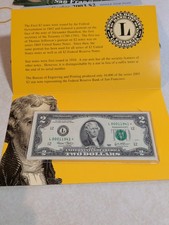
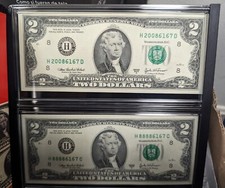
The star note is the single most important variety to check when researching your 1976 2 dollar bill value. Identification is simple: look at the serial number on the face of the bill. A star note will have a small ★ symbol immediately after the last digit of the serial number, replacing what would otherwise be a letter suffix.
For example, a regular serial number might read B 12345678 A. A star note from the same district would read B 12345678 ★. The star is the replacement indicator — it tells you the BEP printed this note to replace a defective bill, issuing it in smaller quantities than the regular run.
How to Check for Fancy Serial Numbers
Fancy serial numbers are a legitimate collecting category for paper money with an established market and consistent demand. There are five main types worth checking for.
Solid Serials & Super Radars
Solid serials have all eight digits the same (e.g., 77777777). Extremely rare and worth hundreds to thousands regardless of condition. Super radars have six identical interior digits (e.g., 18888881) — a step below solids in rarity but still worth a strong premium.
Radar Notes & Repeaters
Radar notes read the same forward and backward (e.g., 12344321) — true eight-digit palindromes that carry a meaningful premium in uncirculated condition. Repeaters consist of two repeating four-digit sets (e.g., 18271827). Less rare than solids or radars but still collectible in high grades.
Ladder Serials
Ladders run sequentially ascending or descending (12345678 or 87654321). The ascending ladder is particularly sought after and can push the 1976 2 dollar bill value well above $200.
Condition & Grading
For common 1976 2 dollar bills without special serial numbers, condition is everything. A note you have folded even once is technically circulated and worth face value to most buyers. In fact, many carefully stored notes still show fold lines from the moment their owner first received them — circulated by definition, regardless of storage since.
Uncirculated means never folded, crisp original paper with full embossed feel and no handling marks. Worth $3–$8 as a single example. Professional grading by PMG (Paper Money Guaranty) or PCGS Currency adds credibility for higher-end examples and star notes, where condition verification matters to buyers.
If you collect silver coins alongside currency, our Morgan Dollar value guide and coin prices guide cover similar ground for the coin side of the hobby.
Where to Sell a Valuable 1976 $2 Bill
If you've confirmed you have a star note, low serial number, or fancy serial, the best venues are eBay (the largest audience for paper money collectors), Heritage Auctions, and Stack's Bowers for higher-value examples. Notes worth under $50 sell best on eBay. Gem uncirculated star notes and rare fancy serials typically achieve stronger results at a dedicated currency auction house.
Common circulated examples are worth face value — simply take them to your local bank and exchange them at $2 each. There is no collector market for worn, folded regular 1976 2 dollar bills.
Where to Buy 1976 $2 Bills
⭐ Star Notes
🎰 Fancy Serial Numbers
📮 First Day Issues
📦 BEP Packs & Uncut Sheets
✨ PMG Graded Bills
📚 Currency Collecting Supplies

Frequently Asked Questions
What is the 1976 2 dollar bill value?
How do I know if my 1976 $2 bill is a star note?
What is a 1976 $2 bill first day issue worth?
Which 1976 $2 bills are the rarest?
Are 1976 $2 bills still legal tender?
Should I get my 1976 $2 bill professionally graded?
How many 1976 $2 bills were printed?

This detailed reference provides a catalog and price guide for federal notes from $10,000 down to $1 face value, Treasury notes of the War of 1812, Fractional Currency, error notes, and uncut sheets.

 '
'